
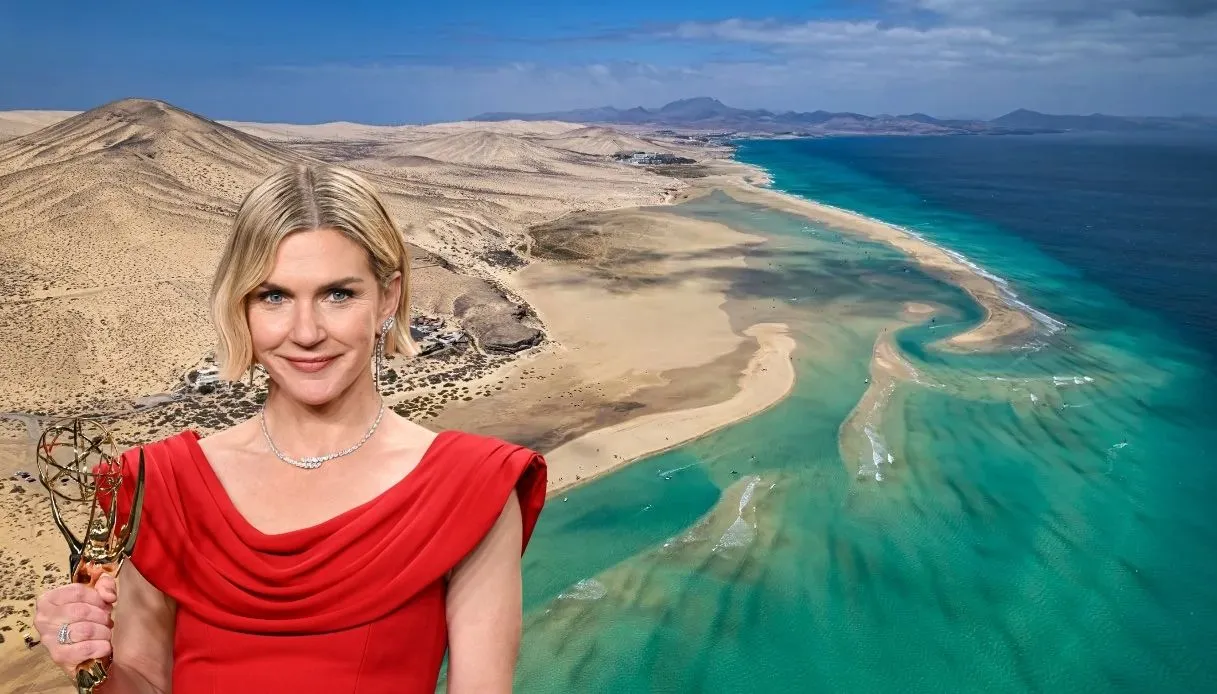
Following the success of Breaking Bad and Better Call Saul, the screenwriter and director Vince Gilligan returned with a new, highly anticipated series: Pluribus. The sci‑fi dramedy premiered on November 7, 2025 and is available on Apple TV. One more reason to watch it? The TV series slew the Emmy Awards, taking home six statuettes including Best Actress in a Drama Series awarded to Rhea Seehorn and Best Screenplay for a Drama Series won by Vince Gilligan. The recognition also includes Best Original Theme Music for an Opening Title, Best Scenic Design for a Contemporary Program, Best Video Editing for a Drama Series and Best Audio Mixing for a Comedy or Drama Series.
The protagonist of the series is Rhea Seehorn, already acclaimed for her role as Kim Wexler in Better Call Saul, a performance that earned her two Emmy nominations. In Pluribus, the actress guides a narrative that sits at the intersection of science fiction and dramedy. The cast also includes Karolina Wydra (Sneaky Pete) and Carlos-Manuel Vesga (the hijacking of Flight 601), with special appearances by Miriam Shor (American Fiction) and Samba Schutte (Our Flag Means Death).
What it’s about
The life of a successful writer is upended by an inexplicable event: a mysterious virus spreads across the world, turning every individual into a person who is constantly happy and optimistic. Carol, the only person in the world who remains immune to the phenomenon, suddenly finds herself to be the most unhappy person on Earth—and, paradoxically, the only one capable of saving humanity from happiness itself.
Where filming took place
Filming took place across the United States and Europe, touching locations of great visual appeal: New Mexico, Montana, and Spain, specifically Albuquerque, Helena, and the Canary Islands. Principal photography began in February 2024, under the provisional title “Wycaro 339,” and lasted about seven months, concluding in September of the same year. Much of the project was shot in New Mexico, where the production involved over 100 lead actors and hundreds of local extras, underscoring the state’s importance as a creative hub for major American television productions.
Albuquerque, New Mexico
Just like the renowned Breaking Bad and Better Call Saul, Pluribus was largely filmed in Albuquerque, New Mexico, a city now symbolic of Vince Gilligan’s creative universe. Reminded of the difficulties that arose during Breaking Bad, when the real house used as Walter White’s home drew crowds of fans, episodes of vandalism, and forced the owners to sell and move, Gilligan decided to avoid using real homes in Pluribus.
For this reason, the houses in the neighborhood of Carol Sturka were built entirely by the crew, with striking realism. The sidewalks, asphalt, and gardens were laid out on the outskirts of Albuquerque, at the foot of the Sandia Mountains, offering a spectacular backdrop to the city. “When we arrived there was only a field full of weeds,” Gilligan recalled. “A few months later there were paved roads, concrete sidewalks, neatly kept gardens, and seven real houses. Not cardboard facades, but solid homes, where we even shot several interior scenes.”
Canary Islands, Spain
Beyond the United States, the production of Pluribus also stopped in Europe, bringing cast and crew to the Canary Islands, in Spain. The Canaries, thanks to the variety of their landscapes, offered ideal settings to recreate locations very different from each other: from the hills of Tangier, in Morocco, to a Norwegian ice hotel. It is precisely in this archipelago that many of the show’s most suggestive and visually ambitious sequences were filmed.
Not the first time the Canary Islands have served as a set for major international productions: in recent years they have hosted films and series such as The Assessment, The Hitchhiker’s Guide to the Galaxy, The Midnight Sky, Doctor Who, and Foundation, confirming themselves as a reference point for cinema and television with global reach.
Helena, Montana
The filming then also touched Helena, the capital of Montana, known as the Queen City of the Rockies. The city, with its mountainous landscape echoing Albuquerque’s, was chosen to shoot some additional sequences, probably used to recreate New Mexico environments without having to travel back there physically.