
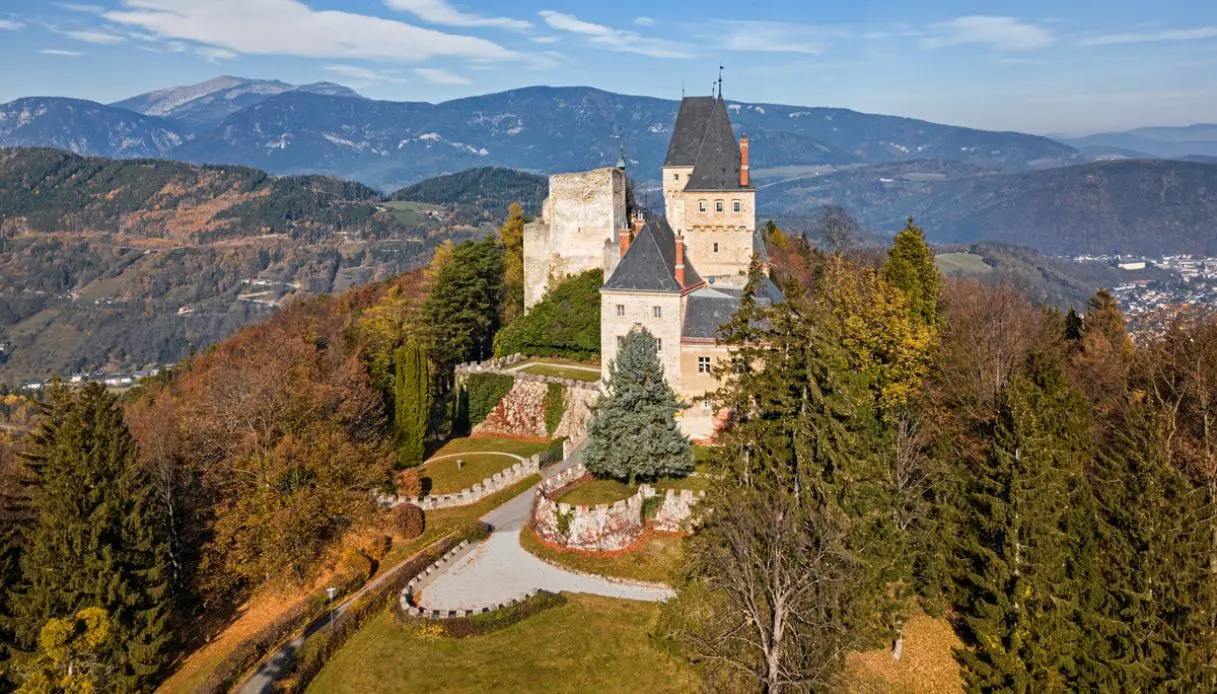
At an altitude of about 750 meters, set among the ridges of the Semmeringgebiet in Lower Austria, a long rock formation rises to welcome Castel Wartenstein. We are speaking of an elegant fortress that overlooks the Schwarzatal region from above, to the point that, more than a castle built to celebrate the wealth of a court, it seems a presence born from concrete needs of control and defense.
Their origins date back to the Middle Ages, when a small fortress protected a border area and monitored the routes across the mountainous landscape. Over the centuries, however, the structure underwent several changes. Today the complex preserves a feature that makes it particularly interesting: beside the parts transformed in subsequent eras, remnants of the original fortress survive, including the Romanesque keep and the medieval palace.
A Brief History of Castel Wartenstein
The lords of Wartenstein were ministeriales of the margraves of Styria, i.e., men bound to territorial power through service and administrative duties. Around 1180 they built on the Raacher Berg a small fortress with a tower and a modest residential building. Its primary function was the security of the border with Austria.
That initial construction was modest in size, but occupied a precise position in the political geography of the time. Its strategic importance diminished rapidly after 1192, the year of Duke Otakar IV‘s death, when Styria passed under Austrian rule. The border that had justified the fortress’s origin thus lost part of its significance.
In the 13th century Wartenstein was expanded. Heinrich von Stubenberg extended the complex northward and eastward, building on the tip of the rocky spur a formidable keep and a second square tower beside the current entrance. During the 14th and 15th centuries the castle belonged to sovereign territorial power and was often pledged. Management was entrusted to officials, called Pfleger, tasked with administering the lordship.
In the 1470s of the 15th century, Emperor Frederick III assigned Wartenstein to the Order of Saint George, founded by him. The King of Hungary Matthias Corvinus managed to seize it without fighting. After his death, in 1490, the Hungarians were expelled and the fortress returned to the order.
In 1547 Christoph Urschenpeck arrived, followed by his descendants, who invested substantial sums in the complex. Their commitment finally enabled them to buy Wartenstein from the Collegium of the Jesuits of Graz, the legal successor of the Order of Saint George. It was then that the fortress began to transform into a more comfortable residence, and from 1633 the owners were the Petrowitsch lords, followed from 1720 by the Neapolitan counts Stella and, later, by the Caracciolo family.
During World War II, the castle housed state offices and Wehrmacht facilities, while in 1945 it suffered serious damage due to fighting. In 1957 it was purchased by a foundation linked to Swedish industrialist Axel Wenner-Gren, founder of Electrolux, and after a major restoration it became the site of an anthropological research seminar. Later it returned to private hands and is intermittently used as a residence.
Visit and What to See at Castel Wartenstein
Visit requires an important clarification: access to the interior and the possibility of visiting the complex are strongly limited, since the castle is on private property. Before planning a hike, it is essential to verify accessibility. Architecturally, the complex unfolds around a long inner courtyard, historically reachable through the main gate or a small pedestrian door set into the entrance tower.
On the western side, perched on a rocky spur about eight meters higher than the courtyard, lie the ruins of the ancient Hochburg, the highest and original part of the settlement. The square Romanesque keep and the palas—the building intended for the lord’s residence and administrative functions—remain recognizable. The keep, besides representing the fortress’s defensive core, allowed control of the territory from above and served as a refuge in case of danger.
Another element of great interest is the Chapel of the Magi, Gothic in origin and restored in 1871. The small chamber still preserves Romanesque features, evidence of the earliest phases of the complex. On the exterior wall you can also see a Romanesque capital, a small but precious detail for understanding the building history of the manor. A staircase leads to the nearby kitchens block, part of the residence’s domestic organization.
The long eastern side of the courtyard is occupied by the residential block remodelled after 1957. Its layout is curious, because the building is so narrow that inside it allows for only one room per floor or per section. The structure is bounded by two large square towers, following a model linked to the ministeriales’ fortresses of the Hohenstaufen era.
The northern tower features walls almost 3 meters thick, while the southern one is slightly smaller. Both were altered in the 19th century, when architect Ignaz Banko intervened on the layout of the complex. The upper floors were equipped with projecting structures, i.e., parts that overhang beyond the line of the underlying masonry. The southern tower, lowered in the 17th century to the height of the roof, was raised again during these works.
In the courtyard you can still see the ancient cistern, protected by a wrought-iron cover dating from the 17th century. Before the arrival of modern supply systems, a water reserve was a vital necessity for the inhabitants and for the fortress’s resilience during a siege.
Where It Is and How to Get There
Castel Wartenstein lies in Lower Austria, within the Semmeringgebiet region, a mountainous area south of Vienna characterized by wooded heights, valleys, and historically important routes linking eastern Austria and Styria. The fortress sits near Raach am Hochgebirge, about 4 kilometers south of Gloggnitz, in the Neunkirchen district.
The most practical geographic reference for reaching the area is Gloggnitz, a town in the Schwarzatal valley connected to the Austrian rail network. From Vienna you can head south by train to Gloggnitz, then continue toward Raach am Hochgebirge by local transport or taxi. By car, the area is accessible via the Semmering road network, a route that winds through the rolling and mountainous landscape of Lower Austria.
The site is mainly a historical testimony to be observed within its territorial context, rather than a destination organized for mass tourism. Before setting out, it is advisable to verify the possibility of approaching the property and the access conditions, avoiding confusion between the presence of the ruins and automatic access to visiting.