
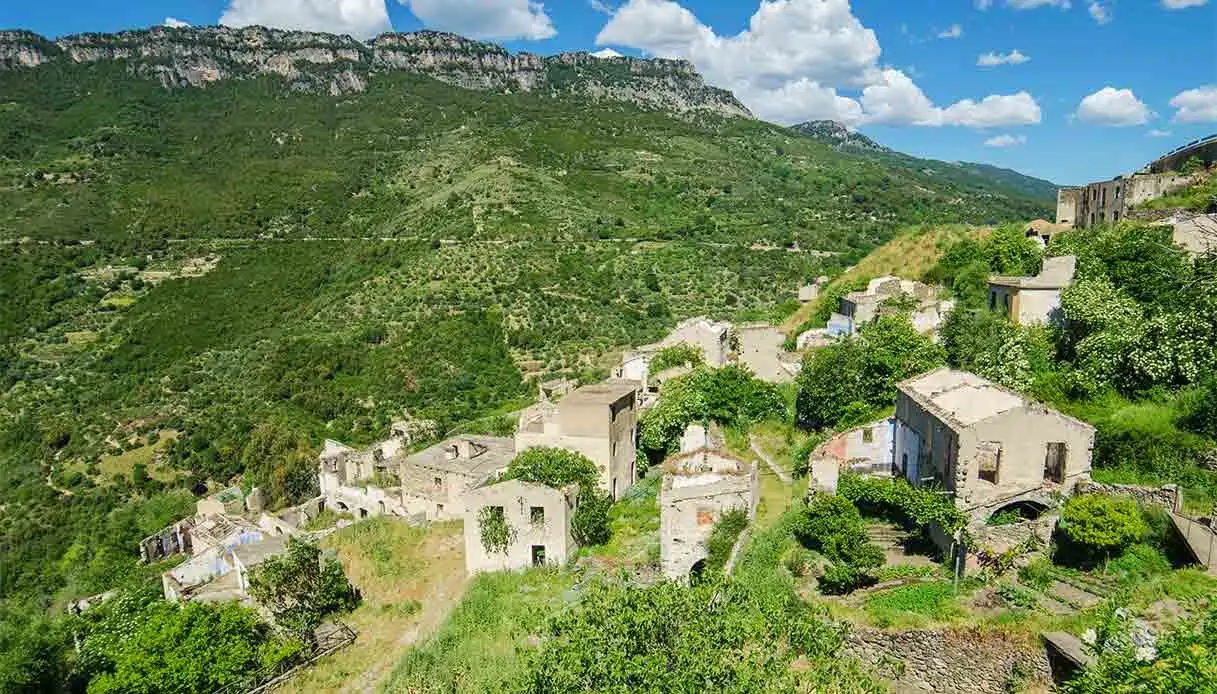
Anyone driving along the SS198 in Sardinia, which from the eastern coast enters the region of the Ogliastra, cannot help but stop to visit one of the island’s most famous abandoned villages, a place you inevitably drive past: Gairo Vecchio. It lies along the road, with a sheer drop on the other side, and, given the small number of cars that pass through this area, silence reigns supreme.
Its history mirrors that of many other ghost towns in Italy, but there is more here. Foremost, it is far less famous than others and, being in Sardinia, it is also far less visited. It cannot really be called a true “inhabited” settlement since no one lives there, and the tourists who visit it, especially in summer, are the only living beings you encounter.
If you happen to visit it in autumn and winter, on cold, foggy days you feel as if you are wandering in a magical atmosphere, as if enveloped by the fog of the past.
The History of Gairo Vecchio
We are perched at 520 meters above the Pardu River. It seems that the name “Gairo” means “land that flows,” and it encapsulates a kind of predetermined geologic fate. Not by chance, its troubled history, which began in the late 19th century due to the instability of the ground on which it sits, had a dramatic outcome.
The village, in fact, was progressively abandoned due to a a severe flood that occurred in 1951. Contemporary reports recount five days of rain and incessant wind that struck Ogliastra and that made the original nucleus of Gairo, already worn down by half a century of landslides and ground movements, unsafe for people and animals. The streets transformed into raging torrents, dramatically sliding the ground toward the valley.
The inhabitants moved further down the valley, forming three other small villages: Gairo Sant’Elena, Gairo Taquisara and Gairo Cardedu. The first sits just a few meters above the old town. The second, which is a few kilometers away, is a charming village of only 300 residents and is famous for being one of the stops where the Sardinia Green Train halts, which in summer crosses through some of these towns (and is the alternative to driving if you want to visit these places). Here runs the Arbatax – Gairo Taquisara line. The third village is the closest to the sea.
But it is precisely Gairo Vecchio, the town that no longer exists, that attracts travelers who love off-the-beaten-path routes away from postcard Sardinia. To visit it, take a few switchbacks and, on the right, you can park and walk into the narrow alleys, stairways, and ruins with the distinctive pink and blue walls (perfect for those who practice Urbex, the passion for abandoned and dilapidated places).
The Village That Comes Alive Once a Year
The most important events held in Gairo are religious celebrations, to which in recent years the Sagra del cinghiale has been added, held in conjunction with the feast of Sant’Antonio Abate, which falls in January. On this occasion, it is customary to light the traditional bonfire and cook the boar meat offered by the hunters: the success of the festival, tied to rural tradition, is considered a good omen for the agricultural year.
The Surroundings
The beautiful territory of Gairo Vecchio unites sea and mountains and attracts many visitors drawn by the beauty of the landscapes and the pristine nature that characterizes this area. The coastal area of the Municipality of Gairo is characterized by beaches of rare beauty, such as the evocative dark-pebble beach of Coccorrocci and that of Cala ‘e Luas with its pink rocks.
The mountainous landscape is made spectacular by the presence of the “Tacchi”, limestone towers formed in the Mesozoic, which rise like towers among the mountains, among which stands Perda’e Liana, the most famous natural monument of Sardinia. A hike among the tacchi along mule tracks allows admiring authentic specimens of wild nature. Among the karst mountains of the Gairo area lie the beautiful Grotte di Taquisara, named after the nearby hamlet; the caves, perfectly preserved, have been equipped and accessible to visitors in recent years.
The Legend of the Gate of Hell
An old legend describes Perda ‘e Liana as one of the gates of Hell, from which demons and witches feared by ordinary mortals would emerge; an ancient folk saying still goes “A sa Perda ‘e Liana su hi heres ti dana” (“To Perda ‘e Liana, what you ask for is given to you”), recalling the pilgrimage of those who went to the mountain’s foot to offer their own soul to the devil in exchange for what they desired.
How to Visit the Abandoned Village
Today Gairo Vecchio is a collection of ruins of buildings that stubbornly cling to the rock of Monte Trunconi, which dominates the valley, among earthen lanes and paved surfaces connected by stairways and inclined paths. The streets delineated the terraces on which the buildings stood, thus they are laid out horizontally at different levels along the slope.
You walk in a timeless atmosphere, observing structures built from granite and schist, held together by mud or lime-sand mortar. The lime was produced in a kiln that remained active until a few decades ago, located where the Taquisara hamlet later arose. Some buildings had three or four floors. Today, some façades still bear wrought-iron balconies. As you wander through the village on foot and peek inside the houses from the street, you can still glimpse how they were inside, with their fireplaces, stairs, windows, and blue-plastered walls. Some must have been truly beautiful… But for safety reasons it is forbidden to enter or approach the old houses too closely.
The sense of abandonment grows as vegetation begins to reclaim the ruins, taking back spaces that once belonged to them. From time to time, gardens emerge, some apparently still carefully tended.
How to Get to Gairo Vecchio
To reach the village of Gairo Vecchio, in the province of Ogliastra, you must travel along the Seui-Lanusei State Road 198 (SS 198), the Sardinian road artery about 80-100 km long connecting Serri, in Sarcidano, to Lanusei, in Ogliastra. It is a beautiful road, beloved by motorcyclists and road-trip enthusiasts for its wild landscapes and countless curves among the mountains of Barbagia.
Coming from Osini and stopping roughly at the height of Osini Vecchio, on the opposite side of the valley, you can see the two Gairos: the old one below and the new one above. A few more kilometers and hairpins later, turning right, you reach the old village: here you can park the car for the visit and then resume the state road toward the world-famous Blue Zone. But this is another journey that we tell you about here.