
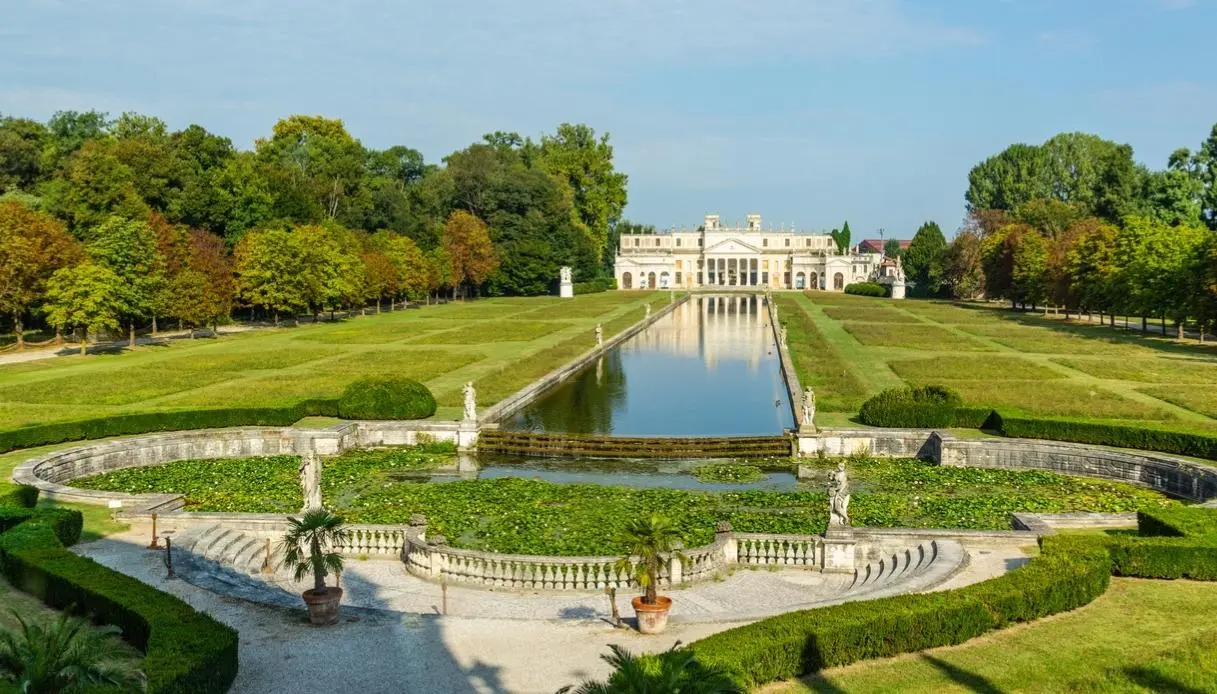
After two years of closure, the garden of Villa Pisani reopens and shines once again. The elegant green space in the town of Stra, along the Brenta Riviera, is a must-visit, with a partial reopening on September 5 and a full completion planned for October. The building, which houses a museum inside, is reopening in stages with a complete restoration to be finished in the coming weeks. Here are all the news.
Villa Pisani Reopens Its Garden
Two years of work were needed to restore the magic of the garden at Villa Pisani in Stra. The building, with a park spanning 14 hectares, is a true gem, and the maintenance, restoration, and safety measures were absolutely necessary. The first reopening from September 5 concerns the southeast sector where the parterre of the rose garden, some historic trees, the Esedra, and the Wisteria Gallery are once again accessible.
Among the elements recovered is the Apollo statue, undergoing restoration, while along the promenade one encounters the so-called Napoleonic Lime Tree, a botanical feature that recalls the villa’s 19th-century history. The long row of the Eastern Carpinata features tree replacements and new plantings, though some specimens belong to the original historical phases, dating back to earlier times.
The progressive reopening program will continue in the autumn: among the areas planned for future openings are the Belvedere Avenue, the Avenue of Triumphs, the Romantic Forest, the Austrian Hill, the Queen of Hungary parterre, the Orangerie, the greenhouses, and the historic Café Haus.
One place remains eagerly awaited among Villa Pisani’s symbols: the Labyrinth. Work is underway, and the stated goal is to complete the interventions by the end of 2026. To protect it, once reopened, a controlled-access system is expected to be introduced.
The New Pathway
The most interesting aspect of the reopening is that the garden finally becomes something to walk through, not merely a backdrop to be observed from the villa. The route blends architecture and vegetation without following a rigid sequence. It passes beside the Gardener’s House, today visible only from the exterior, then toward the Esedra and the axial alignments that define the park’s design.
One of the most recognizable sections is the Wisteria Gallery. In September it naturally doesn’t display the spring burst of color when the blossoms turn the passage into a long violet arch, but it remains one of the corners that best tell the story of the relationship between the cultivated garden and nature. Further ahead the Ninfeo (Nymphaeum) and the large central basin reappear, elements that restore depth to the park’s original layout. It is precisely the continual change of perspective that makes the stroll special: a stretch seems to close in among the trees, the next opens toward the villa or toward the Stables.
Useful Information for the Visit
The National Museum of Villa Pisani and its park are located in Stra, in the province of Venice. To reach it without a car, you can take bus line 53E to the town and then continue on foot for a short stretch. Those who prefer to combine train and bus can travel from Venezia Santa Lucia or Mestre toward Padua, then proceed to Stra by local transport.
For the visit, a full-price ticket of 9 euros is available, covering the courtyards, the portico, and the noble floor, or you can opt for a combined villa-and-park ticket for 15 euros.