
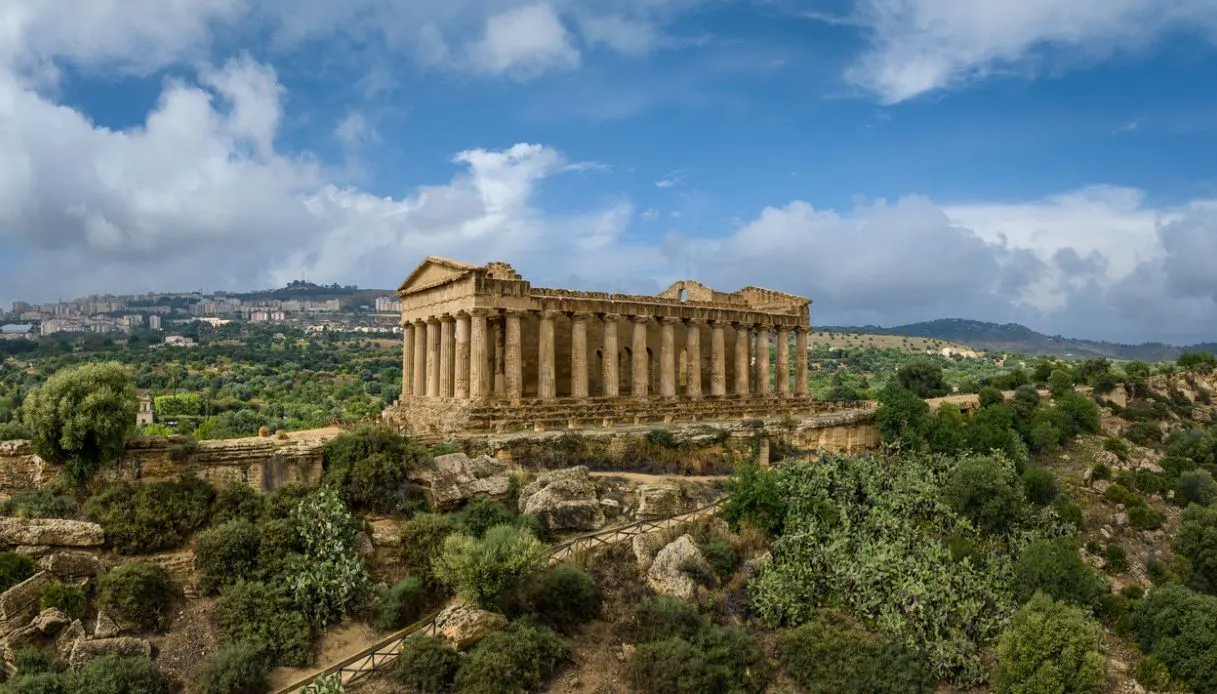
On the southern coast of Sicily, in Agrigento, lies one of the world’s largest archaeological sites: the Valle dei Templi. About 2,500 years ago, here stood Akragas, one of the richest and most powerful cities of the Greek world and, to this day, eight well-preserved temples recount its greatness. Yet this is not merely an open-air museum to admire, but a place where research does not stop and continues to surprise us with new discoveries.
The latest development comes from excavations by the Scuola Normale Superiore di Pisa, which have unearthed fragments of colored frescoes, stuccoes and architectural elements dating to the 1st century BC. A discovery that shifts attention from Grecian splendor to a less-known chapter: the moment when Akragas, now under Roman rule, was changing its face.
Discoveries of Frescoes and Columns on Poggio di San Nicola
The finds emerged from what remains of an ancient building located just south of the ekklesiasterion, the cavea where free citizens of Akragas gathered in assembly. We are on the Poggio di San Nicola, inside the Valle dei Templi’s archaeological and landscape park, where the Normale has been digging since 2020. This year’s campaign, in fact, is the third school excavation carried out in the area.
According to the archaeologists, the remains probably belong to the peristyle of a wealthy domus or to a monumental portico, built when Sicily was already under Roman dominion. The dig yielded abundant ceramic material, ornamented stuccoes, and numerous fragments of polychrome plaster that can be traced to the second and third styles of Roman wall painting. A terraced structure, a canal, and a quadrangular room dating to the imperial era with wall plaster and a terracotta floor also emerged.
There is also a return to the excavations’ past: in the peristyle lay the architectural blocks unearthed by Ernesto De Miro in the 1960s. Moved to clear and study the area, they were accompanied by new fragments: capitals, bases, column drums, a molded architrave, and a frieze with a kyma lesbio “Ionian” motif, a decorative pattern typical of Siceliote productions between the 3rd and 2nd centuries BC. Cataloguing, drawing, and surveying will be used to reassemble them to reconstruct the building’s elevation.
It remains to be clarified, as the study progresses, what the building’s function was. It could have been a large private domus, or a public space, such as a porticoed terrace connected to the Roman temple, given that the adjacent ekklesiasterion had already ceased to function in public life. The excavations also examined the remains of the apse of a small Paleo-Christian basilica, which in the past had been interpreted as an exedra: evidence that this area was frequented for a long time.
An Important Area for Understanding Roman Akragas
The discovery was made on Poggio di San Nicola, a central site for the ancient city. Researchers describe it as a strategic area, located at the heart of Akragas, where civic and assembly buildings such as the ekklesiasterion, the bouleuterion, and the theatre stood. For this reason it is considered a key hub for understanding the urban development of this district and, above all, how city institutions changed during the transition under Roman influence.
The campaign, which began on September 7, will conclude on October 9, and has involved students, doctoral candidates, and early-career researchers from Italian and international universities such as the Universidad Politécnica de Madrid (UPM), ITU of Istanbul, PSL of Paris, FAU of Erlangen, and BME of Budapest.