
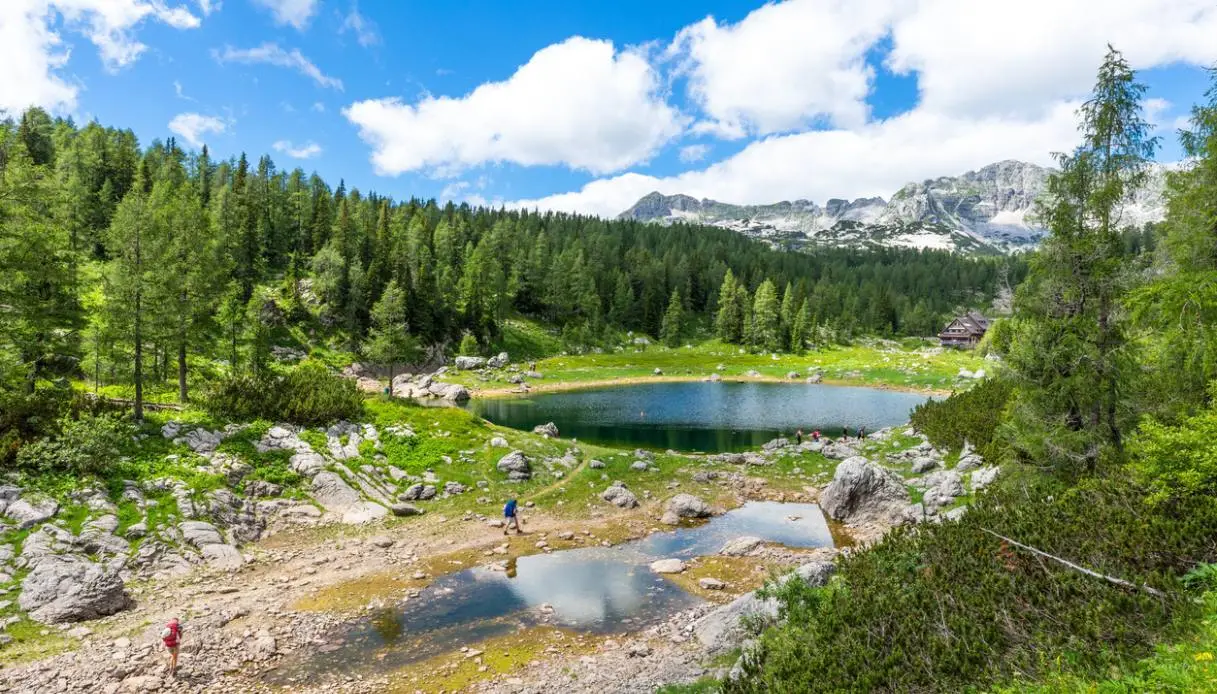
The white limestone gleamed in the morning light, broken only by patches of golden grass and the deep blue of the water’s surface. The Valley of the Seven Lakes, known locally as Dolina Triglavskih Jezer or Valle dei Laghi del Triglav, carves into the karst heart of the Julian Alps in Slovenia.
It stretches between Bohinj Lake on the eastern flank and the Trenta area toward the Isonzo valley, beneath the great mountains of the Triglav massif. Yet the name can be misleading: there are seven permanent lakes, but they are accompanied by several small basins that can appear or disappear depending on the water conditions.
Down below there are forests of spruce and larch, then rock takes space until it transforms the valley into a succession of basins, limestone slabs, scree, and sheer walls. In the midst of all this, the water takes on different tones. Black, green, brown, blue and aquamarine have become part of the valley’s geography itself.
Origin, formation and legends of the Valley of the Seven Lakes
The current shape of the valley arises from a long geological history. Ancient glaciers scraped out the basins in the rocks of the Julian Alps, leaving depressions later occupied by water. Today we have a sequence of basins distributed along a high-mountain karst landscape, with elevations rising from about 1,300 meters to well over 2,000 meters.
Water easily penetrates the fractures of the terrain and feeds an underground network that makes the hydro balance of the area particularly delicate. The surface landscape thus tells only part of the story: beneath your feet continues a circulation system typical of karst environments.
The lowest lake in the sequence is Črno jezero, the Black Lake, at about 1,319 meters. The dark color depends on the position of the basin and the surrounding forested environment. Higher up appears the Dvojno jezero, the Double Lake, formed by two nearby basins. Then comes the valley’s great protagonist, Jezero v Ledvicah, known also as Veliko jezero or the Great Lake. Ledvica means kidney in Slovene, and the name recalls its elongated shape.
Climbing further, one encounters Zeleno jezero, the Green Lake, named for the intense greenish hues of the water, and Rjavo jezero, the Brown Lake. At higher altitudes lie the Jezero pod Vršacem, also known as the Lago sotto Vršac, and other small basins that complete the system.
A peculiarity concerns exactly the Jezero pod Vršacem. Its waters belong to the Isonzo river basin, while other lakes of the valley feed systems linked to the Sava side. In the Triglav National Park, indeed, runs an important European watershed line.
Natural history intertwines with the fantastic: the Julian Alps are the realm of Zlatorog, the Golden-horned Chamois of Slovenian tradition. According to the legend, the animal bore golden horns capable of indicating the way to a vast treasure hidden among the mountains. A young hunter from the Trenta valley, blinded by passion and greed for wealth, shot it. From Zlatorog’s blood sprang the flowers of Triglav, believed to restore strength to the animal.
The tale, however, ends in a dramatic way: Zlatorog takes revenge on the hunter and destroys its own mountain kingdom. The treasure remains hidden among the peaks. Even today the legend belongs deeply to the identity of the Julian Alps and adds a fairy-tale dimension to the Valley of the Seven Lakes.
The visit among lakes, refuges and high-altitude landscapes
The Valley of the Seven Lakes requires a true Alpine hike. The classic route starts from the Bohinj area and tackles the Komarča wall, a steep stretch that quickly raises you to higher elevations. Once past Komarča, the ground becomes more open and the rock takes on irregular shapes. Small hollows, limestone slabs and depressions tell of the ancient presence of glaciers.
The first major stop is the Črno jezero, with the contrast between the dark water, the green of the spruces and the limestone walls that make this lake particularly evocative. The Dvojno jezero offers a different atmosphere. The presence of the shelter makes the area a natural resting point for those taking a multi-day itinerary.
The Veliko jezero, or Ledvica, deserves a longer pause. The kidney shape is particularly evident from above, and its waters can reflect the surrounding mountains during the calmest hours. As you ascend toward higher elevations, vegetation gives way to the karst landscape. The ground becomes almost lunar and the color of the stone dominates the scene. Zeleno jezero adds a bold splash of green, while the upper basins offer a more austere setting.
For a complete visit, physical preparation is required: the routes feature significant elevation changes, rocky stretches, and day-long hiking times. The most favorable hiking season runs roughly from July to September, while spring and autumn require greater attention to terrain and snow conditions.
The refuges form an important part of the experience. Koča pri Triglavskih jezerih sits beside Dvojno jezero, while Zasavska koča na Prehodavcih lies higher up, near the Prehodavci area. Swimming in alpine lakes is prohibited and wild camping is not allowed. The national park also protects springs, lakes, watercourses and habitats that are particularly fragile.
The attention to the environment is also felt in the silence: stop for a few minutes near a lake to distinguish the wind among the trees, the sound of the water, and the calls of animals.
Where it is and how to reach
The enchanting Valley of the Seven Lakes lies in the central part of the Triglav National Park, between Bohinj Lake and the Trenta Valley. For visitors to Slovenia, the most practical eastern reference is Bohinj, reachable from Bled and connected to the public transport network.
The classic access starts from the Ukanc area and climbs toward Komarča. It is a demanding itinerary, suitable for seasoned hikers, with a steep ascent in the first part and then a progression through the valley. An alternative starts from Planina Blato or from the Vogar area, via a route that crosses old alpine pastures and offers a more gradual approach to the lakes area.
A third access comes from the Val Trenta, via the Prehodavci. This is a more alpine route, especially suited for experienced hikers and for anyone who wants to include the Valley of the Seven Lakes in a longer crossing. For those arriving from Italy, the western side of the Julian Alps provides a natural link to Slovenia through the Isonzo region.