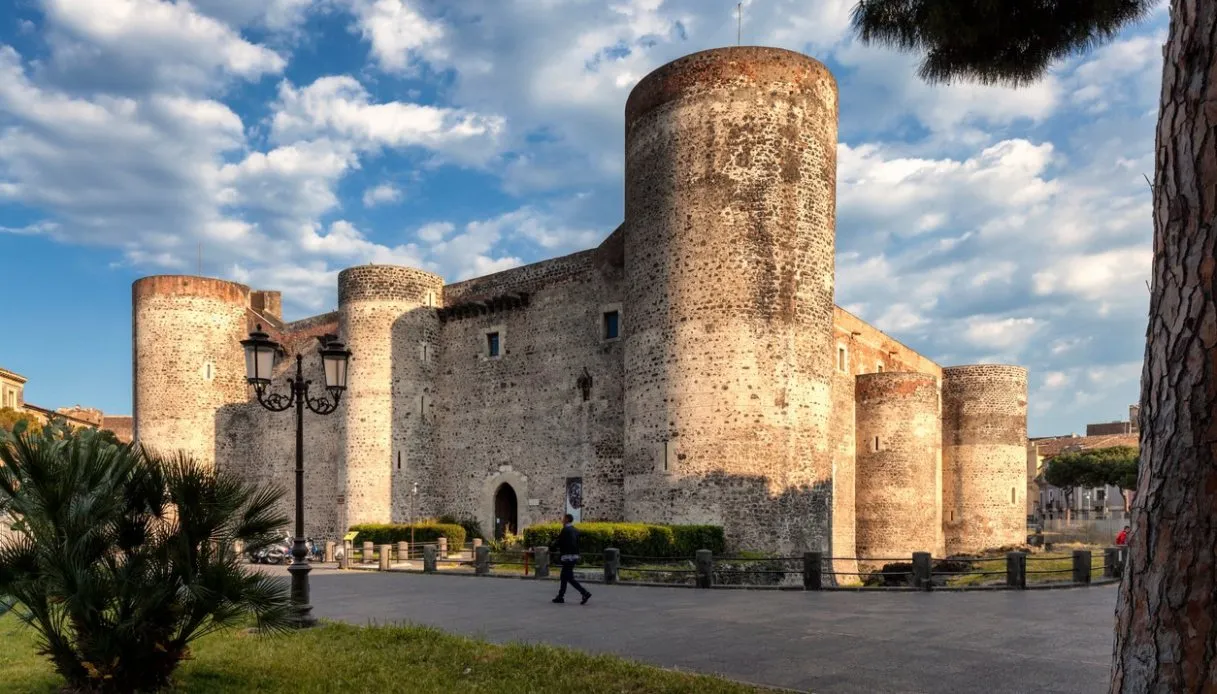
Yes indeed, you read that correctly: the Ursino Castle of Catania is a tale of movements, almost impossible to read without observing the surrounding landscape. The fortress was built in the XIIIth century by the will of Frederick II of Swabia, with a precise strategic function on the coast. Today, however, the sea is distant and the grand building appears firmly inserted into the urban fabric, specifically in Federico II of Swabia Square.
But how is this possible? The reason for this change lies in the city’s geological history: in 1669 a lava flow from Mount Etna reached the castle, dividing into two branches and surrounding it without destroying it. The lava covered part of the fortifications and modified the coastline, removing the fortress from the sea-facing position that had contributed to its military importance.
Today, however, by looking at the outer walls one observes the perfect combination between human engineering and the primal power of Sicilian nature.
A Brief History of Ursino Castle
The construction dates back to 1239 and was part of the system of fortifications desired by Frederick II of Swabia, emperor of the Hohenstaufen dynasty. The fortress had a military function, but it also bore a strong symbolic value: its presence opposed imperial power to that of the Church, represented by the nearby Cathedral.
Ursino later underwent centuries of transformations. It served as a royal residence under the Aragonese and from 1283 it was linked to the assemblies of the first Sicilian Parliament. During the Aragonese period some parts of the building took on a representational function, while in the 16th century the viceroy De Vega chose it as his residence. In that era, among other things, large windows were opened that changed the austere appearance of the facades.
Then came the long period of imprisonment, between the late 16th and 18th centuries, evidenced today by graffiti and inscriptions left by the prisoners on the courtyard walls and in the San Giorgio Hall. Some drawings depict boats and defensive structures. The earthquake of 1693 caused further significant damage: the eastern and southern half-towers collapsed and the southeast tower. The fortress then passed into a new military phase in the Napoleonic era and remained tied to the use as a barracks until the early 1900s.
A curiosity concerns the Swabian eagle placed above the main entrance. The sculpture shows the elegant bird with prey in its talons, identified either as a hare or, according to another interpretation, as a lamb. It is one of the details to look for before crossing the great ogival gate.
The Visit Among Towers, Courtyards, and Art Collections
The visit begins well from the outside, with a walk around the fortress. From the the mass of the towers appears even more imposing. Some parts of the ancient fortifications have been brought to light after removing portions of the lava flow of 1669. The entrance leads to the central courtyard, the true architectural hub of the complex.
The four original wings enclose large rectangular spaces connected by square rooms. The groin vaults characterize the interior spaces, while the towers present a notable peculiarity: on the outside they have a circular shape, while inside they are octagonal. The coverings show ribs arranged in a radiating pattern, with an effect that recalls the structure of an umbrella.
The towers also bear names linked to their history: the Tower of the Flags recalls the royal and knightly insignia; the Salt Tower would have been used as a salt store and preserves a small carved head on one of the vault’s corbels; the Tower of the Warehouses was damaged by the 1693 earthquake, has been consolidated during restorations and today houses the stairs and an elevator to the upper floors; the Towers of Martyrs, also called the Torture Tower, hides a narrow arrow slit and an opening intended for artillery in the 17th century.
Among the most evocative spaces is the San Giorgio Hall, linked to the court chapel dedicated to the saint. The fourteenth-century portal led to the chapel carved inside the southern central tower. It is precisely on its walls that traces of the long prison history of the complex remain.
Then there is the Hall of the Theater which houses artifacts from the Roman Theatre of Catania, recovered during excavations conducted by Prince Biscari in 1750. The Hall of the Stables houses Roman finds and features a very distinctive ogival vault. The numerous holes visible in the ceiling correspond to inverted amphorae inserted to lighten the load.
The route continues through the Art Gallery and the civic collections. The Civic Museum, established in the castle in 1934, brings together collections formed thanks to donations and legacies from important Catanese collectors. The Biscari Collection gathers artifacts from excavations carried out by Prince Ignazio Paternò Castello and from purchases made in the principal Italian antique markets. Also very interesting is the Collection of the Benedictine Fathers, which includes Greek and Roman artifacts gathered in the second half of the 18th century.
Among the paintings in the Finocchiaro Collection are works attributed to Pietro Novelli, Matthias Stomer, and Luis de Morales. The Gallery also includes works from the Mirone, Zappalà-Asmundo, and Balsamo funds. From the upper level, finally, a large opening allows a view of Catania from above, with the city rooftops and Etna on the horizon. The volcano that altered the castle’s position relative to the sea thus returns to the story, but this time through the landscape.
Where It Is and How to Reach It
The Ursino Castle is located in Federico II di Svevia Square, in the center of Catania. To reach it on foot from Duomo Square takes about 12 minutes, following the streets of the historic center. From University Square the route takes a similar time, while from Uzeda Gate it is almost 4 minutes. Even those arriving by bus can use the Borsellino Square terminal as a reference point, about a 4-minute walk from the fortress.
The entrance opens onto the square through the great ogival door, but before entering it is worth taking a stroll around the exterior of the fortress, especially in the moat sector, to see the mass of the walls and towers and to recognize the traces of the ancient fortifications. Federico II di Svevia Square thus remains the simplest reference point to reach the castle and begin the visit.