
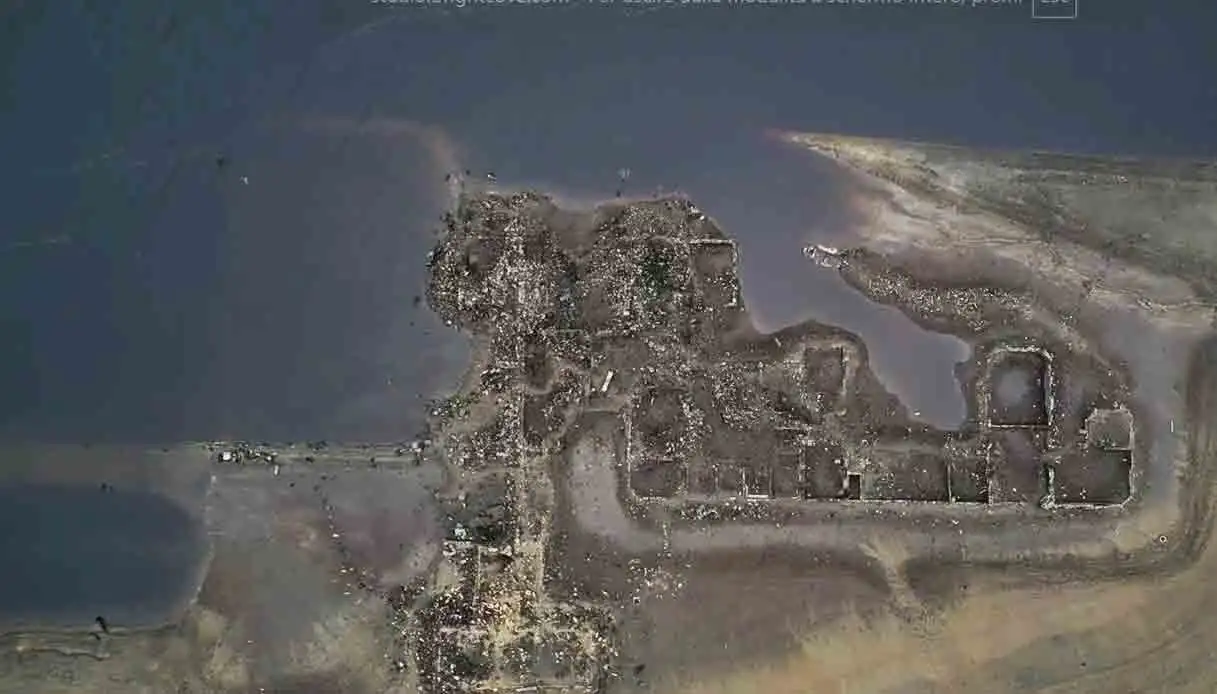
The prolonged drought across the United Kingdom has brought to light the remains of two vanished villages, demolished and submerged more than 80 years ago to make way for a water reservoir. Stone elements, walls, and the foundations of the old homes in Derwent and Ashopton have resurfaced from the depths of the Ladybower reservoir in Derbyshire.
The history of the submerged villages
The villages were deliberately flooded in the 1940s to make space for the reservoir, which can hold as much as 2,869 megaliters of water.
Due to the drought that marked the entire summer, however, the water level has fallen dramatically, standing at just 32% of the total capacity.
Striking aerial images offer a detailed view of roads and buildings lost long ago, imprinted in the mud following the substantial drop in the water level.
It is still possible to glimpse the remains of an old pumping station that rises above the ground, while sections of finely crafted limestone walls remain surprisingly intact despite having spent decades underwater.
Historic buildings, churches, and lime-stone cottages were submerged when the Derwent valley was flooded, between 1935 and 1943, to create the reservoir that today supplies water to Derby, Sheffield, Nottingham, and Leicester.
Currently, the profiles of dozens of limestone cottages – which once housed more than a hundred people – have reappeared for the first time since 2018.
The “ghost village” of Ashopton once boasted a pub, a distinctive toll house, and the grand Derwent Hall, before being erased from maps.
The rise in temperatures during last summer, combined with six months of below-average rainfall, has caused a collapse in water reserves, bringing to light portions of the valley that had not been visible for years.
Doug Clarke, head of water resources at Severn Trent, told the BBC: “We recorded six months of precipitation below the average and temperatures above the norm; as a result, the restoration of levels in the reservoirs will take time. However, overall, our region has water reserves higher than at the same point last year.”
“The reservoirs account for about one third of our water supplies, while the remainder comes from rivers and groundwater. Our teams continue to work tirelessly to treat more water and repair leaks at record speeds.” “We also urge customers to continue using water wisely throughout the year, to help ensure there is always enough for everyone.”
The Ladybower reservoir underwent major renovation work in the 1990s, aimed at raising and strengthening the dam and reducing the risk of overflow in the event of severe flooding.
The remains, with their eerie appearance, offer a rare testament to the village that disappeared beneath the water more than half a century ago. This extraordinary find comes at a time when drought in England continues to worsen.
