
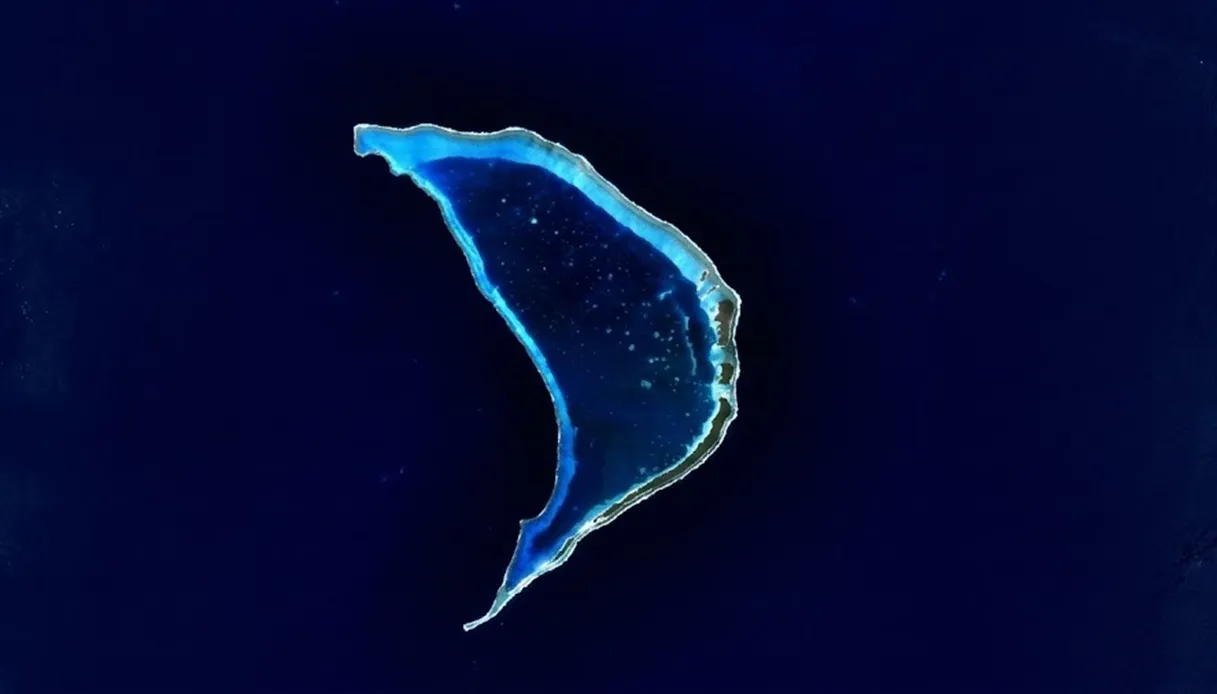
We keep packing our suitcases and traveling to the same places, yet there are still spots on Earth capable of amazing us, where nature seems to have paused at a time antedating even the arrival of humans. Remote corners, far from tourist routes and major environmental changes, where the sea preserves extraordinary colors and biodiversity thrives almost undisturbed. This is the case of two pristine atolls in the Pacific, Bikar and Bokak, belonging to the Marshall Islands, which a recent scientific study has identified as some of the most intact ocean ecosystems left on the planet.
They are not newly emerged or little-known islands, but territories that, thanks to their geographical isolation and the protection offered by local communities, have preserved natural characteristics that are now exceedingly rare. The study, published in the Frontiers in Marine Science journal, shed light on these two hidden paradises, revealing a world of crystalline lagoons, coral reefs, native forests, and a remarkable variety of marine species.
Where are Bikar and Bokak located
To imagine these two atolls one must venture into the heart of the Pacific Ocean, up to the Marshall Islands, an archipelago of Micronesia formed by coral atolls, small islands, and lagoons with infinite shades of blue. It is one of the most remote regions in the world, where the ocean dominates the landscape and the distances between landmasses can reach hundreds of kilometers.
Bikar and Bokak lie in the northern part of the archipelago, at about 116 and 385 kilometers from the nearest inhabited atoll, respectively. A geographical position that has helped shield them from the impact of human activities, making them two authentic sanctuaries of nature.
Viewed from above, the atolls present the landscape characteristic of the Pacific coral formations: thin strips of land that rise from the ocean and enclose pools of water, surrounded by coral reefs and seabed teeming with life. Here there are no large resorts, tourist infrastructures, or crowded beaches, but natural environments that have maintained an exceptional ecological balance.
In 2023, a expedition led by the Marshall Islands Marine Resources Authority together with the National Geographic Pristine Seas program explored these territories, studying their terrestrial and marine ecosystems through dives, underwater cameras, and even a submarine. The researchers documented at least 266 reef fish groups, 15 seabird colonies considered confirmed or probable breeding sites, and numerous large predators, including sharks and carangids. Two possible species yet unknown to science were also identified.
Each atoll preserves different characteristics. Bikar is an important nesting site for green turtles, with 132 nest traces recorded during the surveys, while Bokak stands out for its coral-dominated barriers and for the abundance of fish. Two adjacent ecosystems, but with unique natural identities.
Visiting the Marshall Islands atolls
The discovery of Bikar and Bokak might awaken the dreams of those seeking destinations far from mass tourism, but it is precisely their inaccessibility that makes them so special. These atolls are not conventional tourist destinations and do not possess the facilities needed to accommodate visitors as is common on the most famous tropical islands.
Their importance, in fact, does not lie in the possibility of turning them into new travel destinations, but in the necessity of preserving their exceptional natural heritage. In 2025, the Marshall Islands established their first national marine sanctuary, including Bikar, Bokak, and about 48,000 square kilometers of protected ocean.
For those who dream of discovering this part of the Pacific, the archipelago still offers other travel possibilities. The capital Majuro represents the main access point to the Marshall Islands, while the atoll of Arno, relatively close, allows one to experience a more authentic side of Micronesia, among traditional villages, tropical beaches, and lagoon landscapes.
Also the Ailinglaplap Atoll and Jaluit Atoll tell of the archipelago’s lesser-known beauty, although moving between the islands requires careful planning and the connections are limited. They are destinations best suited for experienced travelers, interested in an experience away from the more frequented tourist circuits.
