
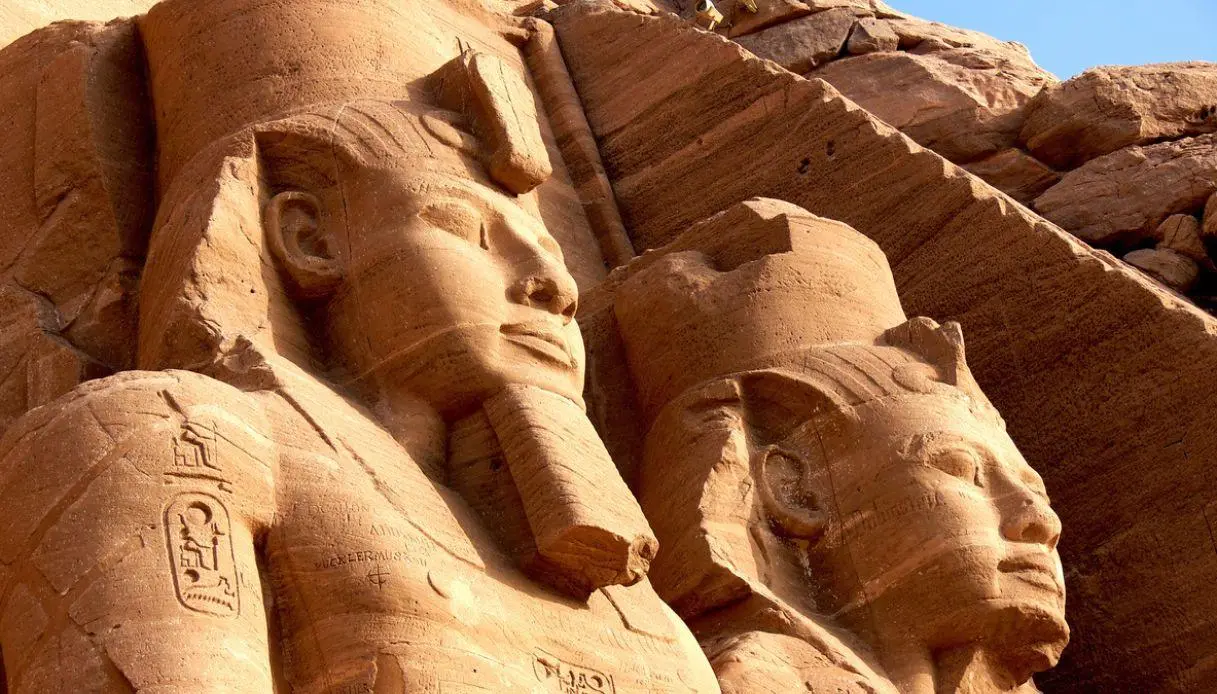
Sometimes, major archaeological discoveries do not originate from an international mission or years of research, but from a stroke of luck. That was the case at Behbeit el-Hagar, a small village in the Gharbia Governorate, in the heart of the Nile Delta. Here, a local resident was tilling a plot of land on his own property, right in front of his house, when he struck a block of stone covered with inscriptions. Rather than ignore it, he promptly alerted the local Antiquities Inspectorate.
The inspectors arrived on site, and an initial assessment confirmed that it was an ancient artefact. Once the legal formalities were completed, the Supreme Council of Antiquities formed a commission and a team of specialists to begin an emergency excavation. The result exceeded all expectations: the remains of two gigantic royal statues, which most likely depict Ramses II, the most famous pharaoh of the nineteenth dynasty, and a block of pink granite inscribed with hieroglyphs.
The Ramses II statues discovered at Behbeit el-Hagar
From the first statue what remains is primarily a colossal head, about 1.60 meters high. The ruler wears the doubled crown, the symbol of the unification of Upper and Lower Egypt. Beside it, the upper portion of the dorsal shaft also emerged, on which an inscription bears the name Horus of the King, “Hor Ka Nakht Meri Maat.” Based on the head’s proportions, archaeologists estimate that the statue, including its base, originally reached about 8.5 meters in height: a true giant, designed to impress anyone who passed by.
The second statue has come down to us in considerably better condition, though its legs and base are missing. The torso measures around 2.40 meters and shows the pharaoh wearing the nemes, the classic striped royal headdress, which is partly broken at the top. The head was also found, with a face still sharp and well preserved, very similar to that of the first statue. Experts believe this figure also represents Ramses II, but attribution has yet to be confirmed.
The pink granite block with the pharaoh’s titles
The third find may seem the least spectacular at first glance, but could prove the most valuable for scholars. It is a pink granite block about 1.30 meters long, discovered roughly one meter north of the second statue. On its surface are still legible traces of two royal titles: “Nesu Bity,” meaning king of Upper and Lower Egypt, and “Sa Ra,” son of Ra.
These are not mere formulas. In the titulature of the pharaohs, these two epithets introduced respectively the coronation name and the birth name of the ruler, and, in this case, they are linked specifically to Ramses II. The block, therefore, strengthens the hypothesis that the second statue also belongs to the same king and suggests that the finds were part of a single monumental complex.
To establish this with certainty, time will be needed. Hisham El-Leithy, the secretary general of the Supreme Council of Antiquities in Egypt, explained that excavations and studies would continue, with the aim of uncovering additional fragments and reconstructing the connection between the objects and the site.