
The landscape unfolds like this: dense forests, hills threaded by rivers, and small medieval towns. And then, when no one expects it anymore, grand towers rise from the greenery. What seems like a fairy-tale place is actually Thuringia, in central Germany, a region that guards some of the country’s most fascinating castles.
The setting seems almost built around these ancient residences, some hidden among the mountains, others perched on rocky ledges that overlook verdant valleys. Yet this territory has for centuries been divided among several principalities, and each dynasty sought to prove its wealth through imposing buildings, art collections, libraries, and gardens designed by the era’s leading architects.
In short, the castles of Thuringia boast features quite different from the austere Romanesque fortifications, as well as from refined Renaissance palaces, up to the elegant mansions that recall the English countryside. What is certain is that these are walls where figures of notable caliber lived, including Saint Elizabeth of Hungary, Martin Luther, and Johann Wolfgang von Goethe.
Wartburg Castle, Which Changed the History of Germany
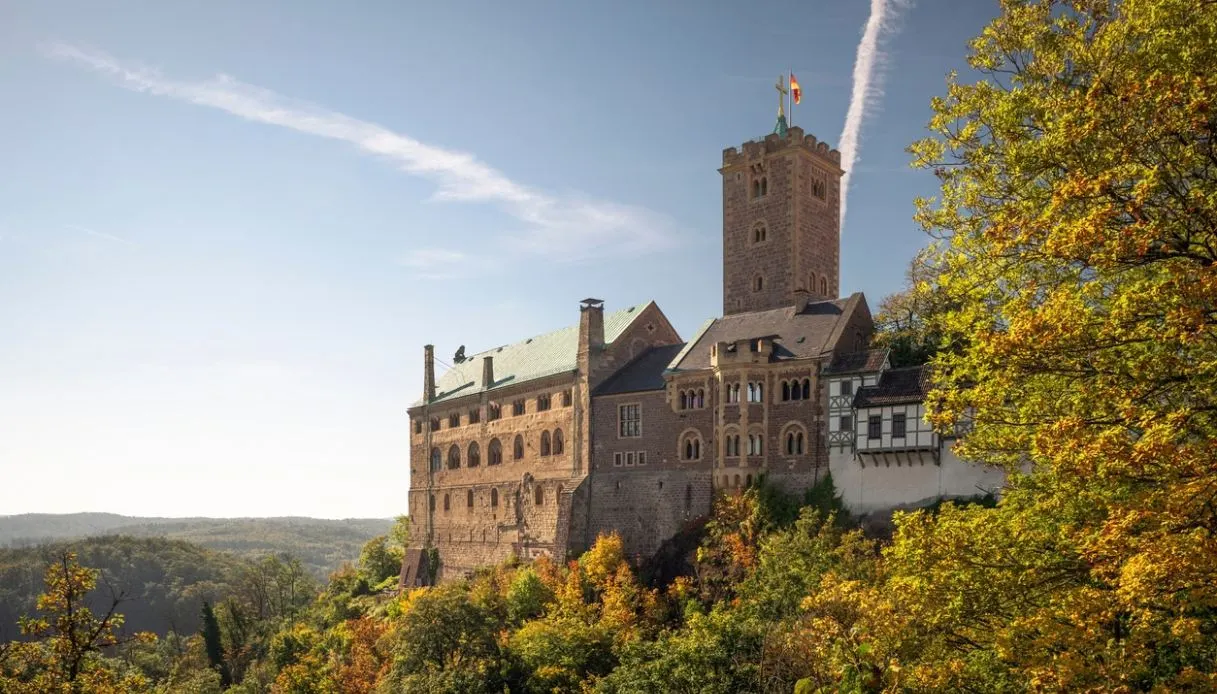
Let us begin this fabulous journey with Wartburg Castle, which presents itself with a powerful enclosing wall, steeply pitched roofs, crenellated towers, and a panorama that embraces the mountains of the Thuringian Forest. Perched above the town of Eisenach, it possesses that solemn air one would expect from a fortress featured in knightly tales.
Today it is one of Germany’s most important historic monuments, so much so that it was designated a UNESCO World Heritage Site in 1999. Its medieval core includes the Palas, an extraordinary example of Romanesque residential architecture, characterized by arcades, monumental halls, and spaces that safeguard the memory of the court of the landgraves of Thuringia.
Among the most important figures associated with it is the aforementioned Saint Elizabeth of Hungary, who arrived there as a very young woman in 1211. The princess gradually renounced aristocratic splendor to devote herself to the poor and the sick. Traditional lore attributes to her the famous Rose Miracle, in which the food destined for the needy allegedly transformed into flowers during a meeting with her husband. Wartburg is also connected to Martin Luther, who found refuge there between 1521 and 1522 and translated the New Testament into German.
Dornburg Castles, Overlooking the Saale Valley
On a spectacular limestone cliff near Jena, there stretches an architectural complex nicknamed the Balcony of Thuringia. They are the Dornburg Castles, three buildings from different eras, yet connected by flower-filled terraces, pergolas, and gardens reflecting the Saale Valley.
The oldest is named Altes Schloss and houses medieval testimonies, including a tower dating back to the twelfth century. A short distance away, the Renaissance Schloss presents elegant façades, regular windows, and distinctive dormers. In 1828, Johann Wolfgang von Goethe visited there, spending several weeks there after the death of Grand Duke Carl August (his friend and patron).
At the heart of the ensemble lies the Rococo Schloss, built around 1740. Its rooms, decorated with colored stuccoes, refined furnishings, and porcelain collections, recount the tastes of eighteenth-century aristocracy.
Altenstein Castle, an English-Style Residence Among the Woods
About two kilometers from Bad Liebenstein, an old spa town in Thuringia (yes, you heard correctly: this region of Germany also offers thermal baths), there stands a building that could belong to the English countryside. It is Altenstein Castle, the summer residence of the dukes of Saxony-Meiningen.
Its façades are embellished with curved pediments, arched windows, semicircular dormers, numerous chimneys, and vertical decorations. The current look dates to nineteenth-century transformations, while the interiors underwent major restorations after the serious fire in 1982. The complex is particularly interesting for its link with Johannes Brahms: a museum section is devoted to the composer, housing documents and evidence of his work.
A surrounding landscaped park of about 160 hectares extends around the residence, crossed by paths totaling nearly 20 kilometers. Among ancient trees and rocky outcrops appear a Chinese pavilion, a Neo-Gothic chapel, and the Teufelsbrücke, the Devil’s Bridge, which connects two dramatic rock faces.
Kapellendorf Castle, Surrounded by Water
In the rural Weimarer Land, the Kapellendorf Castle presents a markedly different look from the sumptuous princely residences. The German term Wasserburg indeed denotes a fortified castle surrounded by water, a fundamental element for its defense.
The structure features imposing 14th-century walls, defensive towers, a wide moat, and an inner courtyard that returns the image of a medieval stronghold. Its architecture tells of an era in which military protection was the priority, well before the pursuit of elegance in later aristocratic residences.
The fortress also played a decisive role in European history: in 1806, during the Napoleonic campaign, it served as the headquarters for part of the Prussian and Saxon troops engaged against the French army in the battles of Jena and Auerstedt. Today the complex hosts a museum and cultural events, including historical markets, performances, and musical initiatives.
Creuzburg Castle, the Residence of Saint Elizabeth
Not far from Eisenach, Creuzburg dominates the town of the same name. With medieval origins, it boasts robust defensive structures that recall the strategic role played by the Thuringian landgraves. A particularly interesting event occurred in 1222, when Saint Elizabeth gave birth to her son Hermann within these walls. The complex belonged to the system of residences frequented by the Thuringian court, which moved between several seats to administer the territories and maintain control of the possessions.
Creuzburg preserves the imprint of Romanesque tradition, although it has undergone subsequent transformations and restorations. Inside, the Elisabethkemenate recalls the saint’s presence and her relationship with this part of Germany.
Buchfart Rock-Cut Castle, Carved into the Mountain
Among the most unusual architectures in Thuringia, the Buchfart rock fortress near Weimar deserves a special place: an ancient (yet highly intriguing) structure that directly utilizes a limestone cliff overlooking the Ilm River valley. It is no coincidence that it is considered the only rock castle in Thuringia, and its cavities are believed to have been excavated starting from the 10th century, probably serving as refuge and protection.
Goethe knew it too, visiting it during his journeys between Weimar and Großkochberg, a locality linked to Charlotte von Stein. The poet was captivated, to the point of mentioning it in his correspondence. Surrounding Buchfart are also popular legends about Trutina, a mysterious female figure associated with the mountain and its alleged supernatural powers.