
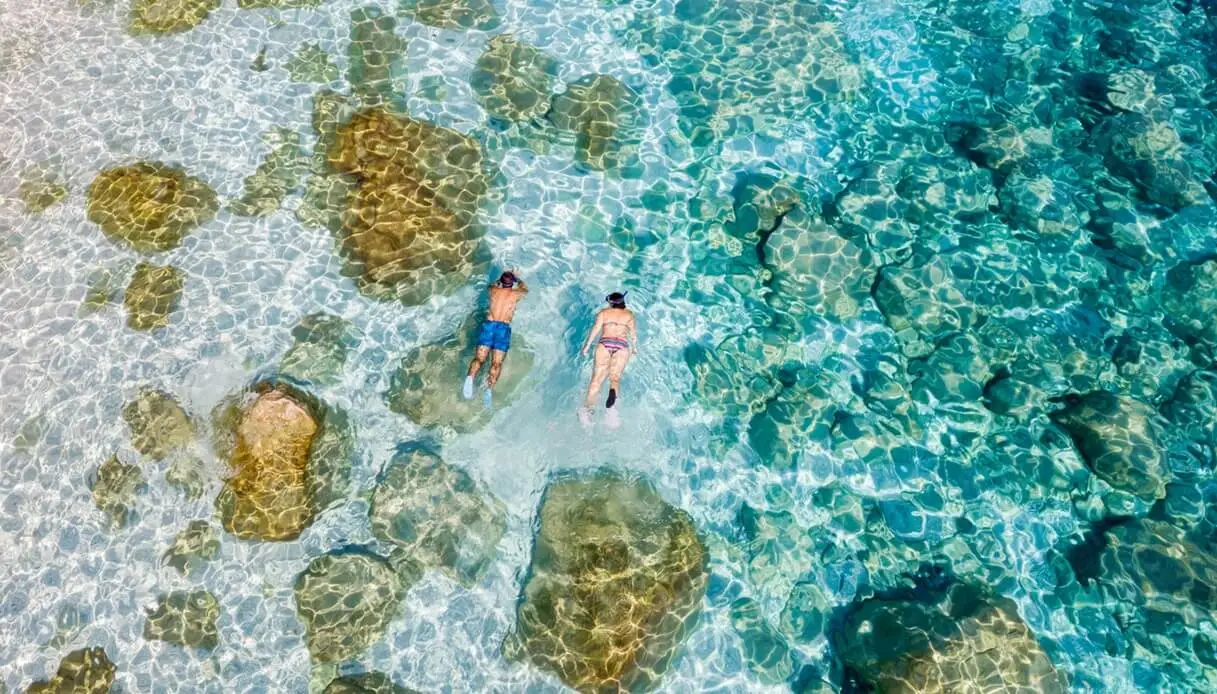
Mask, snorkel, and fins for the hardcore enthusiasts. Then a plunge into the blue and you embark on a journey to discover the magical underwater world, among posidonia meadows that host schools of occhiate and seabreams and reefs where sturdy groupers swim. And, with a bit of luck, you can also encounter aquatic creatures beyond fish, such as a passing loggerhead turtle (Caretta caretta).
Snorkeling is a beloved activity along Italian beaches, especially the rockier and wilder ones, where around the rocks you can encounter a stunning fish fauna. Naturally, there are protected marine areas where this kind of nature experience is enhanced, such as some Marine Protected Areas, i.e., stretches of coast and seabed under protection and regulated with varying degrees of protection, where fishing is limited or prohibited. Here you can immerse yourself in a parallel universe beneath the surface and discover the world below the water, always remembering a few basic conduct rules for a non-invasive experience: do not touch the animals, do not feed them, keep your distance, do not alter the seabed.
Tremiti Islands, Apulia
San Domino, San Nicola, Capraia, Pianosa, and the small islet of Cretaccio form a mosaic of barely 3 square kilometers of land above water: these are the Tremiti Islands, in Apulia, surrounded by a protected area of almost 1,500 hectares and about 20 kilometers of coastline, established over 35 years ago.
The Tremiti waters are among the clearest in the Adriatic and cradle seabeds of great biological value, given the surprisingly varied marine environment considering the archipelago’s small size. Moreover, it is ideal for beginners, thanks to relatively shallow waters.
Bergeggi Island, Liguria
In 2007, Bergeggi Island, a rock rising about 50 meters above sea level between Spotorno and Bergeggi, saw the establishment of a Marine Protected Area.
Today you cannot land on the island, but it remains one of Liguria’s most loved destinations for those who enjoy diving and snorkeling. Swimming along the island’s perimeter, in zones open to bathing, you’ll encounter a wide variety of fish life, thanks to a seabed that is both rocky and sandy, given its proximity to the Ligurian coast (the island lies about 260 meters from the shore, opposite Punta del Maiolo).
Fish, seaweed in a multitude of shapes and colors, crustaceans and sponges, starfish, mollusks, and even a few octopuses are the protagonists of exploration at the foot of this rocky corner of the Ligurian Sea. On Bergeggi Island, which has a long history and ancient remains on its surface, it is not possible to set foot on land, as mentioned, but guided excursions are organized from the sea that reveal all the secrets of the fascinating islet.
Capo Rizzuto, Calabria
The Capo Rizzuto Marine Protected Area, on the Ionian Sea coast of Calabria, is the largest in Italy, and also one of the largest in Europe. It covers, in fact, about 15,000 hectares of sea along a forty-kilometer coastline.
Within the partial protection zone snorkeling is allowed, and here the seabed hosts extensive posidonia meadows and rare species, such as the vividly colored parrotfish. It is one of the few areas in Italy where this peculiar, almost comical species can be spotted.
The splendid Fortress of Le Castella, which sits within the territory of Capo Rizzuto Island, rises grandly on a small islet at the eastern edge of the Gulf of Squillace. It is connected to the mainland only by a narrow strip of land, and right nearby lies the most beautiful area to explore the sea. For those who want to learn more about the ecosystem before diving in, the Capo Rizzuto Marine Environment Education Center hosts a small aquarium with the reserve’s typical species.
Zingaro Reserve, Sicily
A beloved and popular summer destination in Sicily, the Zingaro Reserve sits between Scopello and San Vito Lo Capo on the island’s northwestern coast. Born from a glorious history of popular environmental activism that blocked the construction of a coastal road that would have transformed the landscape into something unrecognizable, this protected area today covers almost 1,700 hectares of land accessible only on foot along seven kilometers of coastline. The trails overlook white and pebbly coves, set between vertical cliffs and lapped by crystal-clear waters.
Between one beach and another, the coastline is entirely rocky, making the Zingaro Reserve a small paradise for snorkeling. Whether visitors reach Tonnarella dell’Uzzo, Cala Capreria, or Cala Marinella—some of the most beautiful spots in the protected area—or approach the coast by boat, they can explore the coves, caves, and rocks that are inhabited by fish of all shapes, sizes, and varieties.
Capo Carbonara, Sardinia
The Capo Carbonara Marine Protected Area spans over 86 square kilometers of sea, from the Capo Boi promontory to Serpentara Island, including the famed Isola dei Cavoli. Established in 1998 to safeguard a largely wild environment, it is today one of Sardinia’s most beloved destinations for snorkeling enthusiasts.
Porto Giunco, Cala Caterina, Cala Pira, Punta Molentis: all ideal zones to snorkel with mask and snorkel and discover a one-of-a-kind environment, with groupers, dentex, parrotfish, and barracuda darting among stunning rocky seabeds and broad beds of posidonia. The underwater scenery is particularly notable for the characteristic, pure white granite rock that continues beneath the surface in hollows and protrusions like natural architecture, teeming with underwater flora. Not to be missed, in this sense, is the Cala Caterina shoal.
Not to mention that, once you surface and remove your mask, the surrounding environment is truly spectacular: crystal-clear sea kisses the white granite, while stubborn vegetation endures the wind and the peculiar soil conditions, adding further contrast with its deep green.