
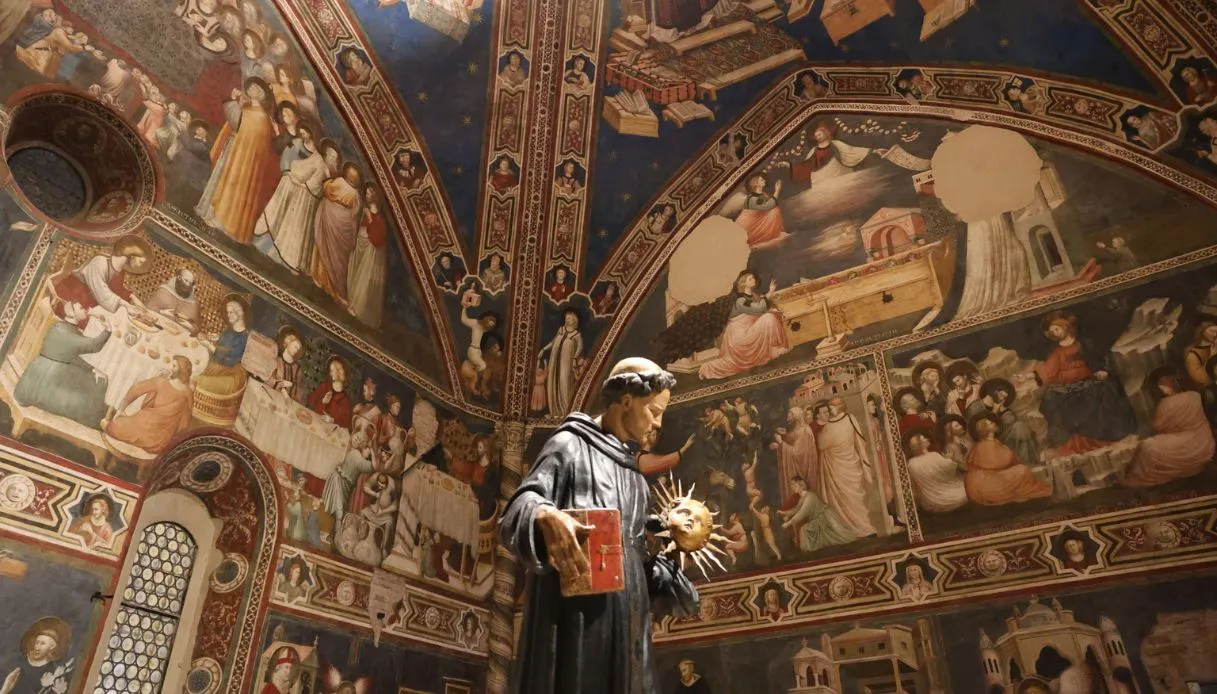
After ten years of closure, the The Cappellone of Saint Nicholas is once again accessible to visitors: we are in Tolentino, in the province of Macerata, where one of the most important cycles of 14th-century frescoes in Italian art has been returned to the faithful and to visitors following a long intervention of consolidation and restoration. The reopening took place on September 10, precisely on the day dedicated to the feast of Saint Nicholas of Tolentino, the saint to whom the monumental space of the basilica is dedicated.
Considered by the Bishop of Macerata and Tolentino, Nazzareno Marconi, as the “Sistine Chapel of the Trecento Marche”, the Cappellone houses one of the largest and best-preserved 14th-century painting complexes in Italy.
A Masterpiece of the Trecento in the Heart of Tolentino
The Cappellone of Saint Nicholas takes its name from Nicola da Tolentino, born in Sant’Angelo in Pontano in 1245 and died in Tolentino in 1305, and in origin it was the chapter house of the Augustinian convent. In the course of the Trecento it was decorated with a grandiose cycle of frescoes in the Giottesque–Rimini school.
According to the most recent critical attributions, the cycle is attributed to Rimini masters led by Pietro da Rimini: the decoration unfolds across the entire space of the chamber, covering the ribbed vault and the walls and constructing an intricate narrative made of images. The scenes weave together the stories of the Virgin, of Christ, and of Saint Nicholas, thereby creating a unitary narration that guides the gaze along the entire chapel.
Above the altar sits the Crucifixion, while at the center of the space lies the fifteenth-century stone reliquary commissioned in 1474. Above the reliquary is placed the polychrome statue of the Saint, attributed to the Florentine sculptor Francesco di Simone Ferrucci.
It is precisely the breadth and quality of the decoration, together with its state of preservation, that make the Cappellone a case of particular significance in the panorama of Italian art. The complex represents, in fact, one of the Trecento painting cycles that are most extensive and best-preserved in the country, with a decorated surface that transforms the entire space into a visual narrative.
The 2016 earthquake and ten years of waiting
The earthquake that struck Central Italy in 2016 also affected the Basilica of Saint Nicholas: various spaces of the building, including the side chapels, were damaged and an elaborate path of consolidation and reconstruction became necessary.
The overall construction project on the Basilica began in April 2024 and involves an intervention worth about €4.5 million, financed with funds from the 2016 earthquake reconstruction. Works have already affected the façade, the bell tower, the roof, and the Chapel of the Blessed Sacrament, while the apse is also nearing completion.
Within this broader program, work on the Cappellone focused in particular on the pictorial program. The objective was to address the condition of the frescoes after the long period following the earthquake, with the removal of temporary protective inserts, the consolidation of detachments, and the restoration of the original chromatic legibility.
The Cappellone’s roof, however, was not affected by the works.
The reopening on Saint Nicholas Day
The choice of September 10 for the reopening carried a special meaning because it coincides with the feast of Saint Nicholas of Tolentino. The Cappellone’s return to the community was accompanied by a ceremony attended by the President of the Marche Region Francesco Acquaroli, the Mayor of Tolentino Mauro Sclavi, and the local civil and religious authorities.
For Acquaroli, the reopening represented a meaningful moment precisely because it occurred during the celebration dedicated to the Saint: the president underscored the symbolic and spiritual value of the place and recalled how, ten years after the earthquake, reconstruction continues to be a duty, a constant challenge, and a responsibility.
Also Guido Castelli, the Extraordinary Commissioner for Reconstruction, highlighted the particular nature of the heritage recovered in Tolentino. The value of a work of art, in fact, cannot be equated with that of a building: a house can be rebuilt, while a lost work cannot be replicated. The Cappellone project thus becomes an exemplar of the work needed to preserve the artistic heritage struck by the earthquake and brings together scientific research and artisanal tradition.