
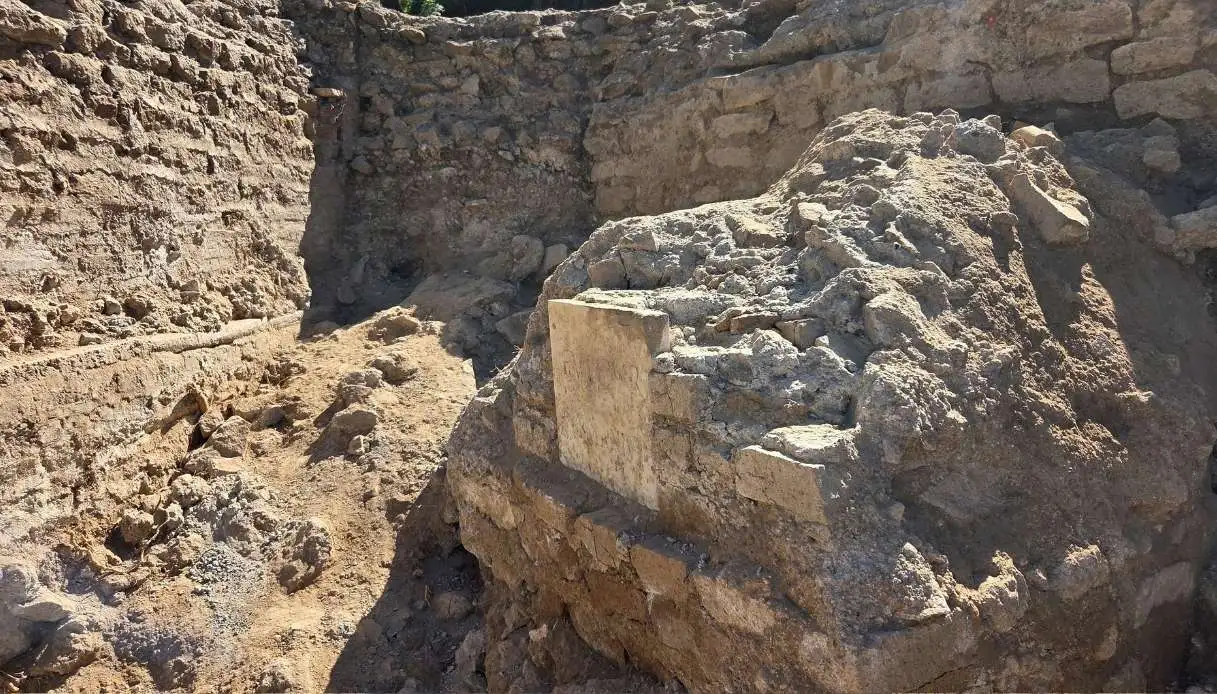
Rome never ceases to astonish; at Villa Adriana, a new archaeological discovery has brought Tivoli back into the spotlight: right here, inside the Amphitheatre, a marble slab emerged bearing the inscription FVLGVR SVBMANIVM, a special reminder of an ancient Roman rite. The inscription points to Summano, a Roman deity associated with nocturnal lightning.
The discovery of the Fulgur Submanium at Villa Adriana
As scholars were conducting excavations in the sector dedicated to the Amphitheatre, a tufa block appeared, stunning everyone. Elements joined with mortar, modest dimensions, and, on the front, a marble slab measuring about 40 by 35 centimeters. It is there that the inscription lies. The capital letters, arranged on two lines, form the formula FVLGVR SVBMANIVM, referring to a nocturnal lightning attributed to Summano. In ancient Rome, indeed, not all lightning belonged symbolically to the same deity. Daylight bolts were generally linked to Jupiter; those at night were instead associated with Summano.
The slab was not found out of place, repurposed into a later wall, or moved over the centuries; it remains embedded in the structure to which it belonged. The hypothesis is that the small building could be connected to a bidental, that is, a place delineated and made sacred after a lightning strike. When a bolt struck the ground, a building, or an object, for the Romans it was not merely a natural phenomenon. The traces touched by the lightning could be collected and buried according to precise rituals. From here the expression fulgur conditum, literally linked to the lightning “deposited” or “buried.”
The significance of the discovery
Villa Adriana is often told through its most spectacular architectures. The Canopus, the Maritime Theatre, the baths, the grand residential complexes. These are the spaces that immediately catch the eye of visitors. The slab unearthed in the Amphitheatre area, however, tells something different because it does not speak directly of imperial power or the grandeur of the buildings. It instead brings inside a religious gesture, in a much more concrete dimension. A lightning strike falls.
The director of the Institute Villa Adriana and Villa d’Este, Alberto Samonà, commented on the news, explaining how the find could shift the gaze from the grand architectures to a deeper understanding of what Roman culture of the era was like; the inscription remaining in its original position offers precious support for scholars who can better comprehend the ritual procedures; the investigations could also have consequences for the overall reading of this part of the villa.
The director of the excavation, Fabio Giorgio Cavallero, stressed that it will be important to study the stratigraphic relationship between the fulgur conditum, the structures identified in the area, and the remains of the palace uncovered during the 2024 excavations. The sequence could help better understand how the sector has changed over time and at which moment the rite linked to the lightning entered the history of this area.
The discovery could provide new elements on the reorganization of the spaces of Villa Adriana in Tivoli, on the different phases of use of the area, and on the weight that religion also carried in the choices related to places and buildings.