
When talking about places to see in Italy, the list seems almost endless. Yet, even for those who know the country well, there are still corners capable of surprising us today. It was The Times who identified a few of them, in a recent article dedicated to Italy, gathering the 30 destinations, attractions, and experiences favored by travel writer Julia Buckley.
A very personal selection that spans the entire peninsula and goes beyond the most famous destinations. Alongside places like the Cinque Terre, Pantelleria and Val d’Orcia appear sites far less known to international tourists, chosen for their history, their landscapes, or their ability to tell a particular facet of Italy. Within the 30 proposals, The Times dedicates a section to the “Seven unmissable sights”, seven attractions considered unmissable.
Miramare Castle, Trieste
It almost seems to rise from the sea, like a fairy-tale castle, the kind you imagine in a Disney movie as the dwelling of Prince Eric in The Little Mermaid. The Miramare Castle was conceived at the request of Archduke Ferdinand Maximilian of Austria, brother of Emperor Franz Joseph, who had a seaside residence built on the Adriatic promontory. Maximilian lived here with his wife Charlotte of Belgium for a relatively brief period, before becoming Emperor of Mexico in 1864.
Banditaccia Necropolis, Cerveteri
Just a few kilometers from Rome lies one of the most fascinating places for those seeking a direct encounter with the Etruscan civilization. It is the Banditaccia Necropolis of Cerveteri, an enormous city of the dead that preserves hundreds of tombs laid out along what feel like actual streets.
The archaeological complex allows a close look at Etruscan funerary architecture: some tombs mimic real homes, with rooms carved into rock and structures that convey how domestic spaces might have been arranged. The site is also part of the UNESCO World Heritage alongside the Necropolis of Tarquinia.
Villa Poppaea, Torre Annunziata
Pompeii and Herculaneum are now essential stops for anyone visiting Campania, but The Times invites readers to venture a little further to reach Oplontis, in the present-day Torre Annunziata. Here stands the monumental Villa Poppaea, a sophisticated Roman residence that tradition attributes to Poppaea Sabina, wife of Nero. The complex is regarded as one of the most important examples of a villa in the Vesuvian area and forms part of the UNESCO site of the archaeological areas of Pompeii, Herculaneum and Torre Annunziata.
Museum of Lunigianese Stele Statues, Pontremoli
In the heart of Lunigiana, in Pontremoli, The Times places a destination decidedly outside the usual tourist routes: the Museum of Lunigianese Stele Statues, housed inside the medieval Castello del Piagnaro. The stele statues are enigmatic anthropomorphic figures carved in stone by the peoples who inhabited Lunigiana from the Neolithic to the Iron Age. The museum preserves numerous original pieces and tells one of the most significant phenomena in European megalthic statuary.
Palazzo Colonna, Rome
In the heart of Rome, just steps from Piazza Venezia, there is a place that may escape even those who have visited the capital many times: Palazzo Colonna. The residence has been tied to the Colonna family since the 13th century, but the interiors accessible today are largely the result of Baroque transformations. What leaves a strong impression is especially the Galleria Colonna, with its richly decorated interiors, marble and gold, frescoes and works of art.
The palace also has a curious cinema connection: it is here that the famous final scene of Roman Holiday—starring Audrey Hepburn and Gregory Peck—was filmed.
Cretto of Burri, Gibellina
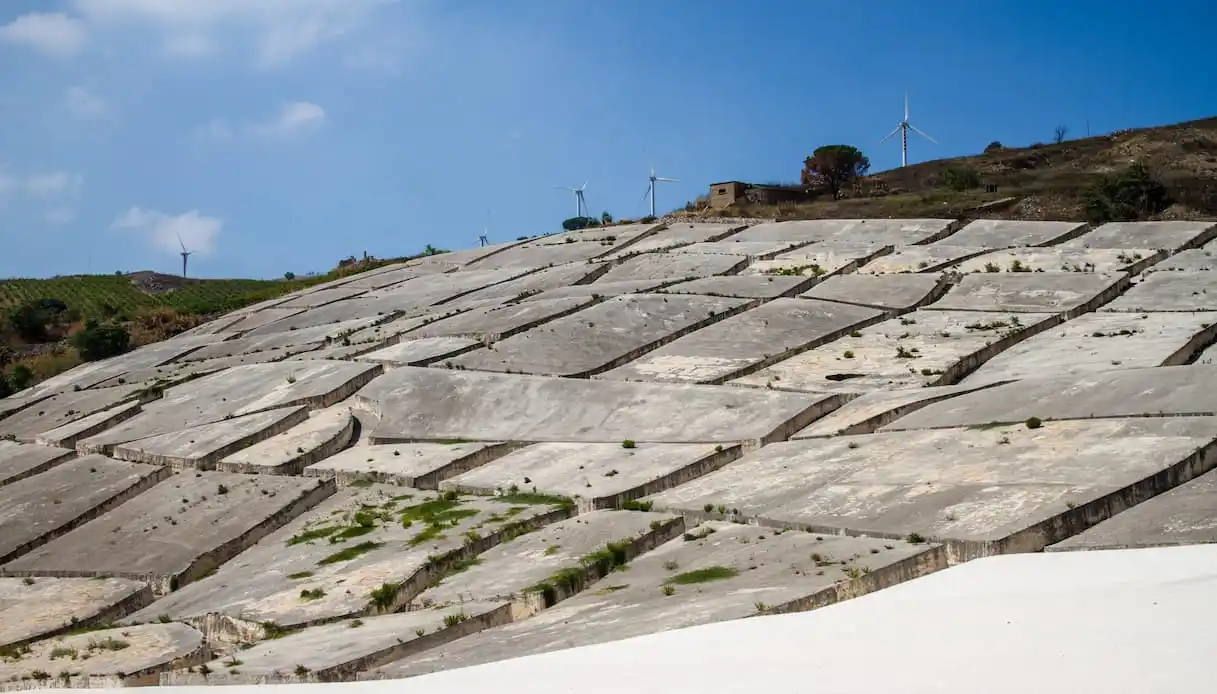
In Sicily, in the territory of Gibellina, the landscape hides a contemporary artwork so immense that at first glance it appears to be a vast concrete plain. This is the Cretto di Burri, created by Alberto Burri on the ruins of the old Gibellina, demolished by the Belice earthquake of 1968. The artist transformed the debris into a colossal land art piece, covering it with a white concrete sheet punctuated by deep cracks that locally recreate the streets of the ancient town.
With about 65,000 square meters, the Cretto stands as one of the largest land art works in the world and, in 2026, gains an even more special meaning: Gibellina becomes the first Italian Capital of Contemporary Art, a designation that has renewed national attention on the relationship between the territory and contemporary art.
Sacred Well of Santa Cristina, Sardinia
The seventh and final wonder takes us to Sardinia, but far from the beaches of the Costa Smeralda. The well dates back approximately 3,000 years and is formed by a perfectly geometric staircase that descends below ground level to reach an underground chamber where a spring wells up. The monument is tied to the water cult of the Nuragic civilization and presents an architectural design characterized by great refinement and plays of light that mark it in certain periods of the year.