
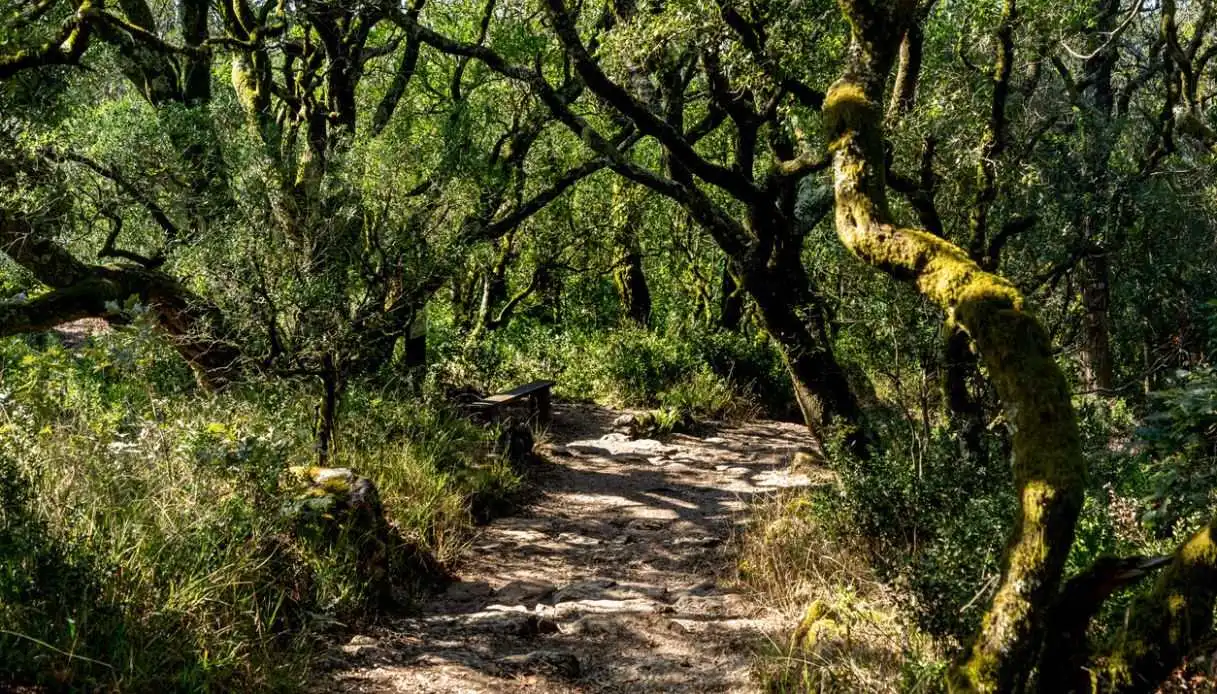
Did you know that in Portugal there exists a forest that can literally make you feel better? The Buçaco National Forest has just been certified as a “healing forest”, the fourth in the world to receive this recognition from the German entity Healing Forest International Certification Office, joining a very exclusive club that so far included only Göttweig Monastery in Austria and two German forests, Lahnstein and Bad Nauheim.
But the beauty of Buçaco is that it already had plenty of reasons to be special before this certification: 105 hectares enclosed by 5 km of walls, more than 250 species of trees brought here by Portuguese navigators, centuries of monastic care, and, hidden among the trees, a royal palace that has today become a luxury hotel.
The Healing Forest: Why It Is Special
Buçaco extends across the parish of Luso, enclosed by a 5 km rampart that houses over 250 species of trees and shrubs, many exotic, brought here by Portuguese navigators during the Age of Discovery. The result is one of the richest dendrological collections in Europe, the product of human stewardship whose roots go back to the VI century, when the monks of the nearby Monastery of Vacariça began tending these lands, later passing to the Discalced Carmelites in 1628.
But what truly distinguishes a “healing forest” from any other woods? The certification requires precise criteria: natural protection from noise and wind, trails with different levels of difficulty, areas dedicated to therapeutic activities, and strict standards of safety and accessibility. All of this is overseen by qualified forest therapists, who guide wellness and rehabilitation pathways, not merely walks in the greenery.
What to See and Do in Buçaco
In the heart of the forest rises a building that seems to have stepped out of a fairy tale: the Palácio do Bussaco, built by the last kings of Portugal as a summer residence and hunting lodge, completed in 1907, just three years before the end of the monarchy. Today it is a luxury hotel in Neo-Manueline style, but even those who do not stay overnight can enter to admire the azulejos and period furnishings, or treat themselves to a lunch beneath the restaurant arches.
Also not to miss are traces of the monastic past: the Discalced Carmelites, who took over the forest’s management in 1628, built here a convent largely demolished to make space for the palace, but whose remains include stone floors, doors and cork-covered ceilings, 16th-century tiled altars, and large religious paintings.
Obviously, along the forest trails you can also practice forest bathing, which consists of consciously immersing yourself in the wooded environment, walking slowly, breathing deeply, and stimulating all the senses with the sounds, scents, and textures of the forest.
Where It Is and How to Get There
Buçaco is located about an hour and twenty minutes south of Porto, not far from the city of Coimbra (30 km) and just 3 km from the spa town of Luso: a location that makes it easily accessible from much of central Portugal. Those departing from Porto or Coimbra can travel by car or take advantage of connections toward Luso, then continue on foot along the paths that wind among the centuries-old trees up to the palace.