
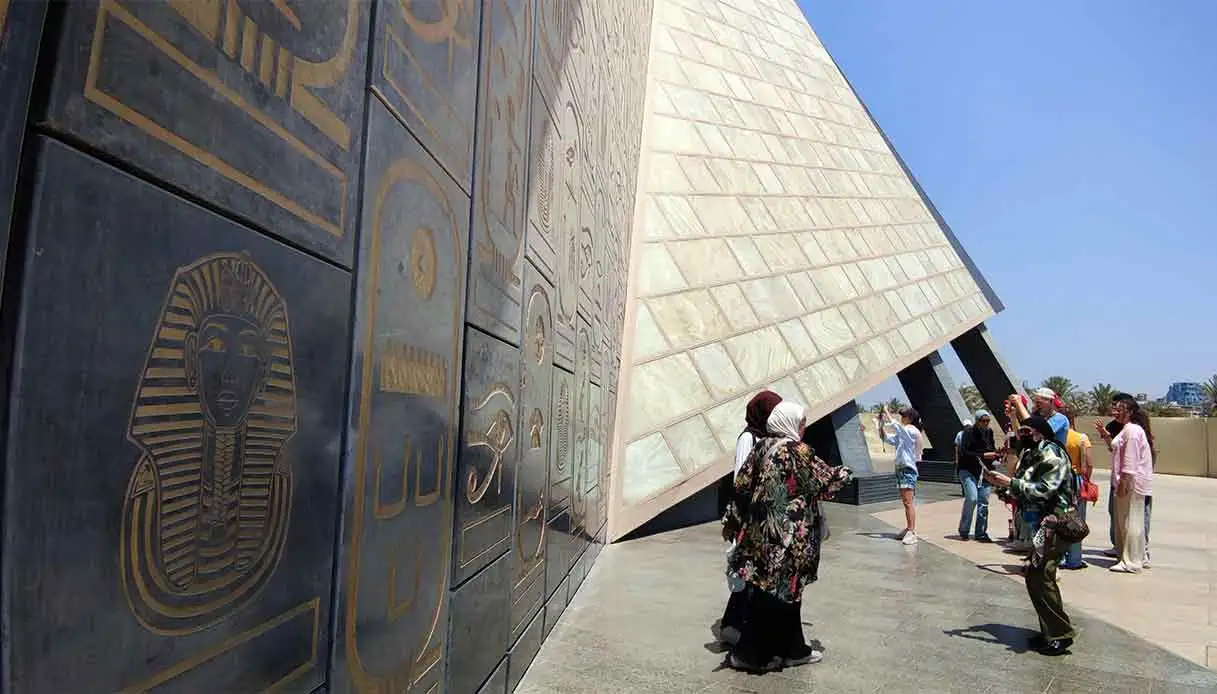
I would describe it as one of the most beautiful museums in the world, not only for what it exhibits (100,000 pieces of rare beauty and historical importance), but also for its spectacular architecture, the location it sits in, the constant symbols that reference Ancient Egypt, and because it was truly conceived to be accessible to all, including children and people with mobility challenges.
I was lucky to visit before the official opening scheduled for November 1, 2025, coinciding with the 103rd anniversary of the discovery of Tutankhamun’s Tomb, in the presence of international political and institutional figures. For this reason, the Egyptian government had to close the Grand Egyptian Museum (GEM) starting October 15 to allow the completion of the final preparations and, above all, the transfer of Tutankhamun’s treasure, which had remained until the last in the “old” Egyptian Museum in Cairo, a place that will continue to house objects from Ancient Egypt, many of which had gathered dust in storage rooms so far for lack of space. And here are my impressions and recommendations for what is not merely a museum visit, but a life experience.
The Grand Egyptian Museum, better known as the GEM, is the largest museum in the world dedicated to a single civilization, that of the Egyptians. It houses artifacts that recount the incredibly rich history of Egypt, from prehistoric times through the Roman era. From the Cairo Museum, the GEM has already received the major objects and the most important mummies (many will remember the famous parade of mummies broadcast around the world during the pandemic), with the exception of Tutankhamun’s treasure, moved only for the grand opening.
[Instagram embed block]
Come visitare il GEM – Grand Egyptian Museum
The Grand Egyptian Museum is colossal, but don’t fear fatigue, for in addition to constantly being impressed at every turn (the “wow” effect is guaranteed), it is also very easy to navigate. There are galleries to visit on the ground floor and on the three upper levels of the museum, totaling 12 galleries. At the moment, 11 galleries are open to the public; the twelfth is dedicated to the treasure of the pharaoh Tutankhamon, which comprises about 5,400 pieces, including the famous gold mask, a symbol of the Egyptian archaeological heritage, and one of the three coffins that contained the mummy (which was found there on November 4, 1922 by British archaeologist Howard Carter in the tomb in the Valley of the Kings), and which will be moved shortly before the official opening to be held in autumn.
The museum hosts permanent collections, temporary exhibitions, and immersive multimedia content. On the ground floor, after the grand entrance with the ticketing area and the security checkpoint, you enter the Grand Hall where the imposing statue of Ramesses II rises to 11 meters, relocated here from the Giza plateau where it had been placed about twenty years ago, itself moved from Ramses Square, where it had stood for decades since its discovery in 1820. This statue is 3,200 years old and weighs 83 tons. And, by itself, it is worth the visit to the GEM.
The museum is organized along a chronological logic. Therefore, on the ground floor are displayed artifacts from the prehistoric period, the Predynastic (3900–3060 BCE), the Old Kingdom (2700–2200 BCE), and the First Intermediate Period (2192–2040 BCE). Here you will find Galleries 1, 2, and 3 respectively dedicated to Society, Kingdoms, and Beliefs.
A monumental staircase, intended to represent the ancient temple processions, leads to the upper floors. The Grand Staircase Gallery is a true gallery in itself, not merely a staircase, flanked by statues of kings and pharaohs, sphinxes, and about 60 artifacts. To ascend to the upper levels there are moving sidewalks and elevators as well.
The GEM’s monumental staircase, beside which there’s a comfortable moving walkway for going up and down
The museum is organized according to a chronological logic. Therefore, on the ground floor are displayed artifacts from the prehistoric period, the Predynastic (3900–3060 BCE), the Old Kingdom (2700–2200 BCE), and the First Intermediate Period (2192–2040 BCE). Here you will find Galleries 1, 2 and 3 respectively dedicated to Society, Kingdoms and Beliefs.
A monumental staircase, intended to represent ancient Egyptian temple processions, leads to the upper floors. The Grand Staircase Gallery is a true gallery in its own right, not merely stairs, flanked by statues of kings and pharaohs, as well as sphinxes and about 60 artifacts. There are moving walkways and elevators to reach the upper levels.
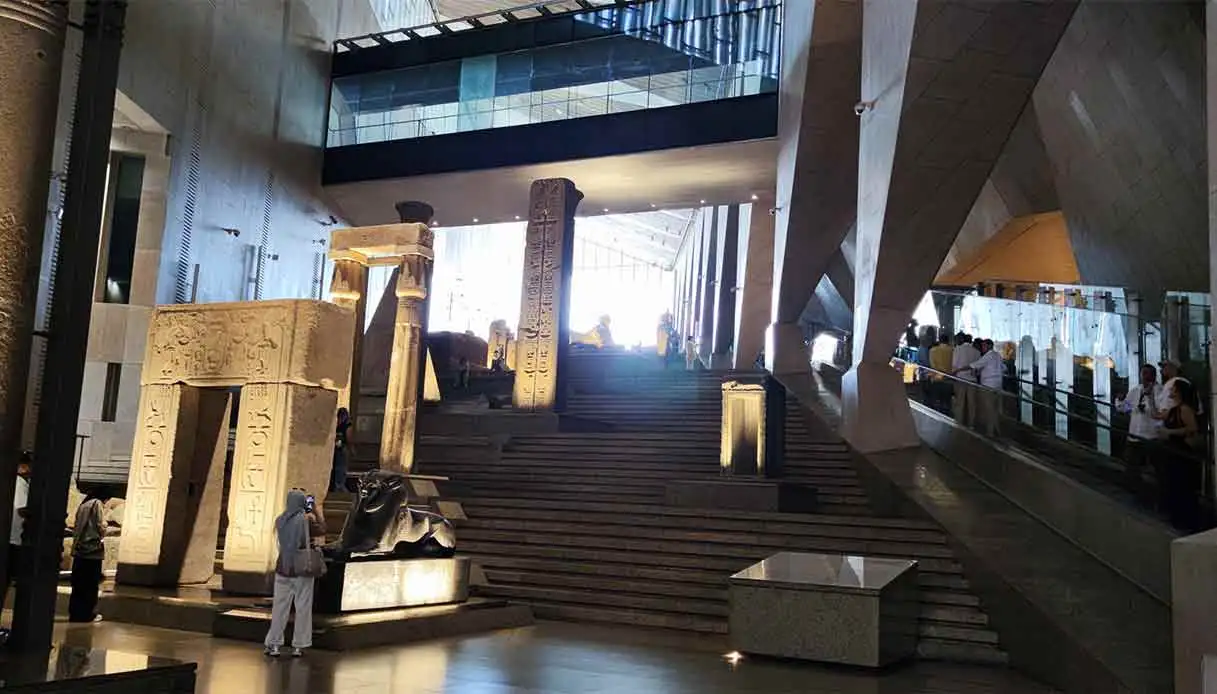 The GEM’s monumental staircase, beside which there’s a comfortable moving walkway to go up and down
On the first floor are Galleries 4, 5, and 6 with artifacts from the Middle Kingdom (2055–1790 BCE) and the Second Intermediate Period (1794–1550 BCE). On the second floor there are Rooms 7, 8, and 9 dedicated to the New Kingdom (1550–1069 BCE), the era of the most famous pharaohs, such as Ramesses II, one of the most renowned and powerful; during his reign Egypt reached a period of great prosperity, military power, and artistic splendor (he was the one who had Abu Simbel built, with the Great Temple and the Small Temple dedicated to Queen Nefertari). On the third floor, finally, Rooms 10, 11, and 12 recount the Third Intermediate Period (1070–656 BCE), the Late Period of Egypt (672–332 BCE), and the Greco-Roman period (332 BCE–641 CE). The museum is surrounded by thematic gardens representing the flora of ancient Egypt. Outdoor exhibitions and shaded paths allow interaction with the desert environment and the nearby pyramids of Giza.
The museum also includes a educational area for children, the Children’s Museum, with interactive sections and exhibits designed specifically for little ones. There is also one of the world’s largest Conservation Centers, with 17 laboratories reserved for scholars. GEM also hosts conference rooms and theatres and, of course, a beautiful shop, a café, and outdoor spaces.
What not to miss at the GEM
The Tutankhamun treasure is the museum’s centerpiece, but the GEM houses, among hundreds of thousands of artifacts, objects of immeasurable value that are definitely worth a visit. In addition to the colossal statue of Ramesses II in the main hall, be sure to see the treasures of Queen Hetepheres I, which include the alabaster sarcophagus, elegant furniture and jewelry, and intimate artifacts that reveal royal lifestyle and craftsmanship; the Solar Boat of Khufu, made of cedar wood, one of the oldest ships in the world, sealed in an airtight chamber near the Great Pyramid of Giza; the Waziri Papyrus, discovered in 2023 in the Saqqara necropolis, a 16-meter-long important manuscript containing some passages from the Egyptian Book of the Dead.
The Tutankhamun Gallery
The area dedicated to the pharaoh Tutankhamun is the last to have opened at the GEM and tells the archaeological story of the tomb’s discovery in 1922 by Howard Carter and his colleagues, funded by Lord Carnarvon, through an exciting exhibition of the “golden king’s” artifacts. Gold is the material of many treasures found in his tomb that are on display here: the famous funerary mask, the gilded throne, the royal diadem, the sarcophagi clad in gold leaf, and many other everyday objects crafted entirely from solid gold.
The Architecture of the GEM
The Grand Egyptian Museum (GEM) is not only a cultural landmark but also a modern architectural marvel that blends ancient symbolism with cutting-edge design. It was designed by the Irish architectural firm Heneghan Peng Architects, with construction beginning in 2005, twenty years ago, right on the Giza plateau opposite the pyramids. The building covers an area of 480,000 square meters. Conceived as an “access gateway to Ancient Egypt,” and already nicknamed the “Temple of the 21st Century,” it is truly an imposing and beautiful edifice.
The constant references to the pyramids run like a thread through this spectacular building, with soaring ceilings and semi-open, ventilated areas featuring triangular motifs that let light and air pass through, in keeping with Middle Eastern architectural style, making the structure sustainable. The long façade, measuring 800 meters, on which gilded hieroglyphs are inscribed on a black alabaster background, also features triangular motifs, just as the walls of the building narrow toward the apex, much like a pyramid. Furthermore, the building is aligned along a visual axis that connects it to the Great Pyramid of Khufu, spiritually and geographically linking it to ancient Giza. One side of the museum is completely glassed, allowing visitors to continually admire the sight of the pyramids of Giza, the only one of the Seven Wonders of the Ancient World still in existence.
On the large external square of the museum, 30,000 square meters in size and located right in front of the main entrance, stands the Hanging Obelisk, an obelisk suspended in the air dating back to the 19th Dynasty and erected by Ramesses II, which was in Sharqiya, in Lower Egypt. It is 16 meters tall and made of granite, weighing 87 tons. The reason for its suspension is to allow GEM visitors to admire the cartouche of Ramesses II at the base of the obelisk, which is only a preview of what awaits visitors once inside this wonderful museum.
How to visit the Grand Egyptian Museum
The GEM is open every day from 8:30 to 9:00, and on Wednesdays and Saturdays it closes at 22:00. The galleries are open from 9:00 to 18:00, while on Saturdays and Wednesdays they close at 21:00. Access is allowed up to one hour before closing.
How much are Grand Egyptian Museum tickets
Tickets to visit the GEM can be purchased exclusively on the Grand Egyptian Museum website or directly at the museum’s box office. The full-price ticket costs about 22.50 euros, children aged 6 to 12 and students aged 13 to 25 pay about 10.80 euros. Guided 90-minute tours are also offered at a higher price (30 euros for adults, half for youths); reservations must be made online, although most groups visiting Egypt already have their own guide accompanying them throughout the tour. For those who decide to come to Cairo on their own—a city that absolutely deserves a long weekend any time of year—this option is also available. Outside the museum there is free parking.
The Grand Egyptian Museum, of course, is the prelude to the Giza Plateau, which you can visit before or after the pyramids of Khufu, Khafre, and Menkaure and the Sphinx. I don’t know which of the two experiences is more exciting.