
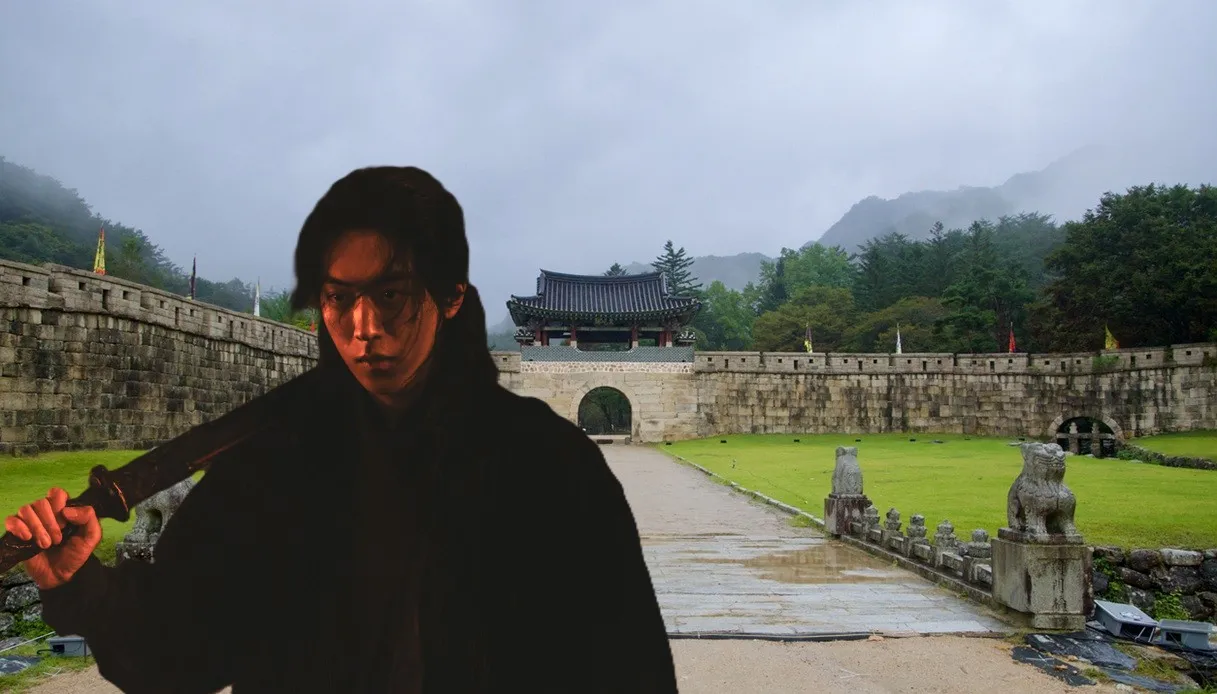
The new Korean drama series coming to Netflix on July 17, 2026 blends mystery, action, history, legends, and South Korea’s traditions: from nature parks to buildings with a distinctive style, we discover together the locations of “The East Palace” (Donggung in the original version).
What it’s about
A sinister presence lingers in the palace of the crown prince: to learn more, the king turns to Gu-cheon (Nam Joo-hyuk) and Saeng-gang (Roh Yoon-seo), the protagonists of the series written by Kwon So-ra and Seo Jae-won and directed by Choi Jung-kyu.
He is a famous ghost catcher because he can transform into a spirit yet keep control over the sword with which he can kill them. She is a court lady who can communicate with the afterlife, hearing its voices and speaking with the dead. Together they manage to unveil the dark secret that shrouds the Royal Palace.
Where the series was filmed
For this dark fantasy in a Korean vein, the production opted for a blend of real settings—indeed visitable for fans of set-jetting, i.e., trips to filming locations—and studio-shot scenes, aided by special effects and CGI. The actual locations of The East Palace exist entirely in South Korea.
Seoraksan National Park
Before being summoned by the king for the show’s special mission, Gu-cheon lived in isolation in the wild: the scenes depicting this period of his life were shot inside Seoraksan National Park. This national park sits in the central-western region of South Korea and has repeatedly been proposed by the government as UNESCO World Heritage: spanning more than 160 square kilometers, it guards a range of natural, scenic, historical, artistic and cultural attractions of priceless value.
The park is, above all, noted for its strong biodiversity. Within its boundaries one can observe a wide array of plant species: from oaks to Siberian pine, including rare species like Hanabusaya asiatica (a flowering plant in the Campanulaceae family). The fauna is abundant as well: flying squirrels and Chinese goshawks populate the park alongside endangered species such as Tristram’s woodpecker and the Korean goral. Seoraksan National Park is well frequented, in every season, by nature lovers and by anyone seeking to reconnect with the natural world. Numerous trails of varying difficulty suit many types of hikers, making it an ideal spot for trekking.
One should not miss a hike near the Ulsanbawi Rock: one of the park’s most iconic granite peaks, easily recognizable in The East Palace’s shots thanks to its five summits. Standing at over 870 meters above sea level, it is not the highest peak in Seoraksan National Park, but it offers an unparalleled view of the East Sea where you can witness the sunrise at dawn.
The Biryong Falls and especially the Towangseong Falls, a spectacular three-tier system rising over 300 meters, are among the other must-see attractions within Seoraksan.
The Sinheungsa Temple is also a haven of peace and quiet where you can get a taste of the core principles of Korean Buddhism. Founded in 652, the temple has had a fluctuating fortune with the pagoda and the other main buildings having been destroyed at least once by fire. Today it is best known for housing the world’s largest bronze Buddha statue, taller than 14 meters: the Great Buddha of Unification.
Other locations
The original title and the numerous scenes set in buildings reminiscent of Joseon-era architecture fueled the suspicion that The East Palace might also feature locations like the Donggung Palace and Wolji Pond. However, the historic site in the city of Gyeongju is not among the places where Netflix’s new k-drama was filmed.
The scenes in question, which show the protagonists inside the haunted royal palace, were shot at the Mungyeong Saejae Open Set: one of the most-used studios for Korean dramas, especially those set in historical times.