
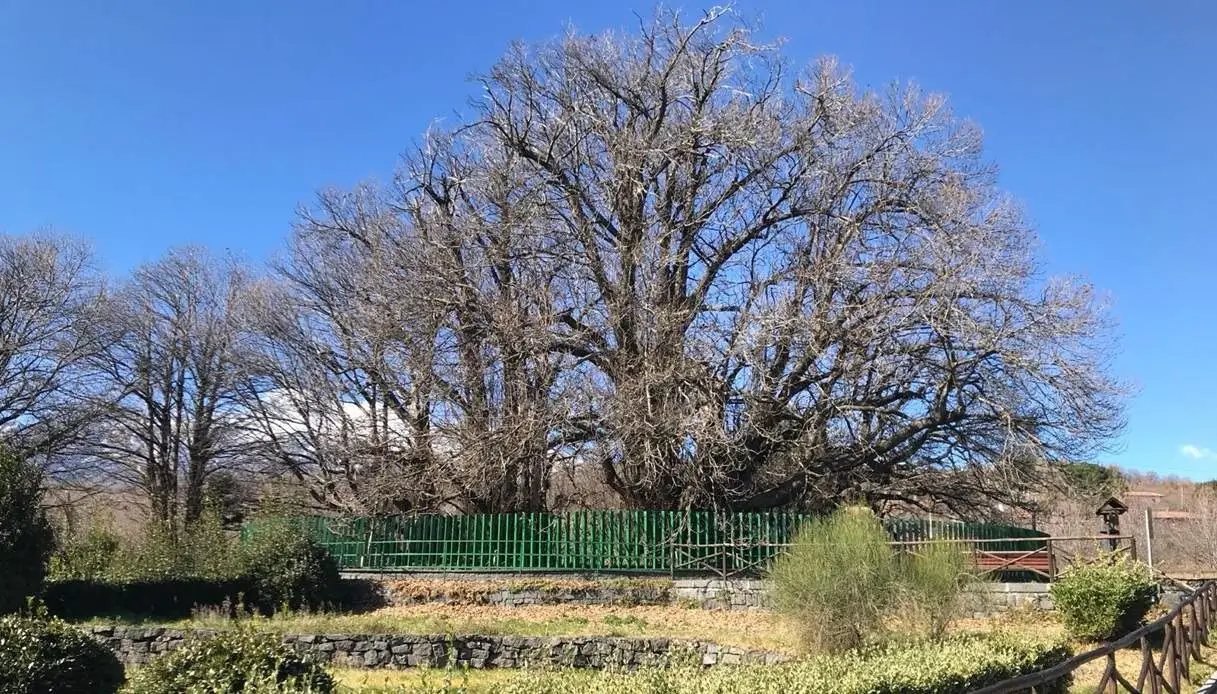
There are monuments that do not need walls, columns, or foundations to span centuries. They grow slowly, season after season, and become part of (or even protagonists in) the history of a territory. One of them is certainly the Castagno dei Cento Cavalli, an extraordinary millennial tree that lives at the foot of Etna, in Sicily, and that now has also claimed an important world record: with a circumference of 52.4 meters, it officially entered the Guinness World Records as the living tree with the largest circumference among multi-trunk specimens.
A record that brings back under international spotlight one of Italy’s most extraordinary green patriarchs, which is thought to possibly date back before the Roman Empire.
The Castagno dei Cento Cavalli conquers the Guinness World Records
The recognition was announced in the final days of November 2026 by the international organization to the working group that followed the candidacy, promoted by journalist and Etna expert Turi Caggegi together with Favazza Etna Winery and with the collaboration of the Comune di Sant’Alfio.
The official measurements were taken on March 29, 2026 by professors Tommaso La Mantia, of the University of Palermo, and Pietro Minissale, of the University of Catania. The tape was wrapped around the entire arboreal complex, recording an external circumference of 52.4 meters. The three main trunks measure 21.7, 11.8 and 21.4 meters.
To secure the record and thus enter the Guinness World Records, it was necessary to demonstrate that it was one single tree and not multiple specimens grown close to one another. The confirmation arrived thanks to genetic analyses: the three trunks share the same DNA and originate from a single seed.
A green giant that could be 3,000 years old
Its dimensions are not the only extraordinary feature of this chestnut. Its age is equally astonishing: experts estimate it was born at least 2,268 years ago, but some scientific hypotheses suggest it could have surpassed 3,000 years. If confirmed, this dating would make it one of the candidates for the oldest chestnut tree in the world.
The first written testimony of a large chestnut tree in this place dates back to 1594. Over the centuries, the tree has undergone transformations due to vandalism, volcanic activity, diseases, and parasites. By the end of the eighteenth century, when its structure was still more intact, it was attributed a circumference of 57.9 meters, larger than today.
The Legend of the Hundred Knights and the Chestnut Tree’s History
The name Castagno dei Cento Cavalieri originates from an ancient legend: it is said that a queen, surprised by a thunderstorm during a hunting expedition on Etna, found shelter beneath its enormous crown together with a hundred knights and ladies. The various versions identify the sovereign as Joanna I of Naples, Joanna of Aragon, or Isabella of England.
The chestnut tree was celebrated by Grand Tour travelers, including the French painter Jean-Pierre Houël, who depicted it in a work from 1782, and Goethe. As early as 1745, a Bourbon edict ordered its protection from cuts. In 1965 it was declared a National Monument, and in 2006 UNESCO recognized it as Monumento Messaggero di Pace (Messenger of Peace Monument).
Where the Castagno dei Cento Cavalli is and how to reach it
To admire this giant of nature up close, you need to reach Sant’Alfio, a small municipality in the province of Catania, on the eastern slopes of Etna. The Castagno dei Cento Cavalieri is located in the Carpineto forest, at via Castagno 100 Cavalli 5, about 2.5 kilometers from the village center.
The easiest way to reach the tree area is by car, following signs for Sant’Alfio and, once you reach the town, the tourist signage that leads to the chestnut. From Catania you can reach the site taking roads that rise toward the volcano’s eastern slopes. The area is free to visit and, according to information published by the Municipality, it is open all year round.