
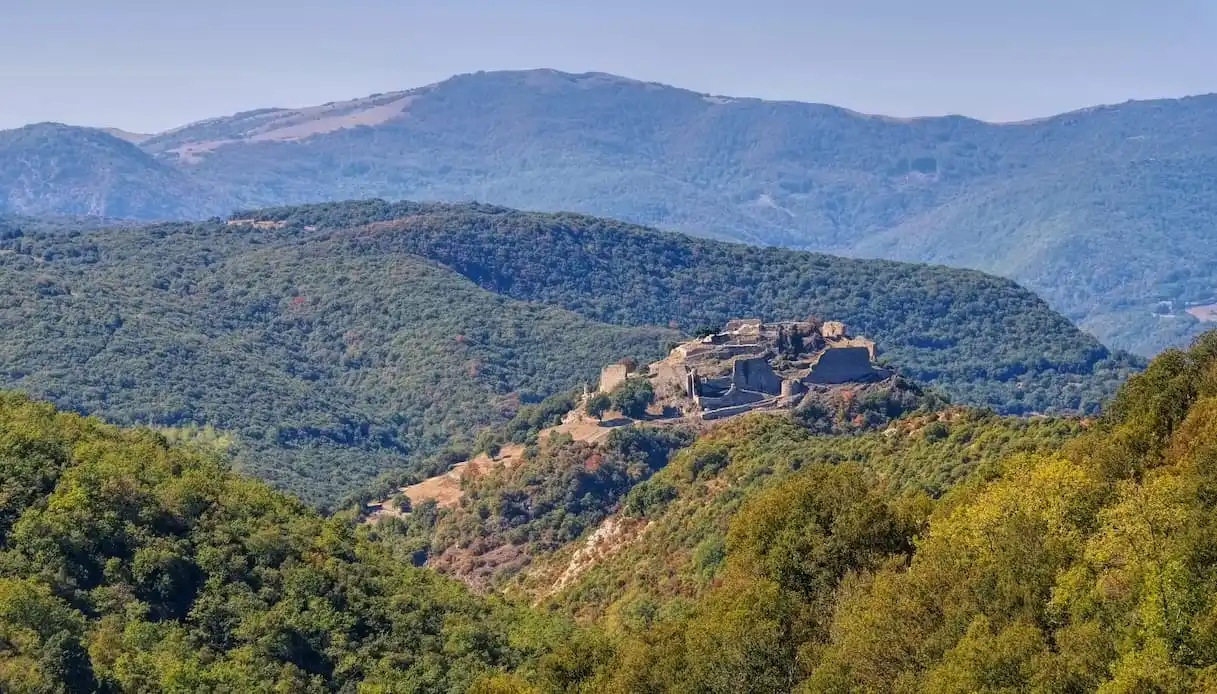
Some castles today are well-known and visited year-round because of their sumptuous furnishings and rooms that remain intact, while others are known mainly for the extraordinary nature and the landscape surrounding them. This is also the case of Termes Castle, perched at 460 metres of altitude in the south of France, where the ruins of an ancient fortress rise from the rock right above the Termenet Gorge. It is here, among the Hautes-Corbières mountains, that the Middle Ages left its mark: the castle was indeed the site of one of the most famous sieges of the Albigensian Crusade and is also considered one of the “five sons of Carcassonne”, that is, the group of strategic strongholds that at the time defended the kingdom.
Today, however, Termes is very different from the fortress that dominated these mountains in the 13th century: its ruins have been the subject of excavations and restorations and allow us to reconstruct, step by step, the history of a place that passed from a noble stronghold to a French royal fortress. Since 2026, moreover, the site has been part of the Forteresses royales capétiennes du Languedoc, listed on the UNESCO World Heritage list together with seven other fortified sites in the region.
Termes Castle: History and What to See
The origins of Termes Castle date back at least to the X century. Built on a rocky spur, the site controlled a strategic position in the Corbières and became the center of the Termes lordship. The most famous chapter of its history arrived in 1210, during the Crusade against the Cathars. The castle, then in the hands of Raimond de Termes, was besieged by the army of Simon de Montfort. The resistance lasted almost four months, ensuring that Termes entered posterity as one of the most intense and well-known episodes of the military campaign against fortresses tied to local lords and Catharism.
After the conquest, the castle gradually fell under the dominion of the French Crown. In the 13th century it was fortified and transformed into a royal fortress, inserted into the defensive system that protected the new French territory from incursions coming from the Kingdom of Aragon. Its military function, however, had a definitive end in the 17th century. In 1653-1654, by order of the Crown, the fortress was demolished to prevent its reuse by rebels after the Fronde. Since then the castle has remained in ruins, but it is precisely this condition that today makes it easier to read the stratification of its history.
During the current visit, what is explored are the remains of the castrum and of the royal fortress, among walls, defensive structures, the main tower and spaces of the ancient noble complex. The visit begins already in the small village of Termes, where the interpretation center, the introductory film, and the exhibition devoted to the 1210 siege are located.
From the village you then need to continue on foot for about 15 minutes along the path that leads to the fortress. The visit generally lasts about one hour to an hour and a half, also considering the interpretation spaces and the route to the castle.
Where Termes Castle is Located and How to Get There
Termes Castle is located in the commune of Termes, in the Aude department, in the Occitanie region of France. The village is about 50 kilometers from Carcassonne and lies among the Corbières, in an area characterized by mountains, gorges and small villages.
The location is also interesting for building a broader itinerary to discover the Cathar castles and medieval fortifications of the Aude. To reach Termes, the most practical option is a car, especially if you are arriving from Carcassonne, Narbonne or Perpignan. The village is small and has a free and mandatory parking for visitors. From the parking you reach the welcome center following the signs along the watercourse.
For those planning the visit in 2026, the castle is open every day in July and August, from 10:00 to 19:30, while in September and October the opening hours are from 10:00 to 18:00. In November access is available on weekends and holidays until November 11, with further openings according to the calendar.
The 2026 ticket costs 6 euros for adults, 5 euros for youths aged 16 to 25 and 3 euros for children aged 6 to 15; children under 6 enter free. There is also a 3-euro ticket to visit exclusively the film and the exhibition at the interpretation center.