
In the rugged landscape of southwestern Sardinia, between the Iglesiente and the Costa Verde, there is a mountain that hides an incredibly captivating story. We are talking about Su Mannau, a place that seems to belong to another dimension: the green of the vegetation, the ancient rocks, and the fresh air that streams from the cavity prepare the visitor for a journey unlike any other, destined to unfold beneath the surface.
The Su Mannau Caves are located in the Fluminimaggiore area and extend for almost 9 km inside a limestone massif. A true underground universe, then, made up of monumental halls, small lakes, cascades, stalactites, stalagmites, aragonites and calcite sheet formations. Concretions that, among other things, continue to change thanks to the presence of water, making Su Mannau a cave still active in natural terms.
The most surprising feature, however, arises from human history: even before becoming a destination for speleologists and visitors, the cavity was frequented for ritual purposes. The first chamber is in fact a true hypogeal temple, used since the pre-Nuragic era and later in Nuragic, Punic and Roman times. Votive lamps and model boats testify to the ancient water cult, creating an unusual link between archaeology and the subterranean landscape.
Origin, Formation and Legends of the Su Mannau Caves
This mysterious karst complex in Sardinia was shaped by two watercourses that run through the region’s depths, the Placido and the Rapido, responsible for the formation of the two large branches that cross the mountain. The Placido branch lies to the left and is the one intended for tourist visits. The Rapido occupies the larger branch, characterized by a predominantly semi-horizontal development and by environments mainly intended for caving, with specialized equipment.
Underground the rock shows a true succession of epochs. Some environments belong to older, fossilized levels, while others still preserve the passage of water. One of the most representative environments is the Rodriguez Hall, linked to the first cave explorations. Paolo Rodriguez was among the first explorers of the cave in the 1930s and mapped its early routes. His name has remained associated with also the great shaft that constitutes one of the most spectacular points along the path.
Nature has then added a remarkable palette: concretions take on different tones due to the presence and oxidation of minerals such as iron, manganese, copper, and zinc. Depending on the environment, one encounters white surfaces, reddish hues, sparkling crystals, and irregularly shaped flowstones.
Among the most singular creatures lives the Stenasellus nuragicus, a tiny endemically cavernicolous crustacean. The elongated, pigment-free body is an adaptation to life in the dark. Its presence helps make Su Mannau a distinctive ecosystem even from a biological standpoint.
Beside it you can find the geotriton, an amphibian tied to humid underground environments, and the greater horseshoe bat, a cavern-dwelling bat recognizable by the characteristic horseshoe-shaped structure on its head.
On the side of legends, one must refer to the ritual dimension of the cave, connected to the presence of the Earth Mother and the water cult. Remains of oil lamps and votive ships are witnesses of religious practices carried out inside the heart of the mountain. More than a tradition passed down, it emerges as a concrete archaeological testimony capable of restoring the spiritual atmosphere attributed to water by ancient communities.
Visiting the Su Mannau Caves
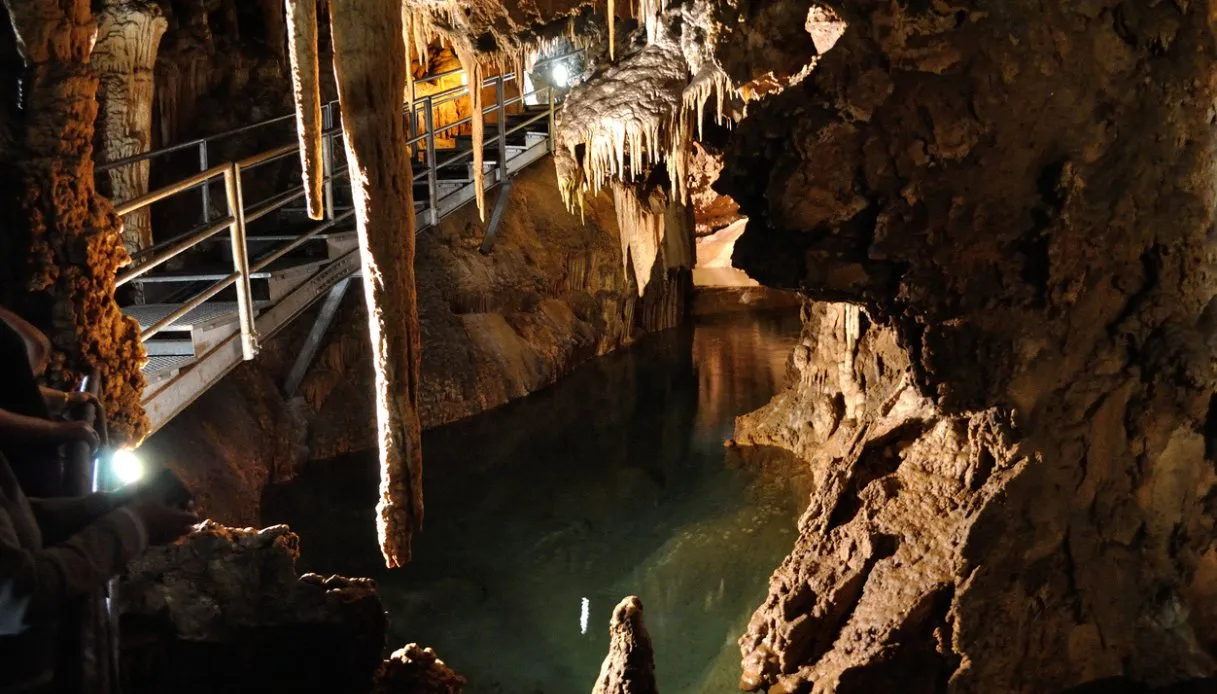
The tourist route measures about 500 meters and takes roughly 1 hour, up to 1 hour and 10 minutes, to complete, but only and always accompanied by guides. Access starts from the archaeological hall, a special space even before entering the real cavity. An opening leads to the Central Hall, an imposing environment crossed by a large walkway. From this point the landscape changes quickly, with water appearing among the rocks, until reaching small waterfalls and underground lakes.
Archaeological Hall
The journey begins in the large environment used as a sacred place. The small lake associated with the Earth Mother and the votive artifacts make this hall different from the classic tourist caves. Here the rock also tells of human presence and the religious function attributed to water.
Central Hall and the Stenasellus Lake
The walkway allows you to pass beyond the Central Hall and reach the Lago degli Stenasellus. It is precisely in these waters that the small endemic crustacean, whose scientific name is Stenasellus nuragicus, lives.
Along the route, concretions, small cascades, and surfaces shaped by water appear. The sound of dripping accompanies the visit and makes the still-active nature of the complex perceptible.
Puddu Gallery
The journey continues toward the Puddu Gallery flowstone, then enters a fossil zone of the cavern. Stalactites and other concretions show an older phase of the underground system, belonging to a period when water followed different paths.
Rodriguez Well
The Rodriguez Well represents one of the most scenographic points: it is a cavity that reaches a depth of about 23 meters and at the center features a column almost 7 meters tall.
The formation was born from the union of a stalactite with a stalagmite, transformed over time into a single large calcite pillar. A viewpoint located about 20 meters high allows viewing the hall from above, while a staircase leads downward.
From this zone, additional branches depart, including fossil environments and routes linked to the Placido River. The deeper sections, however, belong to the speleological itineraries and require preparation and equipment.
Where they are located and how to reach them
The Su Mannau Caves lie in the municipal territory of Fluminimaggiore, in the province of South Sardinia, in that part of the island known as the Iglesiente. The site is about 20 km from the western coast, in an area marked by the presence of ancient mines and the proximity of the Costa Verde.
To reach the entrance by car, follow the SS 126 and take the road toward the caves. Parking is at the site, with the ticket office in the access area. From there a short stretch leads to the cave entrance.
An interesting option concerns the surrounding territory: an ancient Roman road connects the area to the Temple of Antas, an important archaeological site nearby. The route takes about 1 hour and allows combining the underground visit with a landscape itinerary in the area.
Before departure it is advisable to contact the visitor center to check opening times. In winter, in fact, the cave may be closed to the public to favor natural processes linked to the internal microclimate.