
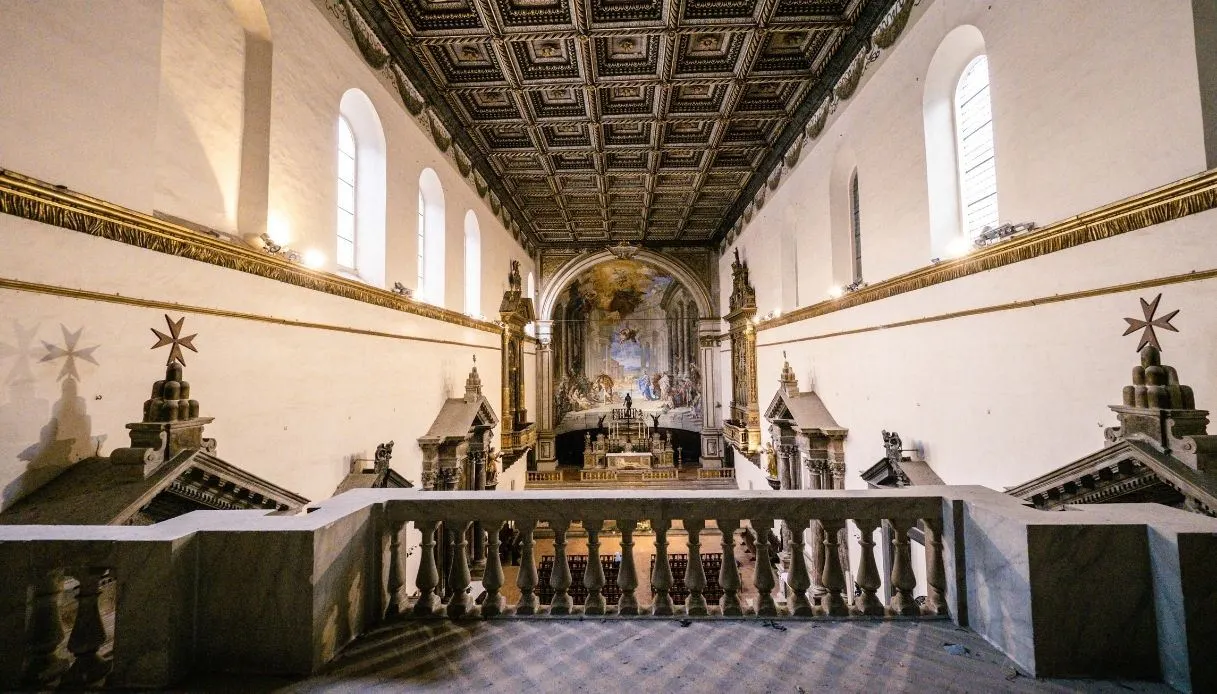
In the levels that slope down from Piazza del Duomo to the valley behind, where for centuries the sick and pilgrims found care and shelter, there remain 18,000 square meters that have never been seen before.
The Santa Maria della Scala, considered among the oldest hospitals in Europe, ceased to fulfill its function in 1990, transforming into a museum. But much of its most authentic history has remained locked behind doors that no visitor has ever crossed.
Starting in September, however, for the first time, the doors of this hidden treasure will be opened to the public.
Inside Santa Maria della Scala: spaces never seen before
On September 10, begins “A porte chiuse. Dentro il Santa Maria della Scala”, a cycle of visits that opens for the first time the spaces previously excluded from the museum route precisely because they were destined for future restoration. The construction site, instead of keeping visitors out, becomes the opportunity to let them in.
They are spaces that still preserve tangible traces of the hospital life of a time, before the Masterplan signed by three international architecture firms (LAN Architecture, Odile Decq and Hannes Peer) redefined their functions and purpose.
For the mayor of Siena, crossing these environments today means above all reclaiming a shared memory: rooms and corridors tell centuries of hospitality, work and faith, even before becoming the new cultural spaces imagined for tomorrow.
How to participate in the visits
The first appointment is set for September 10, then the calendar continues every Tuesday and Thursday until October 29, 2026. Access is possible only by email reservation and for a maximum of 10 adult participants, a choice that makes each visit a controlled and more like an incursion than an ordinary museum stop. The cost of the visit is 5 euros and closed, comfortable shoes and a protective helmet (provided on site) are mandatory.
Participants will move through a setting very different from the routes already open to the public, from the pilgrim cloister frescoed by Lorenzo di Pietro to the rooms that today host the National Archaeological Museum. Here, instead, the itinerary winds through rough, still-to-be-restored spaces where the stratifications of nearly a thousand years of history are legible: from the original functions tied to the Via Francigena to the transformations that, almost half a century ago, led to Guido Canali’s project that marked the transition from hospital to museum.
The route promises some unique viewpoints: the bifores of the Rector’s Palace will offer an unprecedented view of the Cathedral, while the Santissima Annunziata can be admired from above, from an angle usually off-limits to visitors.
There will also be the small window from which the nuns observed the functions unseen, along with the spaces that once housed patients and a sixteenth-century staircase that climbs toward grand halls still to be restored. The path then traverses historic wooden structures, passages still marked by the construction site and viewpoints opening onto the valley of the Fosso di Sant’Ansano, a landscape counterpoint to the architectural density of the interiors.
It is a preview, more than a classical visit: a way to observe up close what it means to restore a living heritage and to understand, before the construction sites take shape, what face the Santa Maria della Scala of the future will wear.