
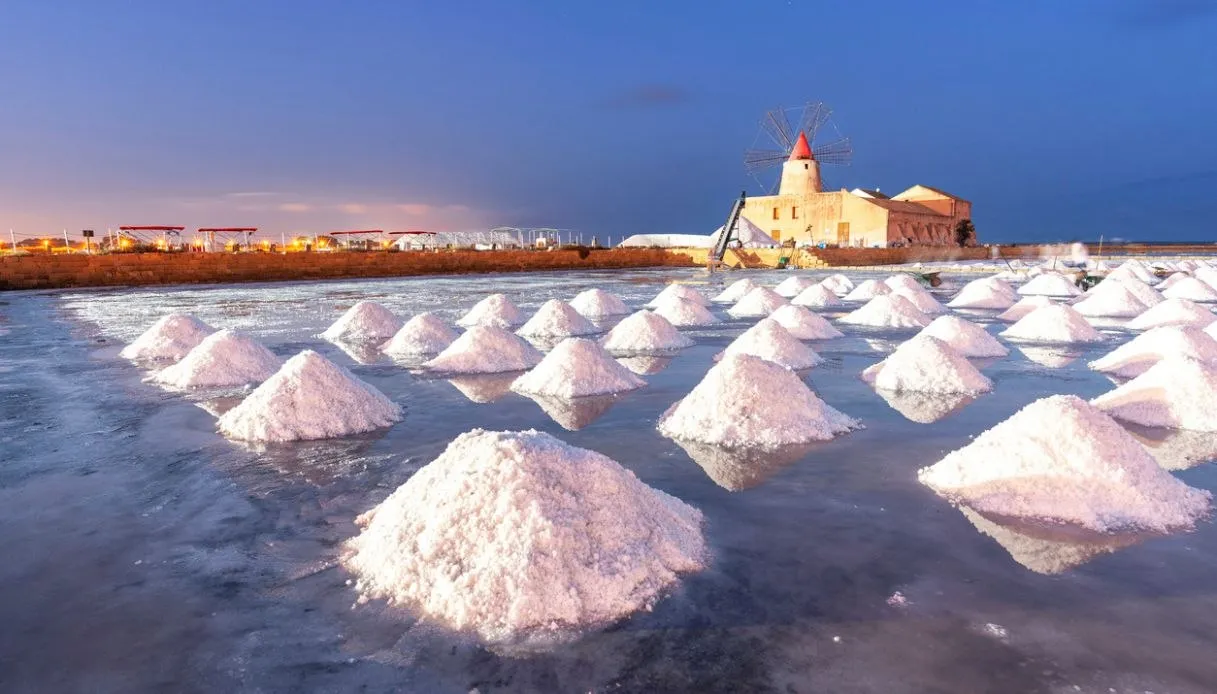
There is a landscape in Sicily, drawn by centuries of human labor and by the wind blowing from the Mediterranean. They are the salt pans that dot the island’s western coast, between Trapani, Marsala, Misiliscemi and Paceco: that mosaic of colored basins, windmills and embankments that today takes a step toward an important international recognition.
The Ministry of the Environment and Energy Security has given the go-ahead for the candidacy of the Saline di Sicilia for inscription in the UNESCO MaB (Man and the Biosphere) Programme, as a Biosphere Reserve. The candidacy, promoted by the Chamber of Commerce of Trapani and advanced by a dedicated committee, will now face the final evaluation in Paris.
If approved, this area would become the first coastal wetland created by humans to receive this title.
A landscape that humans have built together with nature
What makes the Sicilian salt pans special isn’t just their undeniable beauty, especially when flooded by the colors of sunset, when the water turns pink and orange due to salinity and the reflections of the sky. It is the fact that this landscape exists thanks to a balance between human intervention and biodiversity.
The basins, dug and regulated by humans since the Phoenician era and perfected over the centuries, have gradually become a perfect habitat for species that elsewhere struggle to find space: pink flamingos, avocets, cavalieri d’Italia and dozens of other migratory birds find here food and shelter, attracted precisely by the salinity that the salt-making activity keeps alive.
It is a rare case where human production, rather than taking space away from nature, has created new space. The recognition as a Biosphere Reserve would not celebrate a patch of pristine nature, but a model of coexistence between work and the environment that has endured for centuries.
What to do among the salt pans of Trapani, Marsala, Misiliscemi, and Paceco
Beyond the symbolic value of the candidacy, this stretch of coast is already one of the most original experiences that western Sicily can offer, and it’s worth experiencing even before the UNESCO stamp arrives. You can walk or cycle the path along the basins, among the windmills restored to move water and grind salt, now turned into viewpoints and small museums that tell the history of this craft.
The best time to go is late afternoon, when the light brings the colors of the basins to life and increases the chances of spotting pink flamingos feeding along the edges. From here, by boat, you can easily reach the island of Mozia, with its Phoenician ruins facing directly onto the lagoon, another slice of history that interweaves with that of salt.
Those who want to take home something authentic can stop at one of the shops along the road, where you can find the local refined salt, still harvested by hand according to traditional methods. And for those with a few more days, the Egadi Islands are just a short hop away, offering a combination of salt pans with the crystal-clear sea that has made this coast famous.