
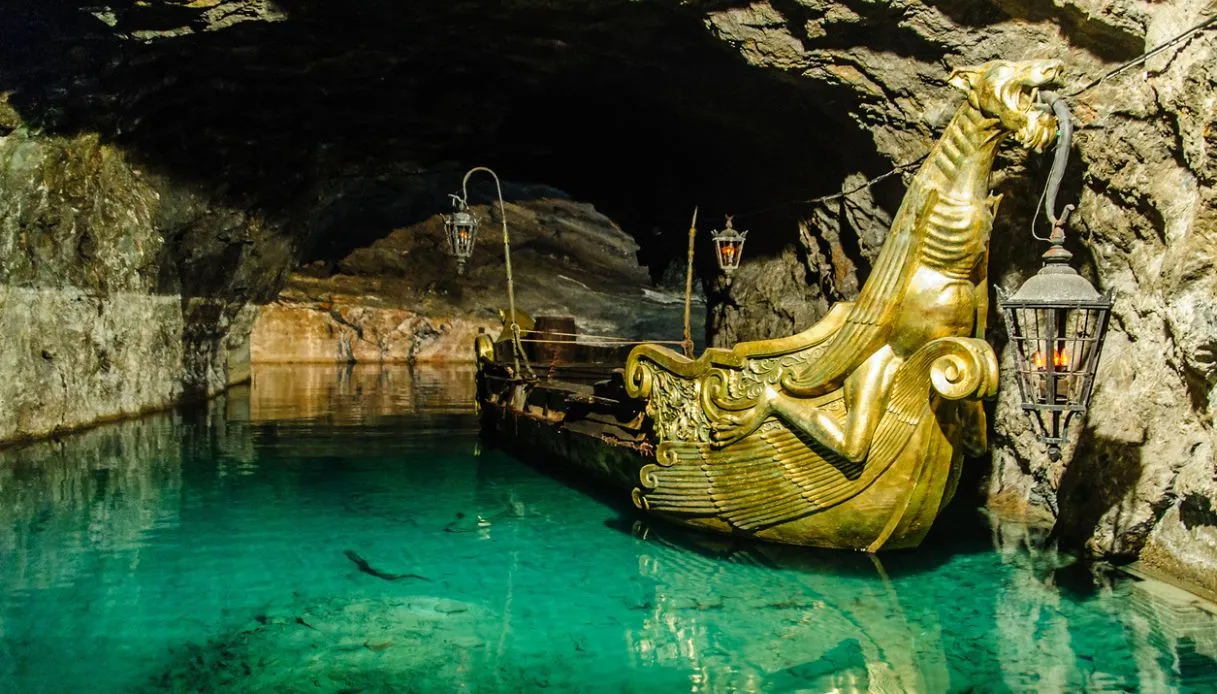
On the surface, life goes on at its usual pace: there are the woods that enrich the surroundings of Vienna, people who commute to work every day, and the everyday life that brings both joys and difficulties. Down below, at a depth of 60 meters, a different world unfolds—a lake of still waters set between towering rock faces and traversed by small boats. Here, time seems to flow differently, measured by the sound of water and by the lights that illuminate the ancient mining galleries.
It is the Seegrotte of Hinterbrühl, regarded as Europe’s largest underground lake, with a surface of about 6,200 square meters. A record that owes its existence to a past that is surprising in some respects: it all began with an industrial accident in 1912. The Seegrotte thus showcases a landscape shaped first by human labor and only later transformed by water.
Today the complex stands as one of the most unusual attractions in the vicinity of Austria’s capital, also because it allows visitors to navigate underground in a setting that still bears the marks of its past.
Origin and History of the Seegrotte
Many years ago the hills around Hinterbrühl were known for their gypsum deposits, a mineral used in a variety of sectors, from construction to agriculture. They were famous already in the 18th century, but never as in 1848, when, during the excavation of a well, a miller discovered a gypsum seam at a depth of about 5 meters. The discovery spurred the start of mining activities, initially aimed chiefly at producing material to improve agricultural soils.
In a few years’ time, an intricate mining system took shape, where workers extracted ore from the walls, progressively widening spaces and creating rooms intended for material transport. Everything changed abruptly in 1912: during a blasting operation, a detonation caused the entry of an enormous amount of water into the subterranean cavities.
Approximately 20 million liters invaded the mining environments, making it impossible to continue the work. It was precisely from that episode that the great lake emerged, today the Seegrotte’s main attraction. The particularly curious fact is that, while it appears completely isolated from the outside world, its balance requires constant intervention. In the absence of a natural drain, at night about 50-60 cubic meters of water are pumped toward the Mödlingbach stream, maintaining a stable level.
The official opening to the public arrived in 1932, with the introduction of a repurposed military pontoon and an electric boat to cross the lake. The success was fairly rapid: by 1937–1938 this corner of Austria welcomed around 50,000 visitors per year.
The Seegrotte’s troubled history does not end there; indeed, it hides a painful chapter of European history. In 1944, during World War II, Nazi authorities requisitioned the complex to transfer part of Heinkel’s aircraft production. The lake was temporarily drained to use the underground spaces to manufacture components and fuselages for the Heinkel He 162 jet fighter.
For these operations, prisoners subjected to forced labor were employed, drawn from the Mauthausen concentration camp system. Near the mine arose the Hinterbrühl subcamp, tragically linked to the inhumane conditions imposed on detainees. In April 1945, during the evacuation of the camp, 52 prisoners unable to flee were assassinated. Others died during the forced march toward Mauthausen.
Today the remains of the industrial installations and the commemorative elements allow visitors to learn about this history. After the war, the Seegrotte gradually returned to its tourist function.
Visiting the Seegrotte Hinterbrühl
Access to the Seegrotte is gained through a passage that gradually leads away from natural light. The visit takes place along a guided route that retraces the main stages of the mining history, up to the lake itself. In the upper part of the complex one passes through gypsum-cut galleries, marked by the 19th-century mining activities.
The walls display irregular surfaces, niches, and side openings that testify to the progress of the work. Particularly interesting is the Santa Barbara chapel, a small place of contemplation that recalls the bond between the dangers of the trade and religious devotion. Santa Barbara, in fact, was the miners’ patron saint.
The most awaited moment arrives, clearly, when you reach the lower level, where a broad expanse of water opens up, surrounded by rock and lit by lights that cast reflections on the walls. Boarding the small boats, visitors have the opportunity to drift slowly, always observing the rock surfaces and the light effects created on the water.
Silence is one of the most distinctive aspects of the experience: voices echo through the underground spaces, while the motion of the boat allows admiring the complex from a perspective entirely different from the footpaths.
To complete the guided route, including the navigation, it typically takes about 45 minutes. The inner temperature remains constant throughout the year (around 9 degrees Celsius), making a jacket and closed shoes with good grip essential. The Seegrotte is open year-round according to its opening calendar, and tickets can be purchased on site.
Location and How to Get There
The Seegrotte is located in Hinterbrühl, a municipality in Lower Austria in the district of Mödling, about 15 kilometers south of Vienna. The area lies within the Wienerwald, the Vienna Woods, a vast region characterized by forests, small towns, and ancient historical landmarks. The exact address is Grutschgasse 2a, 2371 Hinterbrühl.
By car, you reach the town via the road network that links Vienna to the Mödling area, also using the A21 highway depending on your starting point. The drive from the southern part of the capital generally takes 20–30 minutes, with variations due to traffic.
Those who prefer public transport can consider reaching Mödling by train from Vienna and continuing with local buses toward Hinterbrühl. Before departure it is advisable to check updated lines, stops, and connections. The location also allows pairing the excursion with other Lower Austrian destinations, including Mödling, Baden, and Gumpoldskirchen, the latter known for its wine tradition.
