
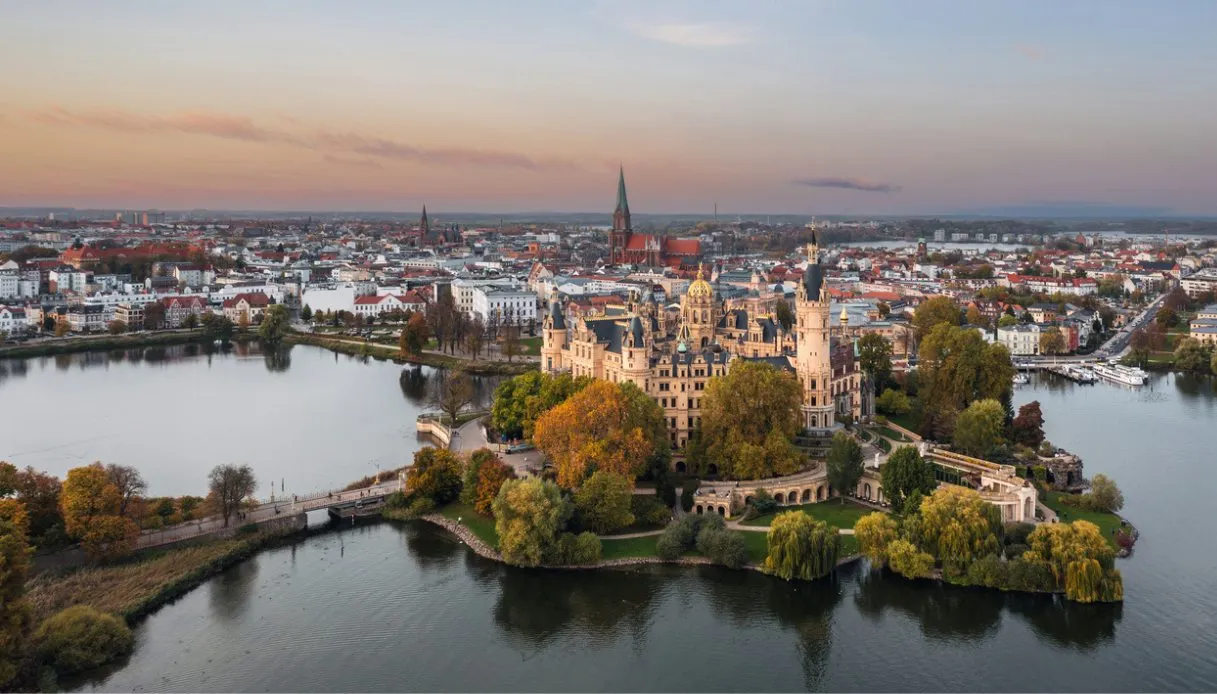
Far from the metropolitan chaos of Berlin and Munich, there is a city where even the landscape itself seems to wear an aristocratic past. We are talking about Schwerin, a place where slender towers, golden domes, cream-colored facades and elegant gardens reflect in the waters of the lakes. And no, it doesn’t end there, because at the heart of this scene lies an extraordinary castle, so elaborate that it looks like the stage set of a fantasy tale.
Schwerin is located in Germany and is the capital of Mecklenburg-Vorpommern, the state facing the Baltic Sea, but the most remarkable thing is that its geography is truly exceptional: the city’s territory includes 12 lakes. Water thus surrounds whole districts, accompanies tree-lined avenues and provides unforeseen perspectives on historic architectures.
Since 2024, among other things, its Residenzensemble Schwerin is a UNESCO World Heritage site. It is the monumental complex tied to the former ducal court, composed of 38 elements including historic palaces, churches, gardens and monumental spaces (with the famous castle at its heart).
What to See in Schwerin
The historical testimonies of this charming German city belong to very different eras, but fortunately its rich heritage has largely remained recognizable.
Schwerin Castle, the Neuschwanstein of the North
Few European buildings possess a setting as dramatic as Schwerin Castle: it rises on an island between the Schweriner See and the Burgsee, connected to the mainland by a bridge. Its silhouette, dominated by turrets, ornate facades and a large golden dome, has earned it the nickname the Neuschwanstein of the North.
Inside its walls follow sumptuous spaces, including the Throne Room, the Ancestors Gallery and the ducal apartments, filled with precious furnishings, porcelain and decorations. Today it also houses the regional parliament (though part of the spaces are accessible through a museum).
Castle Gardens and the Orangerie
Behind the monumental residence unfolds a universe of terraces, sculptures and perspectives designed with meticulous care. The Burggarten embraces the island with winding paths, flowerbeds, an artificial grotto and privileged views over the water.
Particularly fascinating is the Orangerie, an elegant 19th-century structure overlooking the lake, once intended for winter sheltering of the most delicate plants. Beyond the southern bridge then extends the Schlossgarten, characterized by baroque geometries, canals and long avenues.
Schwerin Cathedral, the Giant of Red Brick
Above the roofs of the historic center towers a 117.5-meter-high spire, visible from many points across the city. It belongs to the Schweriner Dom, one of the most important examples of brick Gothic in northern Germany.
The interior houses slender vaults, funerary monuments, a large crucifix and an organ built by the renowned Friedrich Ladegast. A small thing to know, though: to admire Schwerin from above you must climb 220 steps, but we assure you the view is worth it.
Old Town and Marktplatz, the historical heart
On the streets of the Altstadt, the historic center, it almost feels like you have landed in another place: monumental architectures give way to small shops, cafés, half-timbered houses and pastel-colored facades.
The hub is Marktplatz, a historic square dominated by the Rathaus, the neo-Gothic-looking town hall. Not far away appears the Neues Gebäude, an elegant neoclassical building constructed between 1780 and 1783, recognizable by its colonnaded portico.
Curious is the monument dedicated to Henry the Lion, founder of the city, a column topped by the figure of the animal. Attention is also drawn to Buschstraße, a picturesque street that preserves one of Schwerin’s oldest half-timbered houses.
Schelfstadt, the neighborhood with Baroque atmospheres
To the north of the historic center lies Schelfstadt, an old neighborhood with cobbled streets, half-timbered houses, red bricks and restored mansions that lead to Schweinemarkt, a small square characterized by tiny sculptures depicting pigs.
The most important monument is the Schelfkirche St. Nikolai, one of the rare examples of brick Baroque church in western Mecklenburg.
Pfaffenteich, the lake in the heart of the city
It takes only a few minutes from Marktplatz to reach Pfaffenteich, an artificial lake of about 12 hectares surrounded by elegant 19th-century buildings.
In the past it was connected to the activities of the mills and to the city’s hydraulic system, while today it constitutes one of Schwerin’s most pleasant corners. One curiosity is the small ferry Petermännchen, which during the sunny season crosses the basin. Residents jokingly call this short crossing the world’s cheapest cruise.
Schwerin State Museum
Opposite the castle lies the Staatliches Museum Schwerin, housed in an imposing 19th-century building with classical architecture. The collection is particularly appreciated for 17th-century Dutch painting, with works linked to major figures in European art history, among them Rembrandt, Rubens and Frans Hals.
What to Do in Schwerin
The city, as one would expect, also has a more informal soul tied to life on the water, to culinary traditions and to folk tales handed down through generations.
- Join a cruise on the Schweriner See: boats offer seasonal excursions along the lake shores, providing a privileged perspective of the castle.
- Discover the legend of Petermännchen: according to tradition, a small bearded, pointed-hat spirit would dwell in the castle’s underground passages.
- Head to Zippendorf Beach: on the southern shores of the Schweriner See stretches a long sandy beach, accompanied by a promenade with historic villas.
- Taste Mecklenburg cuisine: in traditional restaurants you encounter hearty dishes, potato-based preparations, freshwater fish and regional specialties. For a typical pause, the local beer culture also deserves attention.
Where It Is and How to Get There
The city of Schwerin sits in northern Germany, in the state of Mecklenburg-Vorpommern, about 110 km from Hamburg and 200 km from Berlin.
To reach it from Italy, a practical option is to fly to Hamburg or Berlin and continue by train. From Hamburg, the rail journey generally takes 1 hour, while from the German capital it usually requires between 2 and 3 hours (depending on the connection and any changes).
The main station, Schwerin Hauptbahnhof, is located a short distance from the center, from where one can walk to Pfaffenteich, continue to Marktplatz and finally reach the castle.
For those who prefer road travel, Schwerin is connected to the regional road network and to the A24 highway, which links Hamburg and Berlin.
