
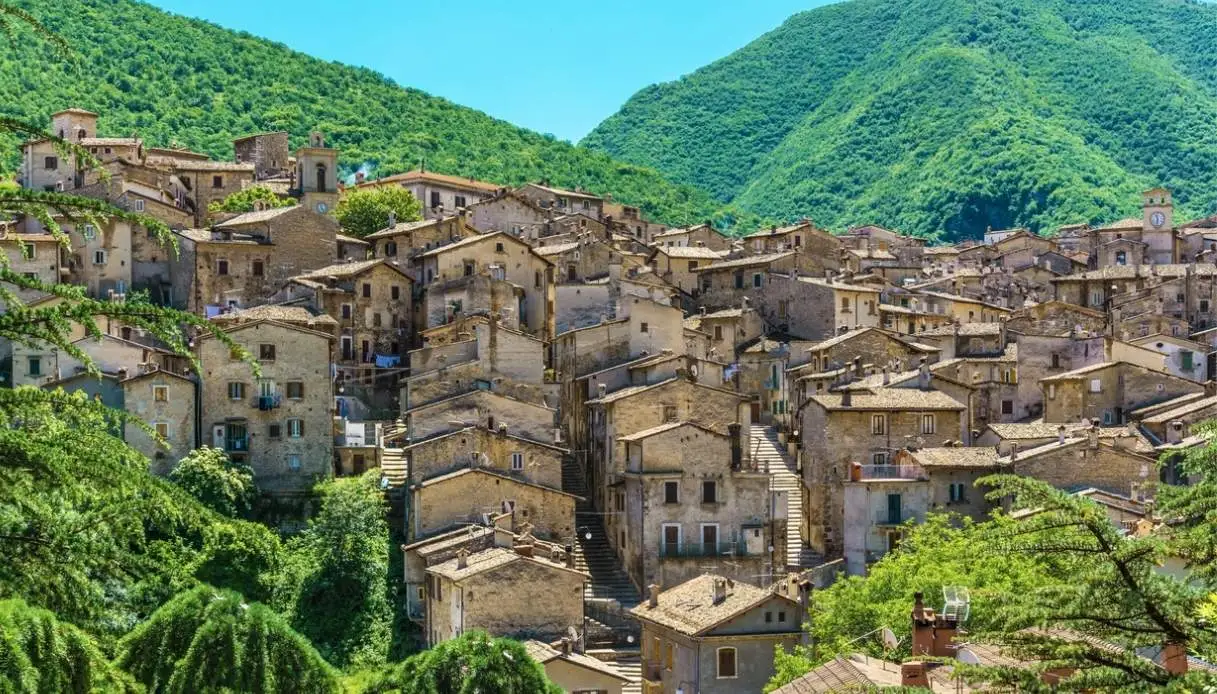
Scanno is accustomed to coexisting with wildlife, but the Abruzzo village has recently begun facing rude tourists and wants to try to restore order. The town, known for its heart-shaped lake and for the landscapes of the Abruzzo Lazio e Molise National Park, in recent years has also become one of the favorite destinations for those hoping to observe deer up close and other animals. This attraction, however, is fueling a problem: after two close incidents in which some male deer charged visitors on the lawns around the lake, the municipality is considering an ordinance that explicitly bans approaching wildlife.
It is not sudden aggression by the deer; it is the visitors who have changed their attitude: feeling cornered, surrounded, photographed at minimum distance and even stroked, they have felt the need to defend themselves.
Scanno, the deer to defend
The episodes that set off the alarm occurred two days apart; in both cases the reprehensible behavior is the same: tourists get too close to the deer present in the meadows of the lake in the Abruzzo village. Feeling surrounded by numerous people and touched, they reacted in the only way they know: they charged the two men and knocked them to the ground. The incident, though without serious consequences, raised awareness about attitudes and about how to protect the environment.
Images of the episodes, filmed with smartphones by other witnesses, quickly began circulating on social media. Along with the videos, calls to respect wildlife more and to avoid behaviors that can endanger both people and animals also increased.
The mayor of Scanno Giovanni Mastrogianni, in an interview reported by ANSA, recalled how the territory has managed to build a balance between human presence and wildlife and precisely to defend this coexistence the Municipality is considering a measure that makes explicit what, in theory, should belong to common sense: a wild animal must be observed from a distance, without seeking physical contact and without offering it food.
The caution is even more necessary at this time of year. During the mating season the male deer can indeed become more territorial and react more decisively to what they perceive as a threat or an invasion of their personal space. A seemingly calm specimen can thus change behavior in a matter of moments.
The wrong behaviors
Scanno’s case is not the only one; in Abruzzo there have been other episodes of close encounters with wild animals. In 2025, in Villalago, a deer wounded a tourist in a residential area, and a few weeks later another incident involved a resident.
The problem, therefore, goes beyond a single animal. What has changed is mainly the way some visitors relate to wildlife. The desire to obtain a spectacular photograph, a video for social media or physical contact with a deer risks erasing the distance that should exist between humans and wild animals.
The zooanthropologist Manuela Macelloni has emphasized how stroking an animal is by no means a positive gesture, especially when dealing with a wild species. Even more damaging, however, is the habit of offering food: a deer that associates the presence of people with a source of nourishment can bring it back to inhabited areas, losing part of the natural wariness that should guide its protection.
The ordinance alone might not be enough; stricter rules with penalties for those who exceed the established limits may be needed.