
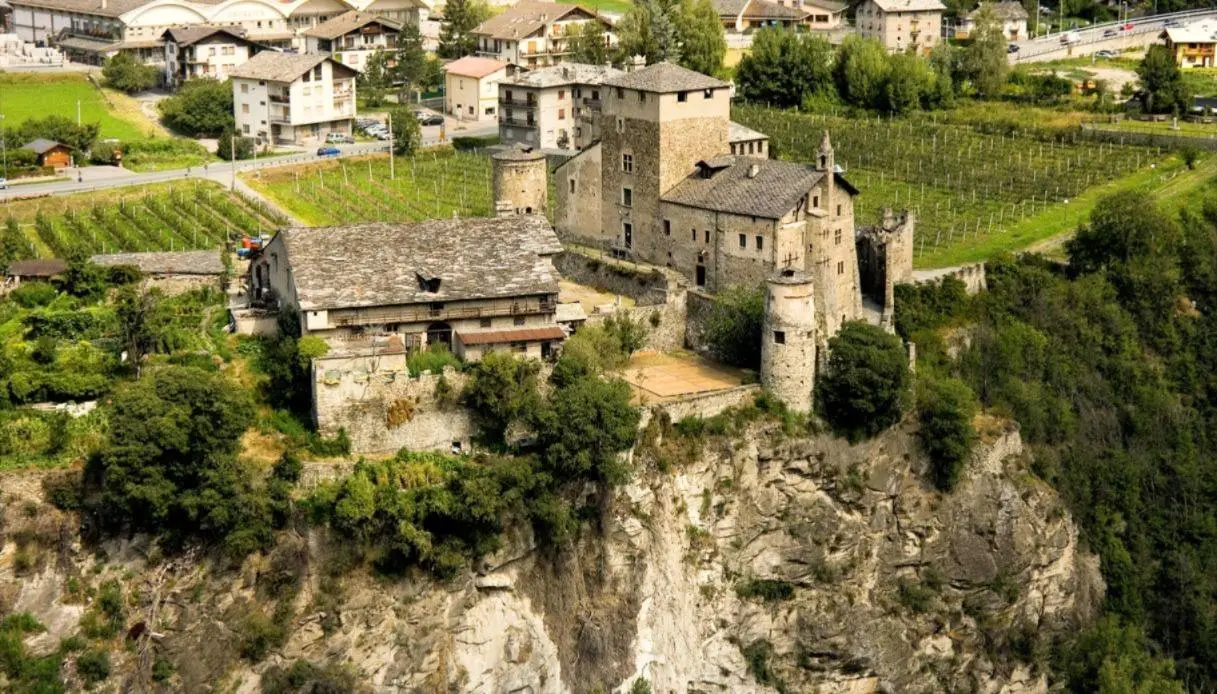
There are castles that conquer with their towers and mighty walls, others with spectacular views… and then there is a medieval manor that surprises with something far more unusual: a ceiling populated by countless carved faces, among nobles, fantastic creatures, dragons, mermaids and grotesque figures that for almost six centuries watch over those entering the main hall. This is the Sarriod de La Tour Castle, in Saint-Pierre, one of the Valle d’Aosta’s lesser-known jewels. Behind its irregular, labyrinthine appearance, the result of centuries of expansions, lies a journey into the medieval imagination made of art, symbols and mysteries, together with precious 13th‑century frescoes and spaces that have remained almost intact over time.
Immersed among apple orchards and gardens, but with a portion clinging to a rocky outcrop above the Dora Baltea, it is an essential stop for anyone who loves discovering authentic and little-known places that are truly astonishing.
The History of the Castle
The castle’s origins date back to between the 11th and 12th centuries, when the complex consisted of a formidable keep—the main square-based tower—surrounded by a curtain wall in the typical layout of the castles of the valley, and a chapel. In the following centuries the Sarriod family, documented as early as the 12th century and owner of the manor for almost nine hundred years, progressively transformed the fortress into a refined noble residence.
It was especially in the quattrocento (15th century) that the castle took on the appearance it still preserves today. Jean Sarriod had the original nucleus enlarged with new wings, a striking spiral staircase and the elegant stone-traceried windows, while his son Antoine renewed the chapel and had the entrance decorated with precious frescoes. In the following centuries more defensive towers were added, along with new residential wings and other spaces giving the complex its characteristic labyrinthine look.
After remaining in the Sarriod de La Tour family until 1923, the castle passed first to the Bensa family of Genoa and then, from 1970, to the Valle d’Aosta Region, which restored and enhanced it up to the reopening to the public in 2018, with portraits, furniture and new acquisitions.
The Hall of Heads, a Masterpiece That Makes the Castle Unique
The real reason to visit the Sarriod de La Tour is found on the first floor of the northern wing: the famed Hall of Heads, considered one of the most original masterpieces of 15th-century secular woodcarving.
What makes it unique is the wooden ceiling supported by 171 carved brackets, each one different from the next. Looking up, you encounter ladies and knights, domestic and wild animals, dragons, mermaids, grotesque faces, demonic creatures and even a unicorn, in a remarkable blend of the sacred and the profane.
Created around 1431-1432, probably during the great renewal works of the castle and on the occasion of the marriage between Beatrice d’Agliè and Giovanni Sarriod de La Tour, this extraordinary ceiling narrates the medieval imagination better than any history book. Each figure carried a symbolic, moral or simply jocular meaning, turning the reception hall into a space capable of astonishing guests and telling the culture of the era through carved wood.
What to See During the Visit to the Castle
Besides the magnificent Hall of Heads, the manor houses other features that are absolutely worth seeing. In the chapel, for example, fragments of a rare 13th-century fresco cycle depict scenes from the life of Christ, including the Adoration of the Magi, the Entry into Jerusalem and the Crucifixion. The paintings remained hidden for centuries beneath a Baroque vault and were rediscovered only during the restorations of the twentieth century.
Attention should also be given to the cinematic fourteenth-century spiral staircase, known as the viret, together with the historical furnishings, the paintings that belonged to the Sarriod de La Tour family and an imposing nineteenth-century iron-bound chest used to store documents and valuables.
Strolling among courtyards, towers, rooms and walkways, one clearly senses how the castle grew over the centuries without losing the authentic charm of a medieval residence still rich in original testimonies.
Where It Is and How to Reach It
The Sarriod de La Tour Castle is located in the municipality of Saint-Pierre, in the Valle d’Aosta, along the plain crossed by the Dora Baltea and a short distance from the better-known Saint-Pierre Castle.
By car, from Aosta and the Aosta West exit of the A5 motorway you should take the SS26 toward Courmayeur. Arriving at the foot of the church of Saint-Pierre, right beneath the renowned castle, turn right and follow the signs to the Sarriod de La Tour Castle parking.
Those coming from Courmayeur, on the other hand, must take the SS26 to Saint-Pierre and, after passing the Saint-Pierre Castle, clearly visible on the right, turn toward the town center following signs to the parking. From there, a comfortable, level path leads to the ticket office and the castle entrance in about five minutes on foot.
For those who prefer public transport, from Aosta you can take bus 581 Aosta-Courmayeur and get off at the stop “Saint-Pierre – Bivio Collina,” from which the castle is reached after about a 10-minute walk. Alternatively, from Monday to Saturday (excluding holidays) there is bus 29 Saint-Pierre-Villefranche, with a stop “Saint-Pierre – Château,” also about a 10-minute walk from the fortress.