
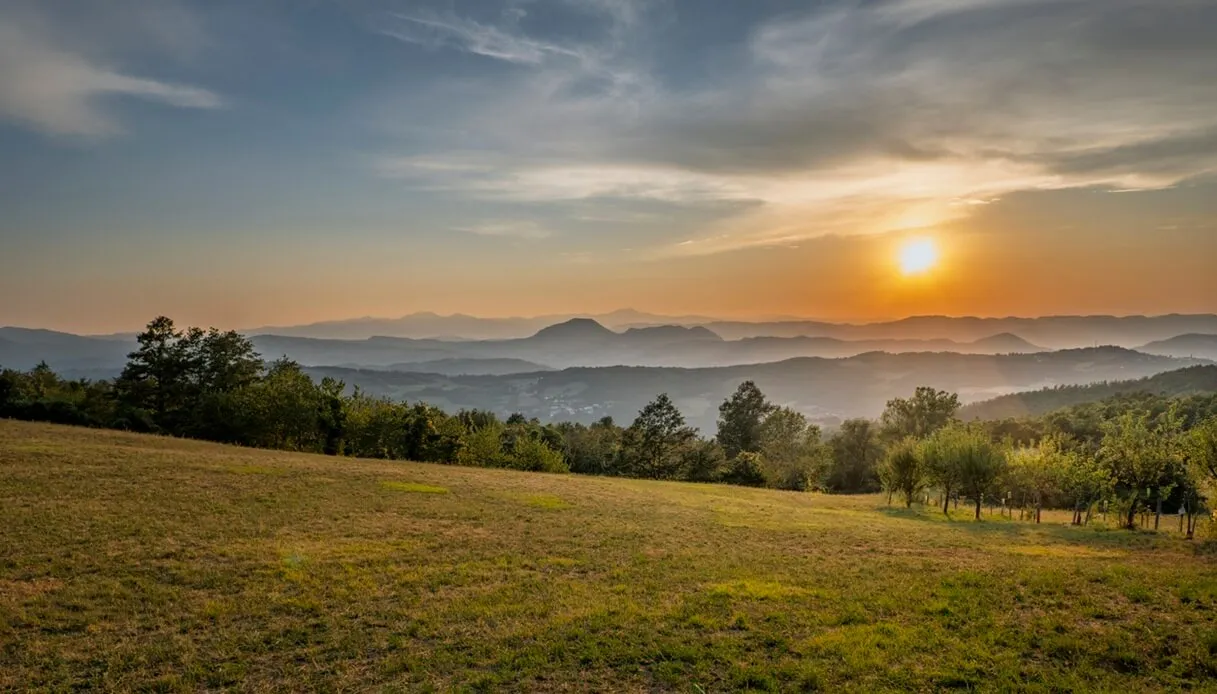
Monte Cimone, Corno alle Scale, and the Parco delle Foreste Casentinesi stand as the most famous and frequented names of the Apennines, in the northern portion of the chain that serves as Italy’s backbone between Tuscany and Emilia-Romagna. Yet the spine is rich with large and small valleys that, even if less visited, guard a treasure of natural panoramas, mountain culture, and living traditions that deserve to be sought out, discovered, and explored. An example? Bologna’s own mountain, San Benedetto Val di Sambro, a strip of ridge just a stone’s throw from Bologna, where Emilia looks toward Tuscany and where, in autumn, the forests stretching to the horizon light up with special colors: brown, ochre, and copper gradually accompany the treetops as they shed their leaves, while the burrs of chestnuts carpet the undergrowth and their fruits adorn tables.
In this small corner of the Apennines you’ll find scattered stone villages and tiny hamlets, farmhouses with panoramic courtyards, revived old trails that trace the route of an ancient Roman road. But there’s also a lake born by chance, a cuisine made from chestnuts, mushrooms, and truffles, and a network of paths to explore the territory in every corner.
San Benedetto Val di Sambro and Surroundings
Pian del Voglio, Rioveggio. Names almost mythical that linger in the imagination of many Italians thanks to the exits of the Autostrada del Sole, the A1, in pleasant mountain zones between Bologna and Florence, where long weekends used to be marked by queues. Now these toponyms have largely faded from memory after the opening of the Valico Variant, which provides a quicker and more direct connection between the capitals of Tuscany and Emilia.
Meanwhile, calmly, time passes on the Bologna Apennines. The silence among the mountains is interrupted only by the occasional passing of a car on the scenic highway, or by a train in the valley floor. The Sambro torrent valley intersects with those of the Setta and the Savena, other mountain streams that carve this undulating land, whose elevations range from 278 to 1190 meters.
The main center is San Benedetto Val di Sambro, a small mountain town with many hamlets. With these it shares a landscape of extensive woods, from the elevations of Pian di Balestra to Monte dei Cucchi, above a thousand meters, but also the distinctive layout, with a stone bell tower marking the town center and some natural balconies offering marvelous views of the surrounding territory.
Passage through ground, it has changed its face many times. Initially the most important administrative seat was at Piano, which in 1862 became Pian del Voglio; in 1871 the seat moved to San Benedetto and only in 1924 did it take the current name. What gave these ridges an identity, though, was long before the Flaminia Militare, the ancient Roman road that, according to a hypothesis still debated by scholars, connected Bologna to Arezzo.
San Benedetto and the Villages of Val di Sambro
The main town is the starting point, but the beauty begins in the hamlets. In Pian del Voglio, for example, stands Palazzo Ranuzzi de’ Bianchi, a late-14th-century building recently restored, while the historic core of the town preserves the characteristic stone buildings, and among the few streets of the settlement you’ll find picturesque shops and a few restaurants under the arcades.
Not far away there’s Qualto, a small gem. It is the oldest village in the area, dating back to the 13th century. Here the pleasure is getting lost wandering among narrow alleys and houses with slate roofs and stone doorframes. At the top of the village, in the square, rises the 14th-century church of San Gregorio Magno. Access to the entrance is reached by climbing a stairway from which one can enjoy a splendid view of the surrounding Apennine peaks.
Medieval is also Zaccanesca, where the architectural traits left by the master stonemasons are preserved intact. In Ripoli the 14th-century church is worth a pause, while the Serrucce are a small cluster of houses laid out on terraces, with a wide view over the rolling mountain crests surrounding the area.
At almost 800 meters above sea level stands Madonna dei Fornelli, which owes its name to the sanctuary of Our Lady of the Snow, erected in 1638 to give thanks for the end of the plague. The small village is animated by accommodations that host hikers on the Via degli Dei, the popular trek that links Bologna to Florence, or on the Via Mater Dei, another route that passes through here.
Monteacuto Vallese is one of the smallest hamlets, but perhaps it offers more in terms of viewpoints from which to enjoy a beautiful view toward the valley of the Setta and the Appennine peaks further west.
The final stop is Castel dell’Alpi: in 1951 a landslide blocked the Savena, a catastrophic event for the ancient village, which nevertheless gave rise to the province’s only natural lake. In summer it is crowded with bathers and fishermen; in autumn, when the waters reflect the woods, it is even more beautiful.
A tip for those arriving or continuing toward Tuscany: although the Pian del Voglio highway exit is the closest, enjoy the road that connects the Sambro valley to Passo della Futa, an extremely scenic driving route of rare landscape beauty.
Trekking among the panoramas of the Bologna Apennines
The guiding thread for trekking in the Bologna Apennines is the Via degli Dei, the route that links Bologna and Florence and stops at Madonna dei Fornelli. Along the way, in the Monte Galletto Wind Park, since 2024 one encounters a rare, if not unique, installation: a wind organ, created by luthier Claudio Pinchi. It is a true wind-powered pipe organ that produces sounds and chords that vary according to the direction and intensity of the air currents passing through the pipes.
The most evocative experience, however, is on Monte Bastione, which hosts the most scenic stretch of the Flaminia Militare. From the plateau of Pian di Balestra, at about a thousand meters above sea level, with a shelter and a small church, one enters the forest and encounters eleven kilometers of basalt-paved road, with some sections perfectly preserved. They were brought to light at the end of the 1970s and today walking over them, with leaves covering the stones, is a small journey through time.
Experienced hikers can tackle the Madonna dei Fornelli loop along the Flaminia: about 24 kilometers and 910 meters of elevation gain, challenging but decidedly rewarding in terms of the richness of the landscapes traversed and the views enjoyed, especially in autumn.
For a lighter day, the CAI 930 trail from Castel dell’Alpi to the Madonna della Neve sanctuary is ideal, a little over 6 kilometers with 140 meters of elevation, suitable even for those not accustomed to significant climbs.
Fans of popular history will appreciate the Via dei Mulini, which follows the Sambro and the Setta and allows discovering about forty watermills, some hidden by vegetation, others still visible and operational. Ripoli and Madonna dei Fornelli are finally stops on the Via Mater Dei, the route linking the sanctuaries of the Bologna Apennines.
The Ancient Flavors of the Bologna Apennines
In San Benedetto Val di Sambro and its surroundings, the table often carries the same scent as the forest. In autumn, for example, the truffle marks many dishes with its distinctive aroma. The chestnut is another treasure that characterizes the area’s cuisine.
The mountain desserts are not missing, such as zuccherini montanari, cookies listed in the regional catalog of traditional products, with San Benedetto Val di Sambro among the municipalities in the production area.
This zone of the Bologna Apennines, marked by a moderate tourist flow—never too crowded but never truly forgotten—boasts numerous establishments that blend traditional flavors with local cuisine, characterized by the use of zero-kilometer ingredients, with contemporary touches. Since most visitors come to stay in these places preferring slow tourism, where the pleasure of dining has a special place, the offerings have adapted and found room for a democratic cuisine, ready for every need, and with bright and rare creativity.