
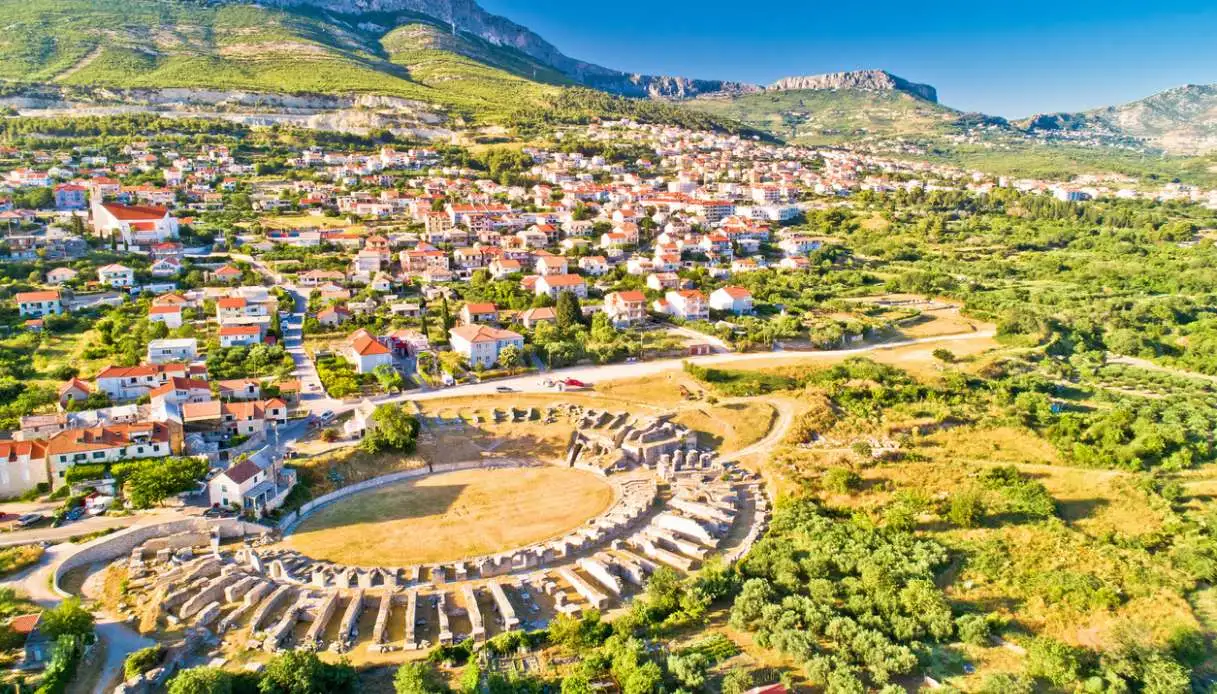
The waters of the Jadro River flow beside Solin in central Dalmatia, accompanying one of Croatia’s most significant archaeological testaments. Solin is the modern town, where however there is also Salona, the ancient Roman center. Once the capital of the Roman province of Dalmatia, Salona was among the most important cities of the eastern Adriatic. Today, amid monumental walls, early Christian basilicas, necropolises, and remains of public buildings, its past resurfaces only a few kilometers from Split.
Roman in its monumental layout, paleochristian in the richness of its sacred places, Croatian in the stories tied to medieval monarchy, Salona preserves traces of different eras within the same landscape. Its ruins include the amphitheater, baths, forum, city gates and vast necropolises, among which Manastirine, Kapljuč and Marusinac. The site is considered the largest archaeological park in the country and allows visitors to observe, through buildings and fragments, the transformation of a major Roman center into a place foundational to the Christian history of the Adriatic.
A Brief History of Salona
The origins of Salona lie in antiquity, but it was during the Roman era that it reached a position of prime importance: it became the capital of the Dalmatia province and developed as a political, administrative, commercial, and cultural hub. Its extent and the monumentality of its buildings testify to a prosperous urban reality, equipped with infrastructures and public spaces for a large population.
According to local tradition, it would also be the birthplace of the emperor Diocletian, a central figure in Roman history and a native of this stretch of Croatia. It was also one of the most important centers for the spread of Christianity in the region. The basilicas and paleochristian necropolises preserve the memory of the early Christian communities and salonitan martyrs. Manastirine, in particular, represents one of the largest open-air paleochristian necropolises, with tombs, architectural remains, and traces of religious buildings that speak to the growth of the new faith.
At the end of the ancient world, Salona gradually faded, and the city disappeared as a major urban center. From that moment, the territory underwent centuries of political transformations and settlement changes. In the Middle Ages, the ancient ager salonitanus lay between important centers of power such as Trogir, Split, and the Klis fortress. The latter played a strategic role, passing over time under the control of Croatian noble families and, subsequently, the Turks.
The memory of Salona also survived through Croatian medieval history: to the east of the ancient town, along the Jadro, lie the ruins of the so-called Šuplja crkva, the “Empty Church.” The name derives from the appearance of the ruins, once bordered by uncovered walls.
Another site of great interest is Rižinice, in the fertile Rupotine valley on the eastern flank of Mosor. Excavations uncovered the remains of a small church and buildings believed to be part of a possible monastic complex.
The archaeological rediscovery of Salona owes much to Frane Bulić, a Croatian archaeologist, historian, and conservator who dedicated a large portion of his career to studying the ancient city and its paleochristian heritage. His work helped transform Salona into a reference point for international archaeological research.
A Visit to Salona Between Roman Ruins and Paleochristian Memories
Visiting Salona offers the opportunity to traverse a vast archaeological area where monumental remains emerge through vegetation and open spaces. The route allows one to recognize the layout of a Roman city while tracing the paths of Christian communities that developed in the following centuries.
The most dramatic spot is the amphitheater, located in the northeastern part of the ancient urban zone. The building was part of the city’s defensive system and could accommodate around 18,000 spectators. Its tiers and the surviving structures evoke the public spectacles of the Roman era, including gladiatorial games.
The Urban Basilica leads into the heart of the city’s Christian story. The ecclesiastical complex arose beside one of the earliest Christian worship sites, which was carved out inside a private house. The remains of the ancient chapel preserve a semicircular apse, a stone bench intended for the clergy, and the base of the altar’s balustrade.
Among the most evocative places is the Manastirine Necropolis, a vast paleochristian funerary area that houses tombs, architectural fragments, and remnants of religious buildings. The complex is linked to the memory of Salona’s martyrs and stands as one of the most studied and valued sectors of the ancient city.
Within the necropolis lies Tusculum, a building erected by Frane Bulić for the first international congress of paleochristian archaeology, held in Salona and Spalato in 1894. The name recalls Cicero’s residence near Rome. Constructed from numerous ancient fragments, it was designed as a meeting and working space for scholars. Today it houses a small commemorative collection dedicated to Bulić, while the upper rooms are used by archaeologists engaged in studying the Salonitan monuments.
The visit can continue within the city walls, through the gates, the forum, the temples and the baths, elements that reproduce the image of a settlement laid out according to Roman urban planning models. The thermae, in particular, recall the social function of bath complexes: places for hygiene, rest, and public life.
Beyond the archaeological area, the route along the Jadro leads to Gašpina mlinica, an ancient water mill among the few still preserved along the river. Inside, the milling system and the stone millstone are maintained, while on the western facade, above the doorway, there is also a Roman-era stele.
To complete the visit, it is worth following the river’s course to the Jadro area, dedicated to the natural, cultural, and industrial heritage connected with water. Along the banks grows a rare bald cypress, the Taxodium distichum, native to swampy regions near the Gulf of Mexico.
Where It Is and How to Get There
The ancient Salona is located in Solin, in central Dalmatia, about 5 kilometers northeast of Split. The town sits at the foot of Mount Kozjak (780 meters), and on the western slopes of Mosor, which reaches 1,340 meters. The area also includes the settlements of Vranjic, Mravince, Kučine, and Rupotina, extending toward Kaštela, Trogir, Podstrana, and Omiš.
The location makes it an easily combined stop with a stay in Split, especially for travelers who wish to mix Roman heritage with the attractions of the Dalmatian coast. The archaeological area is reached from central Solin by following local roads toward the historic site. For a more complete visit, it is worthwhile to also allow time for the Jadro River and the Gašpina mill, so as to grasp the connection between the natural landscape and the city’s history.