
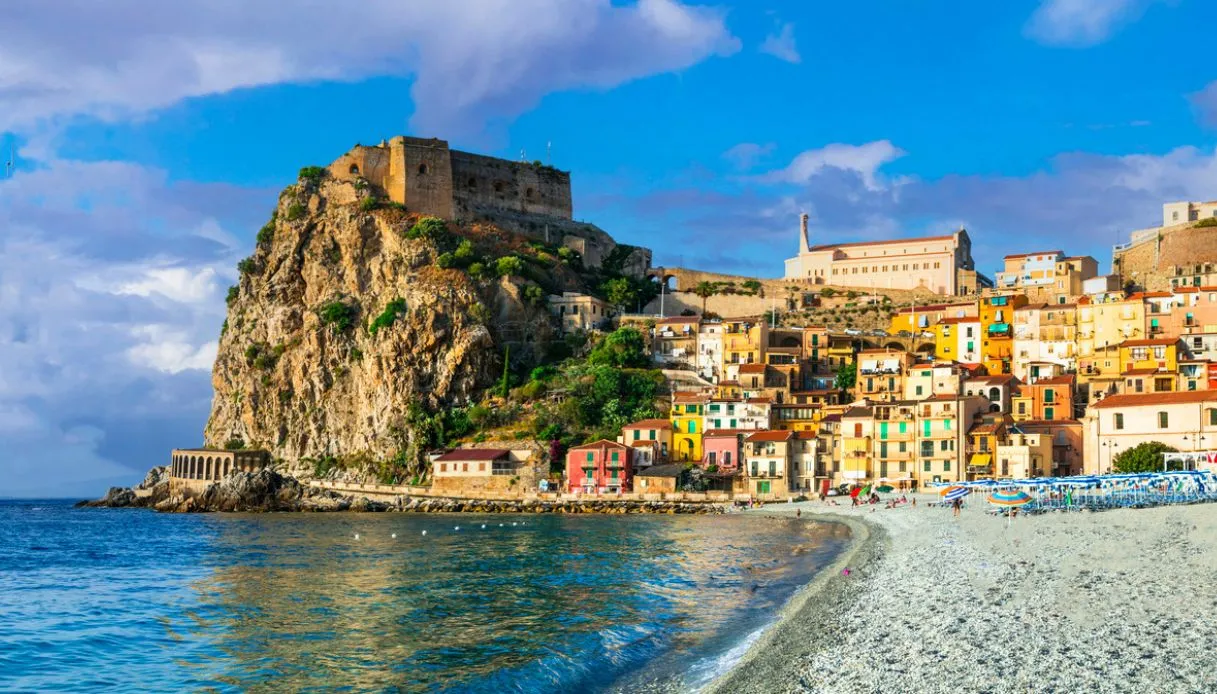
Perched on a rocky spur that seems to extend toward the Strait of Messina, the Ruffo Castle of Scilla is one of the most recognizable symbols of the Costa Viola as well as the true genius loci of Scilla, about 20 kilometers from Reggio Calabria.
Its position immediately reveals why it was chosen and transformed over the centuries: jutting toward the sea, the promontory provided an ideal vantage point to command the Strait and spot anyone approaching the Calabrian coast.
But when you arrive up here, it will be the panorama that captures your attention first. The castle separates two of Scilla’s most evocative faces: on one side Marina Grande, with the beach spread at the foot of the cliff, and on the other Chianalea, the famous fishing village with houses almost touched by the water.
The Long History of the Ruffo Castle of Scilla
The origins of the Ruffo Castle take us far back in time: first the Etruscans, then the fortifications of the Magna Graecia period and finally the Romans, who expanded the existing structures and recognized the strategic importance of this promontory hanging over the Strait.
However, traces of the oldest phases are scarce: modern excavations have yielded mainly the walls of the Monastery of San Pancrazio, dating to the 9th century and also connected to the need to defend the territory from Saracen incursions. In 1060 the complex became a military fortress, definitively reinforcing that defensive vocation that would accompany the promontory for centuries.
A turning point arrived in the sixteenth century, when the castle passed to Paolo Ruffo and became the family’s residence, which remained there until the early eighteenth century. Even today, before entering, you can recognize on the portal the noble crest of the Ruffo and a large plaque that recalls the restoration work carried out during that period.
However, the fortress’s destiny continued to change: in 1808 it became state property, while the violent earthquakes of 1783 and 1908 caused severe damage to the structure, subsequently restored.
From a military outpost and noble residence, the Ruffo Castle took on a new function in the twentieth century: since the 1970s it has become a place of gathering and culture, initially as a Youth Hostel and later as a space intended for exhibitions, conferences and cultural initiatives.
Inside the Ruffo Castle Between Towers, Sea and Myth
Once you cross the bridge that precedes the entrance, you will face the stone portal with a pointed arch, crowned by the Ruffo coat of arms. After passing the corridor covered by a lowered vault, the inner courtyard opens, from which the grand staircase leads to what was once the family’s residence.
The irregular plan of the Ruffo Castle is a consequence of its very long history: the different parts of the building belong to different eras, yet the whole preserves the appearance of a true fortress, with curtain walls, towers and loopholes.
In the interior spaces you will find artifacts, models, natural specimens, and crafts that also tell one of Scilla’s deepest traditions, swordfish fishing, an activity tied to the Strait’s maritime culture.
From up here, the gaze falls toward the alleys and houses of Chianalea, runs across the Marina Grande beach, and crosses the Strait to Sicily, so close that it seems almost within reach.
In the highest part of the complex also stands the Scilla Lighthouse, built in 1913 as a reference point for vessels navigating the Strait and still linked to the Navy today.
But looking at the sea from the Ruffo Castle also means entering the realm of legend: the Strait is indeed the stage for the myth of Scylla and Charybdis and for Odysseus’s adventures recounted in the Odyssey. The myth tells of Scylla, a beautiful nymph transformed into a monstrous creature, destined to terrorize sailors approaching the coast.
If you can choose the visiting time, reach the castle at sunset: as the sun sinks toward Sicily, the light wraps the walls in golden and ochre hues and the Strait gradually changes color. Bring comfortable shoes to handle the ascent and prepare your camera: once you reach the top, facing the sea, Chianalea and the Sicilian coast on the horizon, it will be hard not to use it.