
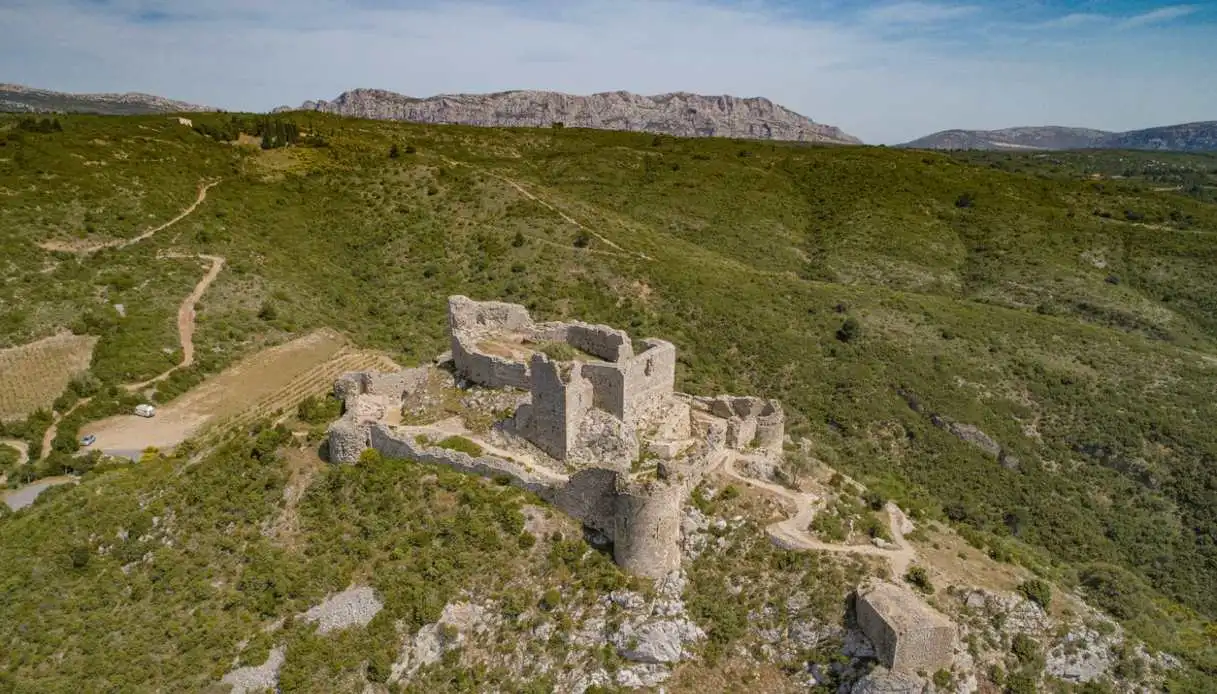
In July 2026 the Royal Fortresses of Languedoc joined the UNESCO World Heritage list, earning international recognition for their historical, architectural, and landscape value.
Spread across Aude and Ariège in Occitania (France), these eight fortresses tell the birth of the French royal power in the south of the country after the Albigensian Crusade (13th century). Built on spectacular elevations, they form a defensive system in which walls and mountains seem to merge into a single landscape.
Montségur Castle
Perched at 1,207 metres on a rocky spur in Occitania, Montségur Castle, the last refuge of the Cathars (members of a medieval Christian religious movement deemed heretical), is one of the most recognizable symbols of Languedoc, located in Ariège. Tied to the memory of Catharism, it was transformed into a royal fortress after the territory came under the control of the French crown.
Its commanding position offers an exceptional panorama of the surrounding Pyrenean mountains and makes evident the strategic value of its construction. A visit allows you to discover a place where religious history, medieval conflicts, and military architecture intertwine. The castle, reachable via a 30-minute uphill walk from the parking area, offers guided tours to transport visitors back in time.
Aguilar Castle
Located 2 km from the village of Tuchan, the Aguilar Castle (Eagle’s Nest) was part of the territorial control system established by the French crown. The fortress sits in a strategic position and retains elements that attest to its defensive function.
Surrounded by the mountainous and wine-growing landscape of the Corbières, with views that allow you to admire Mont Tauch, the chalk cliffs of Vingrau, the Tautavel Tower, and Canigou, it offers the opportunity to observe the relationship between medieval fortifications and the natural environment in which they were placed. The Aguilar 360° trail provides a circuit around the castle for incredible photo opportunities at amazing spots.
Carcassonne Castle and Walls
The fortified city of Carcassonne, perched above the Aude plains, is one of Europe’s most famous medieval complexes. Its walls and its castle constitute a significant example of medieval military architecture and illustrate the strategic importance of the city throughout history.
The visit allows exploration of a unique ensemble of 52 towers, the double ring of walls, and its castle (12th century) set on a hill amid vineyards that narrate the evolution of the region’s protective system. Carcassonne, together with the Citadelles du Vertige (the Royal Fortresses of Languedoc), is classified as one of the Grands Sites Occitanie.
The Four Fortresses of Lastours
The Lastours castles are four fortresses (Cabaret, Tour Régine, Surdespine, and Quertineux) perched on a rocky ridge in the Aude. Their arrangement on the promontory creates a striking ensemble and helps to understand the role these buildings played in controlling the territory.
The site is characterized by the direct relationship between architecture and landscape: the fortress ruins rise from the mountain, offering one of the most representative panoramas of the Royal Fortresses of Languedoc. The visit unfolds in two phases: a discovery of the panorama from the Belvedere (April to November) and access to the monuments via a hiking path that starts from the old textile factory.
Peyrepertuse Castle
Considered one of the most spectacular fortresses in Languedoc, Peyrepertuse, extending about 300 metres, dominates the landscape from heights of about 800 metres in the Corbières. The structure follows the shape of the long limestone ridge upon which it is built, creating an impression of continuity between rock and architecture. Its elevated position, above the village of Duilhac-sous-Peyrepertuse, clearly shows the defensive function of the castle and invites visitors to immerse themselves in one of the most characteristic settings along the fortress itinerary.
From the parking area, a 20-minute ascent leads you to the site and, once there, you can admire bastions, murder holes, loopholes, the Saint Louis Staircase carved directly into the stone, and the Chapel of Saint Jordi (Saint George) – placed in a high position, it offers a view over the wild landscape of the Corbières.
Puilaurens Castle
The Puilaurens Castle, near Lapradelle-Puilaurens and overlooking the valley of the Boulzane river, is one of the fortifications integrated into the royal defensive network – once part of the five children of the Carcassonne citadel. Built in an isolated and commanding position at 697 metres on a rocky spur, it allowed control over a strategically important area of the Languedoc territory.
Its ruins preserve the charm of mountain medieval fortresses and stand as a testament to the military role these castles assumed after the establishment of royal power in the region.
Open from late March to mid-November, this castle is reachable with a 15-minute walk from the ticket office. On-site you can admire the crenellated wall, the barbican, the ramparts walk, the remains of the square-based tower, and the Tower of the White Lady.
Queribus Castle
Situated near Cucugnan (3 km away), the Queribus Castle occupies a high, panoramic position at around 728 metres. Included in the system of the Royal Fortresses of Languedoc, it represented a crucial observation point along this defensive line.
Its position helps illustrate the strategic logic that guided the construction of medieval fortresses, often placed on hard-to-reach and easily controllable elevations. Once you reach the summit, the 360° panorama, from the Pyrenees to the Mediterranean, is sure to captivate you. For the visit you can rent an audio guide or download an app.
Termes Castle
Termes Castle, overlooking the Termenet Gorges and the quaint village, completes the set of the eight Royal Fortresses of Languedoc. Its ruins, which have benefited from excavations and restorations (following the deliberate destructions of 1654), recount the military role of these sites particularly during the Albigensian Crusade, built to consolidate the French crown’s control over a complex territory.
Set in a natural environment characterized by ridges and valleys, the site offers another example of the relationship between defensive needs and landscape features. The castle, closed in December, January, and February, is reachable via a 15-minute walk. At the village’s reception there is a museum display and a short film can be viewed.