
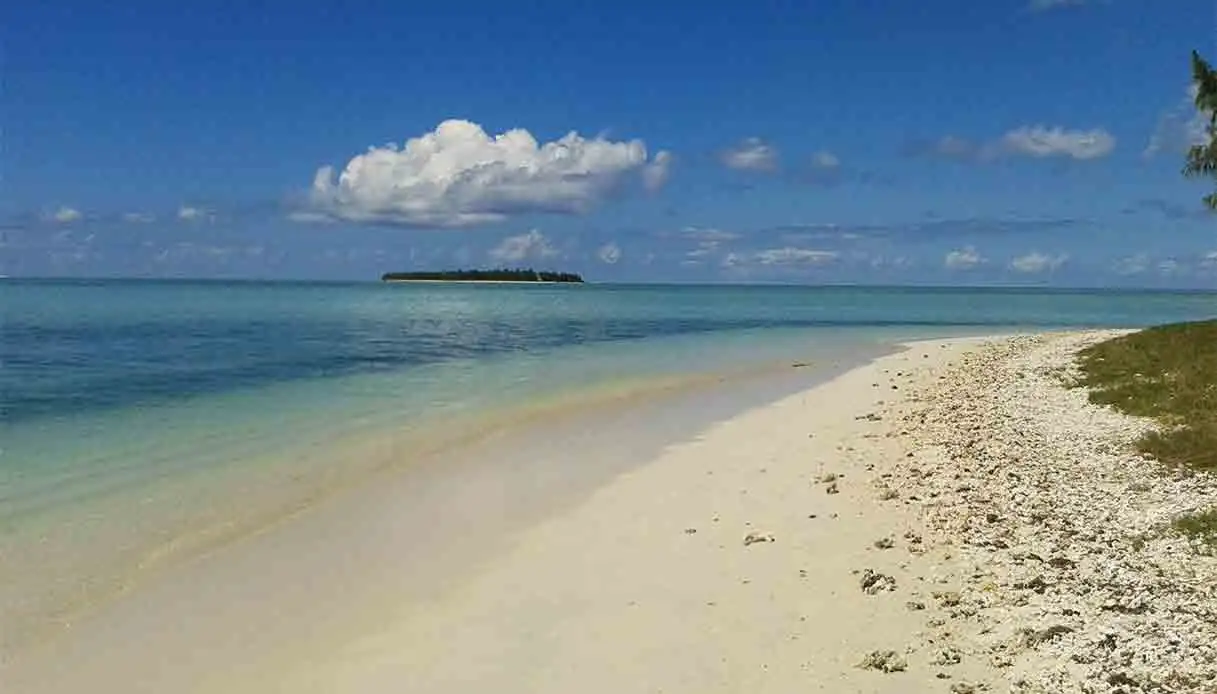
Banish from memory every destination you believed to be the ultimate in travel. There is one that outshines them all and is about to become the new place to be. We’re talking about an island, secluded in the heart of the Indian Ocean, far from crowds and mass tourism, not easy to reach — you need to make three layovers — but precisely for all these reasons it’s the genuine paradise we’ve long envisioned.
The island is Rodrigues, off the coast of Mauritius, of which it is part, and about an hour and a half by air away, so not exactly close. Very few tourists go there, but its wonderful isolation won’t last long, as new luxury resorts are opening. The secret is to go now, before it’s swarmed by honeymooning couples, the wealthy and magnates, and then by families with children.
Tourism on Rodrigues isn’t yet the island’s main livelihood. Those who choose to spend a holiday on this small island will realize that the population earns its living from fishing, agriculture, and crafts. Here the atmosphere is the same as it was in Mauritius, Seychelles, and even the Maldives up to around fifty years ago, before the tourism boom.
Why take a Rodrigues vacation
This gem that rises from the middle of the ocean is truly tiny: 18 kilometers by 8, surrounded by a crystal-clear lagoon in a thousand shades of blue that make the heart dream. The coastline, rather rugged, offers bays and tiny coves where it feels like you’ve stepped into paradise. On the eastern tip, three spots are spectacular: Anse Bouteille, Pointe Coton Beach, and especially Trou d’Argent, regarded as one of the most beautiful beaches in the entire Mascarene archipelago. It is said that a pirate treasure lies buried on this small beach. Encircled by cliffs, it is accessible only on foot, after a 45-minute trek along the path starting from Pointe Coton.
But for truly powdery beaches, sheltered by lush tropical greenery there are plenty around the island and beyond. Indeed, off Rodrigues there are several islets reachable by boat that deserve a day trip. The most famous is Île aux Crabes, the crab island, on the southeast coast amid the lagoon, but there’s also Île Frégate, Île aux Cocos, Île aux Sables, and to the north Île aux Fous, the island of the fools. And then many small emergent lands, some of them nameless.
To seek a bit of “life,” you should head to Port Mathurin, on the northern coast, with its colorful and bustling market; it is the administrative and main commercial center of Rodrigues, in a way the island’s capital.
Natura incontaminata
For reef enthusiasts, it’s a true underwater paradise. Its coral reef is pristine. There is also a unique ecosystem, with corals, fish, and crustaceans that exist nowhere else. On land, too, there are endemic species, such as the Rodrigues fody, the Rodrigues canary, and the Rodrigues flying fox. And there is a plant once thought extinct that still grows on this island: the “café marron,” scientifically Ramosmania rodriguesi, which bears a lovely white flower. According to locals, it possesses the power to cure venereal diseases and hangover symptoms a bit like coffee, hence the name.
To admire the pristine nature that still exists on the island, you must not miss the François Leguat Reserve, named after the eighteenth‑century French explorer and naturalist who first came here and was fortunate to discover some species now extinct, such as the Dodo. The reserve had also seen the disappearance of the giant tortoise, but a repopulation project was launched to recreate the Eden described in the explorers’ ship logs. The project has yielded very satisfactory results, to the point that today hundreds of tortoises reside there.
Within the François Leguat Reserve there are also caves that can be explored, accompanied by specialists who recount the island’s history from a geological perspective.
Soggiornare a Rodrigues
On the island’s loveliest stretch of coastline sits one of Rodrigues’s most luxurious resorts, the Constance Tekoma Rodrigues – Lodge, which has recently been refurbished in Creole style. There are only 32 rooms facing the sea, each with a private terrace and an outdoor bath or shower. Inside, there is a panoramic restaurant, a bar, and, for those who crave more than the sea, a pool. Nothing else is needed in a paradise like this, perhaps only a private, exclusive spa treatment. And there is also this option.
On the southern coast there are more accommodations, mainly lodges. Recently renovated is the C Rodrigues – Mourouk, which has 65 rooms and two villas and is perfect for water sports enthusiasts, offering a kite club and, for families, a beach club.
Come arrivare a Rodrigues
As noted, to reach the remote Rodrigues Island in the middle of the Indian Ocean, starting from Italy you must make three layovers. The island, which has a small airport, Plaine Corail, is linked to Mauritius’s Sir Seewoosagur Ramgoolam International Airport by a flight lasting about an hour and a half, and this is the only way to reach it.
To reach Mauritius you can break the journey in Dubai. The route is shorter, but you land in the Emirate at night and wait a few hours before boarding the flight to Mauritius. There are also connections from Paris with more convenient timings, but the flight lasts a couple of hours longer.
Quando andare a Rodrigues
Given that the climate here is always tropical, as in all tropical countries there are months that are more or less recommended for visiting Rodrigues. Between October and December the weather is optimal, with bright days, calm seas, and water temperatures above 28°C. The period is also ideal for whale watching. In January and February conditions are similar, but there is a risk that cyclones may arrive. From March to September, winds are stronger and the water temperature can drop to around 23°C; from December to April, in addition, rainfall is much higher.