
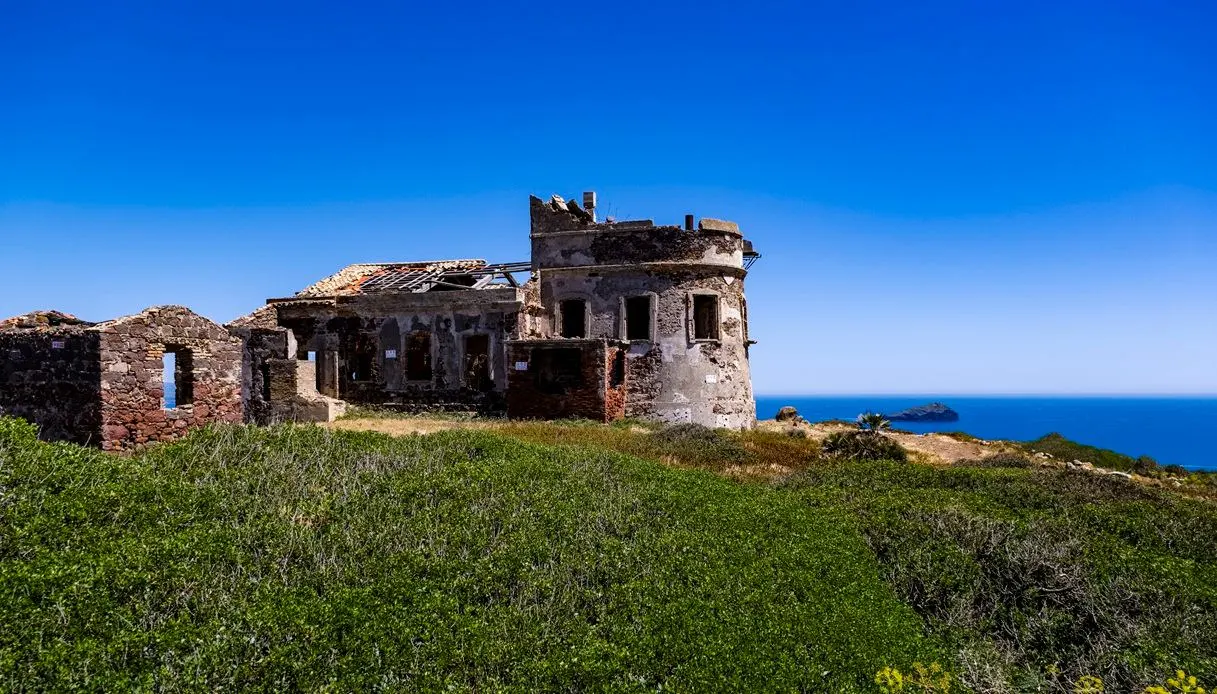
Overlooking a wild and pristine coastline at the southern tip of Sant’Antioco, in Sardinia, there stands an ancient military station whose gaze sweeps out over the blue expanse of the Gulf of Palmas. Today, nestled among walls weathered by time and structures now in ruins, this place retains the charm of a history long forgotten, yet it also bears the marks of abandonment that threaten to erase its historical memory.
It is the former Capo Sperone signaling station, known as Su Semafuru: the main building is unstable and the accompanying structures have collapsed into ruins. For this reason it appears on Italia Nostra’s Red List, the register of Italian cultural assets that flags those in need of protection. The map gathering these sites is now available online, inviting you to discover how many other treasures of our heritage are at risk of being lost (and to submit reports on other assets to safeguard).
Su Semafuru, the ancient military signaling station to be protected
Built starting in 1887, the Capo Sperone signaling station played a strategic role in maritime communications and was used during the world wars. Shut down permanently in 1958, it gradually fell into disuse, eventually becoming a fragile testimony of history.
Its value is not limited to architecture: the structure rises within a landscape of immense natural beauty, inside the Special Protection Zone “Isola di Sant’Antioco, Capo Sperone,” important also for the presence of wildlife and plant species of interest. Restoring this building would therefore preserve a part of the territory’s memory, in a context of high environmental value.
The Red List of at-risk cultural assets is now online
The Su Semafuru story in Sardinia brings the fragility of Italy’s vast patrimony back into focus.
The Red List of Italia Nostra began in 2011 to gather reports of monuments, historic buildings, archaeological sites, villages, and landscapes in need of protection. In October 2026, the association renewed the project with a public digital platform: through an interactive map you can explore the reported assets, consult their entries, and learn about their conservation status and the issues identified.
Numbers tell the scale of the initiative: out of 520 reports collected over fifteen years, 402 have been validated. Of these, 341 concern assets still awaiting protection, while 58 have moved onto the Green List because they have been recovered or secured. Three have been placed on the Black List because they have been irreversibly lost.
From abbeys to archaeological sites: other treasures to save
From forgotten monastic complexes to ancient fortifications, and from archaeological sites to architectures linked to the history of seafaring, the Red List holds stories of very different kinds, scattered across the entire country. Among the places to be saved are: the Abbey of Santa Maria di Calena, in Peschici, one of Gargano’s historic religious complexes; the Arsenal of Venice, tied to the maritime power of the Serenissima; the Megara Hyblaea archaeological area in Sicily, which preserves traces of an ancient Greek colony; and the Rocca di San Paolino at Ripafratta, in Tuscany, a fortress that speaks of centuries of military history.
But the map is not merely a catalog of places to discover and protect: it is also a tool open to citizens, who can submit new reports that will be reviewed subsequently. A way to bring to light treasures often far from the most trodden tourist routes and to draw attention to buildings, landscapes, and testimonies of the past that risk disappearing forever from our architectural and cultural heritage.