
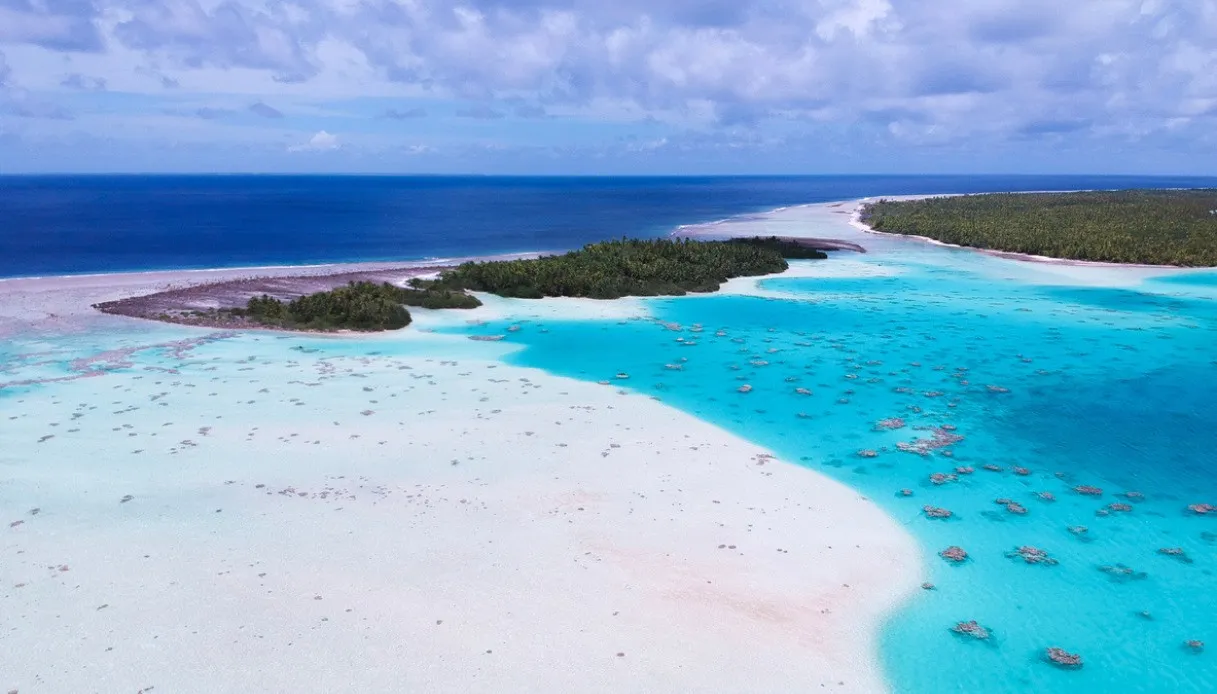
Observing it from above, Rangiroa appears as a gigantic ring drawn across the Pacific. A slim sequence of islets, palms, and ribbons of sand encloses an immense turquoise expanse, so vast that it could cradle the entire island of Tahiti. Yes, we are in French Polynesia, more precisely in the Tuamotu Archipelago, among the most extraordinary scenery in this corner of the world.
Rangiroa corresponds to the largest atoll in the territory, to the point that it is generally cited as the second-largest in the world by size. Its traditional name, Ra’iroa, means “vast sky” or “immense heaven,” an expression that seems to have been born from observing the boundless space between the sea’s surface and the horizon.
What is truly staggering, though, is that millions of years ago there was only a volcanic island. Then, with the gradual subsidence of the terrain and the growth of coral structures, an ring of reefs formed around a central basin. Today there remain visible about 240 motu, small landmasses that shape the atoll’s perimeter.
What to See in Rangiroa
Be prepared to feel a little disoriented: in this region, places that appear close on a map can require long crossings, while channels cutting through the barrier reef regulate the movement of tides and marine life.
The Tiputa Pass and the Dolphin Show
Among the most famous spots of this Polynesian atoll is Passe de Tiputa, one of the main connections between the ocean and the inner basin. The currents attract large concentrations of fish and predators, turning the channel into a privileged observation point for diving enthusiasts.
Explorations of the seabed, however, require attention to currents and are organized by specialized centers. From the Ohotu jetty, on the western shore of the passage, it is possible to spot dolphins surfacing through the waves.
The Blue Lagoon, a Lagoon Inside Another Lagoon
On the western side lies the Blue Lagoon, one of the most photographed natural wonders in the area: a group of 5 motu encloses a small body of water within the already immense main lagoon, creating a kind of natural pool framed by tongues of very light-colored sand.
To reach this marvel, one must navigate about an hour by boat (yes, it’s one of those experiences not to be missed).
The Île aux Récifs, a Landscape Nearly Lunar
In the southwestern part of Rangiroa, near the motu Faama, you can admire Île aux Récifs, also known as Reef Island, where enormous formations of fossilized coral emerge from the water to reach about 2 meters in height.
Among spires, small channels, and natural cavities gather transparent pools warmed by the sun. These structures stand as a testimony to the ancient evolution of the reef.
Avatoru and Tiputa, the Villages Between Ocean and Palms
Polynesian daily life centers mainly in the villages of Avatoru and Tiputa, separated by the channel of the same name. Avatoru hosts services, small shops and homes surrounded by tropical vegetation that you can explore even by bicycle.
Tiputa, for its part, offers a more intimate atmosphere, with churches, simple buildings and gardens that tell of a community tied to fishing and local traditions.
The Black Pearl Farms
One of the island’s most important traditional activities is Tahitian pearl farming, renowned for hues ranging from silver-gray to deep green, with violet reflections.
A visit to Gauguin’s Pearl offers insight into the techniques used to cultivate pearl oysters Pinctada margaritifera.
The Rangiroa Vineyard, a Rarity in the Pacific
Finally, here is one of the most unexpected surprises: Domaine de Dominique Auroy, famous for introducing viticulture on a small coral motu. The first vines were planted in 1997 and the first production of Polynesian wine arrived in 2000.
Among the varieties cultivated there are Carignan, Italia, and Muscat de Hambourg. A wine tasting thus offers a decidedly unusual experience for a destination mainly celebrated for its tropical landscapes.
The Most Beautiful Beaches of Rangiroa
Rangiroa stands out from other Polynesian destinations also for its long stretches of coast made up of coral and rocks. The most spectacular sandy expanses cluster on motu reachable by boat, often surrounded by shallow seabeds.
- The Pink Sands: a beach length of about 150 meters, full of surprising pink hues. The coloration is also due to tiny shells of foraminifera, marine organisms that help form the sediments.
- The Beaches of the Blue Lagoon: small, very light sands that encircle the inner basin, among coconut palms and crystal-clear waters.
- The Tiputa Beach: located near the village of the same name, it is one of the best-known spots to spend a few hours by the sea. The presence of currents near the channel requires particular caution when choosing where to swim.
- The Beaches around Avatoru: on the northern edge, a sequence of small coves, low cliffs, and crystal-clear channels alternating. Toward the end of the motu, near the Avatoru Pass, the scenery becomes especially evocative, with the ocean on one side and the inner expanse on the other.
Where It Is and How to Get There
The Rangiroa Atoll belongs to the Tuamotu Archipelago, in French Polynesia, roughly 350 km northeast of Tahiti. It is part of a vast ensemble of coral atolls scattered across the Pacific Ocean, characterized by low-lying lands and lagoons enclosed by natural barriers. To reach it from Italy, you first need to reach Tahiti’s Faa’a International Airport in Papeete, via intercontinental air connections with one or more layovers.
From Tahiti, direct domestic flights to Rangiroa are operated by Air Tahiti. The journey lasts about 1 hour and provides aerial views of the atoll’s striking geometry. The airport is located on the Avatoru motu, near the main accommodations and tourist services.
The generally most favorable period coincides with the relatively dry season, from May to October, characterized by pleasant temperatures and typically less rainfall. From November to April, instead, you have the chance to enjoy the warmer months, but with a higher risk of rain.