
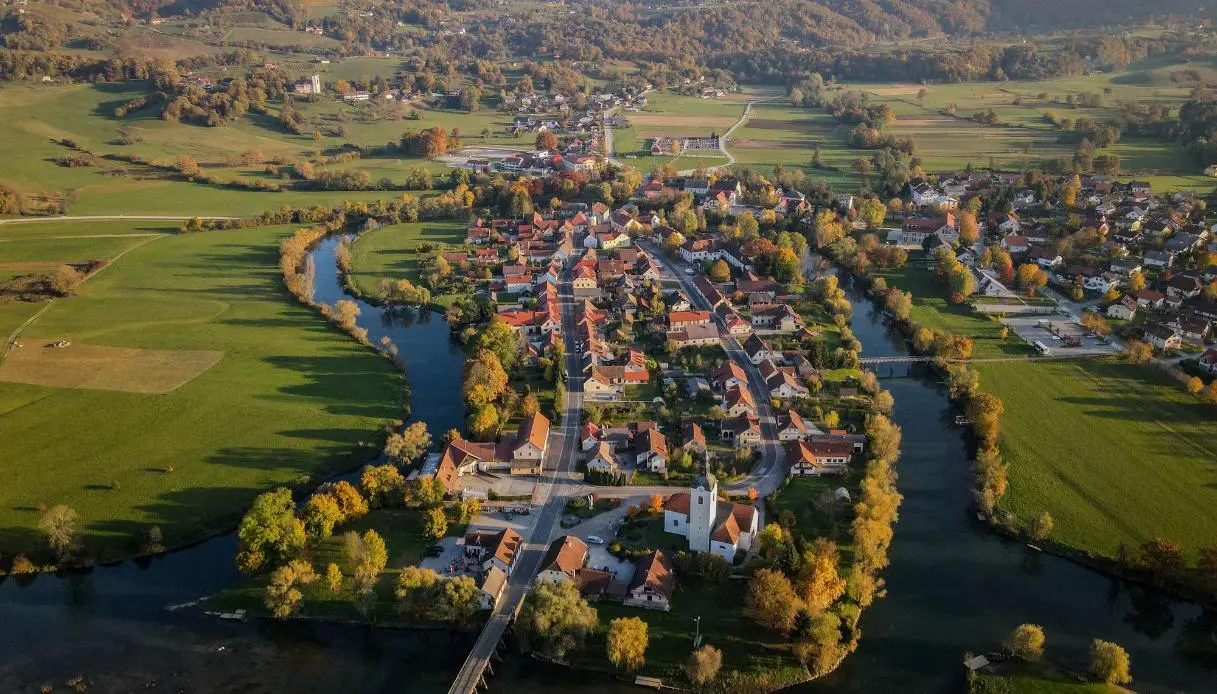
Not many kilometers separate it from Bled, a highly frequented tourist destination, yet Radovljica possesses the ability to have chosen discretion as its distinguishing trait. It sits on a natural terrace above the Sava Valley, with the silhouette of the Julian Alps providing a backdrop to the houses of the old town.
Bourgeois residences from the 16th and 17th centuries, newer buildings, baroque palaces and painterly decorations tell of different eras without erasing one another. Radovljica thus appears almost as a small time capsule, enclosed between traces of medieval fortifications and the alpine landscape.
To this historical identity is added a distinctive gastronomic vocation: today it is known by the nickname Dolce Radol’ca, linked to the tradition of beekeeping and honey, supported in recent years by a chocolate culture.
What to See in Radovljica
Behind the elegant façades of this Slovenian town, one encounters museums, workshops, artistic testimonies, and corners tied to figures who left a deep mark on the country’s culture.
Linhart Square, the Old Town Square
The first encounter with Radovljica passes through the large rectangular square named after Anton Tomaž Linhart. The surrounding façades mainly belong to bourgeois architecture from the 16th to the 19th century and preserve frescoes, decorations, and original structures.
Linhart was an 18th-century dramatist and historian, regarded as the first author of Slovenian-language comedies, and his birthplace stands along the square. A fountain dedicated to Josipina Hočevar adds another element to the urban scenery, while the artisans’ old houses give this space the commercial character of past eras.
Šivčeva House
Among the historic houses stands out the Šivčeva hiša, a 16th-century late-Gothic house regarded as one of the most interesting examples of Radovljica’s ancient architecture. The façade and interiors preserve elements of the original structure, and today the building houses a gallery.
Radovljiška Graščina and the Beekeeping Museum
The Radovljiška graščina dominates Linhartov trg with its Baroque architecture. The rooms on the first floor were renovated in 2021 and host the Beekeeping Museum and the City Museum.
The former tells one of Slovenia’s most deeply rooted traditions through the history of beekeeping, honey production, and the distinctive decorative art of the panjske končnice, the painted boards applied to traditional Slovenian apiaries. The palace also houses a Baroque Hall used for concerts, receptions, and other events.
Lectar House and the Living Gingerbread Museum
Not far from the palace one encounters the Lectar House, linked to the tradition of the lectarji, the characteristic gingerbread hearts. In the workshop, artisanal production is still active, allowing visitors to see up close an old confectionery custom.
St. Peter’s Church
At the far end of the square rises the parish church of St. Peter, one of the city’s principal Gothic monuments. The structure features three naves and, beside the presbytery, displays a 16th-century portico.
Particularly curious is the so-called Gothic Tavern, a space that in the past served priests for selling wine. Today the place’s tradition survives in an original artistic form, with works created by Branko Čušin using red wine itself as a painting material.
The Medieval Walls and the Moat
Behind the church, traces of the fortification that once protected Radovljica surface. The defensive system includes the best-preserved medieval moat among Slovenian towns.
From the façades of the square, one moves to a more intimate setting connected to the military function of the old city. A renovated tunnel also allows visitors to learn about part of the underground structures associated with the fortifications.
The Architecture of Ivan Vurnik
Radovljica also preserves a strong imprint of 20th-century Slovenian architecture. Ivan Vurnik, born in the city, is one of the most important figures on the national architectural scene.
His influence is visible in several places, among houses, villas and urban interventions. Villa Savnik and the Grajski dvor belong to this heritage, while the architect’s birthplace sits near the moat.
But that’s not all, because along Gorenjska cesta one meets villas linked to the Secession and Art Nouveau milieu, including Šmajdova and Šarčeva, designed by Danilo Fürst, a pupil of Jože Plečnik.
What to Do in Radovljica
The city’s identity emerges primarily through traditions still recognizable in its gastronomy, craftsmanship and the surrounding landscape.
- Follow the story of the bees: by entering the Beekeeping Museum and then reaching the Lectar workshop.
- Explore the surroundings by bike: it offers a pleasant way to reach rural landscapes, valleys and viewpoints in the region.
- Reach Kropa: an ancient center tied to ironworking. The forging tradition survives in the urban heritage, in the museum and in decorations made by local blacksmiths.
- Climb towards the panoramas of Gorenjska: from there you can observe the alpine landscape from different perspectives, among forests, waterways and ridges. Begunjščica mountain dominates the area near Begunje, while Jamnik offers one of the region’s most characteristic views.
- Visit Brezje: an important chapter of Slovenian religious culture. The Basilica of Our Lady Help of Christians is the country’s national shrine and next to the church there is also a museum dedicated to nativity scenes.
- Discover Begunje: to follow a double itinerary, the medieval one of Kamen Castle and the musical path tied to Slavko Avsenik, a central figure in Slovenian folk music.
Where It Is and How to Get There
Radovljica is located in Gorenjska, in the northwest of Slovenia, between the Julian Alps and the Karavanke ranges and a short distance from the Sava valley. Its position makes it particularly appealing for those who wish to combine a cultural visit with excursions in the alpine environment. From Trieste, the motorway route passes through the Fernetti pass, continues toward Ljubljana and then toward Kranj and Villach, up to the Radovljica exit.
From Gorizia one follows the H4 motorway toward Nanos, then the A1 toward Ljubljana and subsequently toward Kranj and Villach. From Udine one can reach Tarvisio, continue toward Kranjska Gora, and re-enter the Slovenian motorways near Jesenice, before the Radovljica exit. To use the indicated Slovenian motorways, a motorway vignette is required, the digital pass for vehicles subject to tolls.