
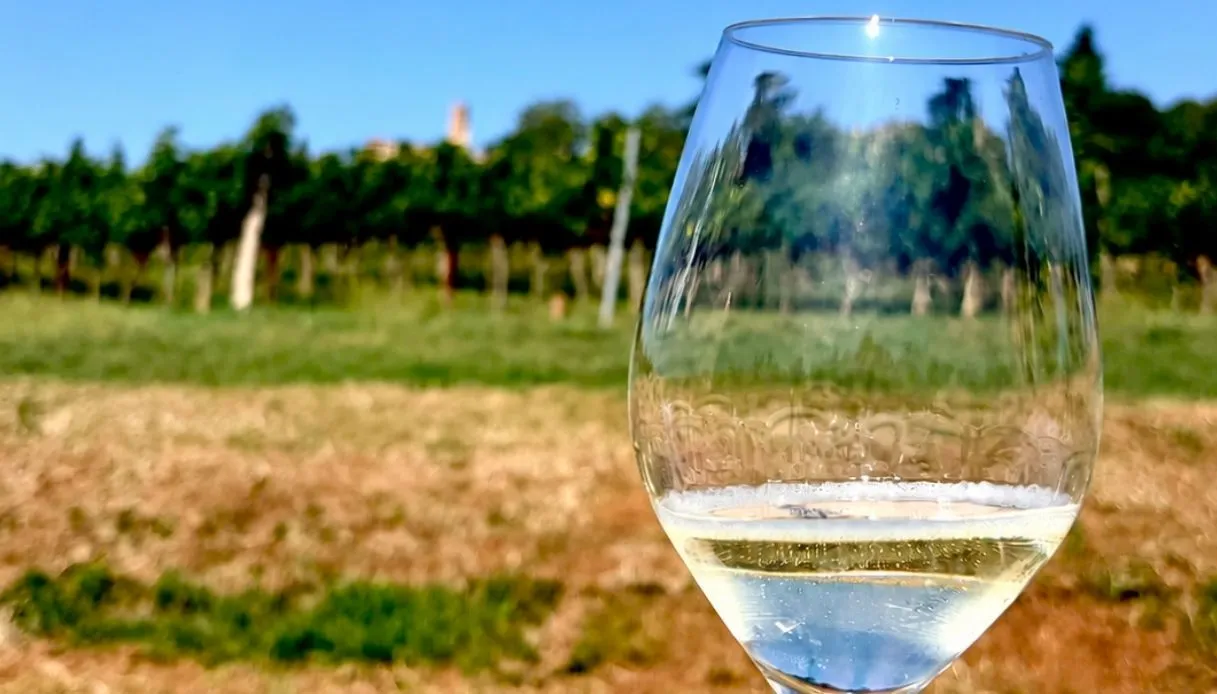
Gastronomy-themed road trips are increasingly in demand, and from north to south across Italy there are genuine wonders to explore, one example being the Strada del Prosecco, in the Treviso area, which highlights the sparkling wine most loved at aperitifs… and more. Between Conegliano and Valdobbiadene the hills enchant with tastings, of course, as well as castles, villages and trails to explore on foot.
Wine? Just a starting point: the rows rise and fall along gentle slopes, church spires stand above the vineyards, and it’s easy to be amazed by mills still in operation. The view wanders among these scenes, which represent the Prosecco Hills, recognized as a UNESCO World Heritage Site. With a weekend of 3 or 4 days you can discover it at a relaxed pace, alternating walks, cellars, villages and a few stops at the table.
The recommended 3-day itinerary
Trying to structure a three-day itinerary along the Strada del Prosecco from east to west here is how to organize a weekend to discover the Hills:
- Day 1. From Conegliano. Follina. (Conegliano, San Pietro di Feletto, Refrontolo, Molinetto della Croda, Follina (about 25 km covered);
- Day 2. Follina, Cison di Valmarino, Rolle, Miane, Combai, Valdobbiadene (about 35 km covered);
- Day 3. From Valdobbiadene you depart for San Pietro di Barbozza and Santo Stefano (about 20 km covered), we recommend adding Asolo to the circular itinerary (about 20 km more)
The villages of the Prosecco hills
For an itinerary among the villages of the Prosecco hills, start from Conegliano; besides being one of the “historic capitals of Prosecco,” its center revolves around Contrada Granda, flanked by arcades and palazzos.
From Conegliano a few kilometers are enough to change the scenery completely. San Pietro di Feletto is one of those stops that risks dragging out longer than planned. Its ancient parish church houses a remarkable cycle of frescoes and occupies a panoramic position, surrounded by vineyards and forests. In the surroundings you can also reach the Molinetto della Croda, in Refrontolo: an old mill built against the rock, beside a waterfall. Small, photogenic, almost hidden.
More to the north, Follina shifts the register again. The town has been tied for centuries to wool processing and preserves one of the area’s most interesting religious monuments, the Abbey of Santa Maria with a cloister that feels quietly peaceful. In the surrounding area there are also walks following the streams and passing through a landscape that is increasingly close to the Prealps.
A few minutes by car separate Follina from Cison di Valmarino. Here it’s worth leaving the car and continuing on foot. Piazza Roma, the old houses, narrow lanes and palaces tell of the long bond between the town and the Brandolini family. The Via dell’Acqua follows the Rujo stream between little bridges, small waterfalls and ancient works: a green interlude perfect between one winery and the next.
A deviation leads to Rolle, a tiny hamlet nestled among the vineyards. There’s no need for a long list of monuments here. The reason to come this far is the landscape itself: a few houses, a church, the hills that roll around all around you.
On the western side, naturally, there is Valdobbiadene. The town center leaves an elegant imprint, with the Cathedral of Santa Maria Assunta, the bell tower and several historic buildings around Piazza Marconi. But a short distance away you step into the Cartizze landscape.
Santo Stefano and San Pietro di Barbozza are almost obligatory stops. Between narrow roads, steep vineyards and small rural clusters you enter the heart of a winegrowing area that must contend with significant slopes and often manual work. It is also the right area to enjoy a walk on the Cartizze Ring, even more so before a wine tasting.
Asolo isn’t exactly on the Strada del Prosecco, but it is one of the most scenographic villages in the area. Known as the “city of a hundred horizons,” it is worth discovering starting from the Rocca, the civic museum and, of course, we suggest retracing the paths that recall the talents of Eleonora Duse and Freya Stark.
The castles to visit
Before the bubbles there were walls, towers, fiefs and noble families. The area still bears many traces of that past, even though not all fortresses survive intact today. In Conegliano the castle still dominates the center from above. Of the ancient structure what remains is mainly the Torre della Guardia, today the seat of the Civic Museum, some stretches of the fortifications and other elements of the original complex.
Those seeking something more scenographic should stop in Susegana where the Castle of San Salvatore tells the history of the Collalto family, who today handle tastings, production and sale with a green, territory-respecting approach.
In Vidor the medieval fortress no longer exists in its original form: it was destroyed in the 16th century. The memory of the castle remains in local history and in the town’s reenactments. The most recognizable silhouette, however, remains Castelbrando, perched above Cison di Valmarino. Fortress, noble residence, stately home: over the centuries the complex has changed its appearance multiple times. Today it houses a hospitality establishment, but some spaces are accessible to visitors.
The Strada del Prosecco
Don’t think of the Strada del Prosecco as a panoramic route to be driven from start to finish; founded in 1966 it was the first to be recognized in Italy. Driving it you touch the villages we’ve mentioned, but stopping everywhere is not mandatory; it is a totally customizable on-the-road journey. The possibilities for detours are endless. There are the Lakes of Revine for those who want to include a nature stroll, the waterways of Cison, the itineraries around Follina, the Molinetto della Croda and the trails that climb toward the Prealpi.
The flavors not to miss
The protagonist is inevitably the Conegliano Valdobbiadene Prosecco Superiore DOCG, produced mainly from the Glera grape. From one hillside to the next, exposure, altitude and soil characteristics change. The interpretations of producers also change. Tasting the wine directly in the cellar allows you to encounter versions Brut, Extra Brut, Extra Dry and Dry and to understand how different they can be from one another.
However, the region does not live by bubbles alone. In Refrontolo you meet the Refrontolo Passito, a contemplative red wine made from Marzemino grapes. A decisive pace change after a day dedicated to sparkling wines.
At the table, the cuisine remains the straightforward Treviso area fare. Cured meats and cheeses are the easiest way to begin, perhaps during a tasting. Then come polenta and meats, risottos, fresh pastas and dishes built around seasonal products. In autumn, in Combai, the star is the Marrone di Combai IGP. In the colder months radicchio, soups and more substantial preparations also make their way onto menus. Among Veneto’s traditional specialties, sopressa is not missing, often served with bread or polenta, while the cheeses already foreshadow the approaching Prealps and the alpine pastures of Monte Cesen.