
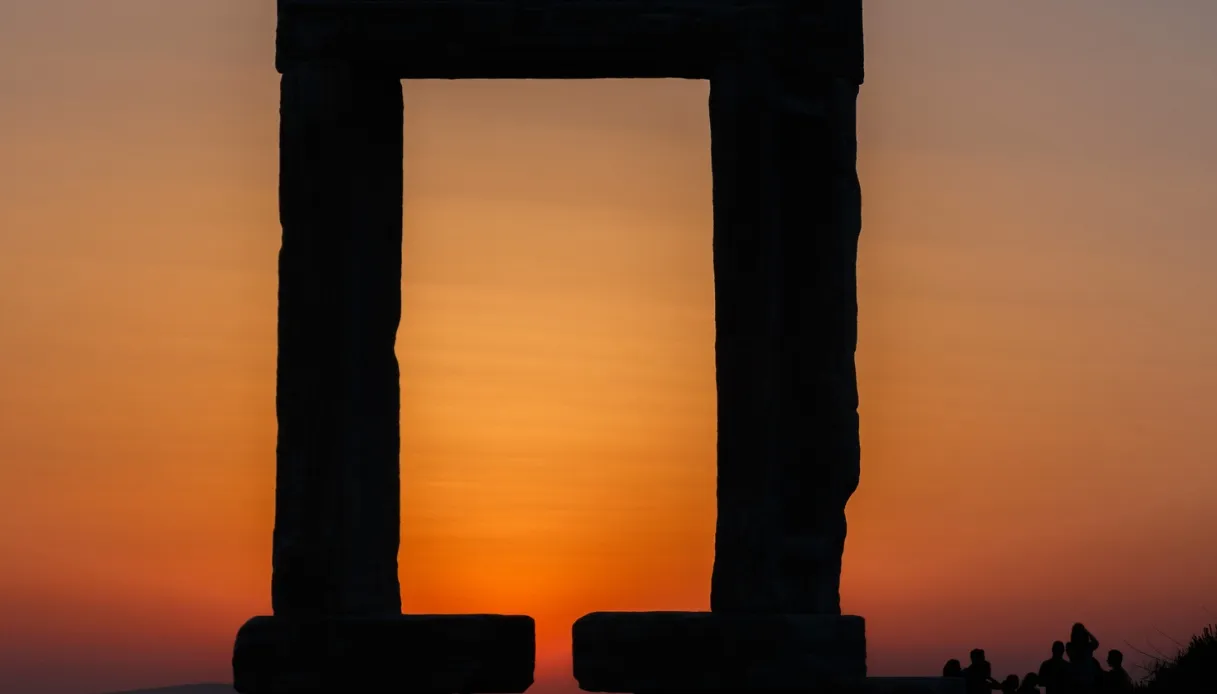
Even before setting foot on Naxos, you may catch sight of it: the silhouette of the Portara appears before the ships bound for the Chora, the island’s main town, planted on a narrow strip of land that extends into the Aegean. It looks almost like a colossal gateway ready to welcome those arriving from the sea, only that behind that threshold there is no temple anymore.
It remains a monumental gate, solitary and surprisingly intact, built with enormous blocks of local marble. The sea opens around it, while behind you can discern the profile of the city of Naxos, with white houses and the buildings of the historic quarter climbing toward the Venetian castle.
There is something unusual about the scene: a structure designed to be part of a grand religious building has, through the centuries, become an autonomous monument. The temple has vanished, the gate has remained. And it is precisely this incompleteness that has transformed the Portara into the most recognizable symbol of this splendid Greek island.
Brief History and Legends of the Portara
The story of the Portara begins in the 6th century B.C., during a period of great prosperity for Naxos. Around 530 B.C., the tyrant Lygdamis promoted the construction of a monumental sanctuary intended to exalt the island’s power. The project envisioned a building of imposing proportions, crafted according to the principles of Ionic architecture.
Recreations by scholars allow us to imagine a rectangular temple about 50 meters long and 25 wide, or nearly 60 by 28 meters. A colonnade would have surrounded the building, with 6 columns on the short sides and 12 on the long ones.
< /ask-ai-widget>
Behind the project was also a political ambition: Lygdamis wanted to make Naxos a power capable of competing, at least monumentally, with the great centers of ancient Greece. The dream, however, was cut short before the completion of the work, because political shifts and conflicts led to the tyrant’s downfall and the gigantic chantier was abandoned.
Rema a fascination regarding the sanctuary’s fate: the most widespread interpretation links it to Apollo, the deity associated with music, prophecy, and light. The Portara’s orientation offers an important clue, because the opening faces Delos, the sacred island considered by Greek mythology as the birthplace of Apollo.
Another hypothesis calls upon Dionysus, the god of wine, revelry, and fertility deeply linked to Naxos’ tradition. The island indeed occupies a central role in the myth of Ariadne and Dionysus, so much so that it is considered one of the lands most closely associated with the god’s cult.
It is Ariadne herself who carries the most famous legend tied to Palatia. According to the myth, Theseus, after slaying the Minotaur in Crete with the help of the Cretan princess, departed with her for Athens. During the voyage the two reached Naxos and halted on the Palatia peninsula. Upon waking, Ariadne found herself alone. From this tale arises the Italian expression “piantare in asso,” born from the transformation of the old saying “piantare in Nasso,” meaning to abandon someone right on the island.
Yet the tale offers a second version: Dionysus would have seen Ariadne on the island, fallen in love with her, and later taken her as wife. The tradition thus links Palatia to a story of abandonment, love, and transformation, adding a mythological dimension to a place already steeped in memory.
In the following centuries the site underwent further transformations. Part of the complex was reused in Christian times, while during Venetian and Ottoman dominations many stones of the temple were recovered for new constructions. The Portara, instead, stayed in place mainly for one reason: moving blocks of that size would have been an enormous undertaking.
Visiting the Portara, What to See and Do
The visit is brief, but the setting deserves time. From the Chora you reach Palatia via a narrow raised road that crosses the sea, and the route already offers one of the island’s most beautiful views of the Portara, especially as you approach the islet and leave the harbor behind.
Once you reach the peninsula, the path leads toward the monument. The ground is simple, with stone, steps, and uneven surfaces, so it’s wise to wear comfortable shoes.
Observing the Structure Up Close
The first thing to do is stop in front of the marble blocks. The Portara is built with material sourced from the quarries of Flerio, inland on Naxos, a area known since antiquity for marble extraction.
The surfaces of the stones still tell of their workmanship. Looking at them up close reveals the amount of material required to create an entrance of such dimensions and helps one better grasp the original project’s ambition.
Reconstructing the Temple in the Mind
Around the gate remain the foundations and other archaeological elements that help one understand the intended layout. The Ionic colonnade would have given the sanctuary a monumental presence, while its seaside position would have made the building instantly recognizable to anyone arriving in Naxos by sea.
Stopping at Sunset
The most spectacular moment arrives when the sun dips toward the horizon. The Portara’s location creates a tremendously dramatic natural backdrop: the solar disk passes through the doorway opening and the marble takes on warm tones, while the sea changes color minute by minute.
During peak season it’s wise to reach Palatia a little early, especially to calmly choose the best spot. The sunset draws many visitors, and the small space around the gate can become crowded.
Where It Is and How to Get There
The Portara sits on the islet of Palatia, immediately in front of Naxos’s Chora, on the island’s western side. The distance to the town is minimal, and the connection to the mainland is via a raised road.
Visitors staying in the Chora can reach the area directly on foot, starting from the seafront and following the path toward Palatia. The walk is one of the most pleasant aspects of the visit, because the landscape gradually changes. Behind you remain the harbor and the city’s houses, while in front opens the stretch of the Aegean Sea surrounding the islet.
This marvel also lends itself to a visit in the hours before sunset, perhaps after exploring the Chora and the Venetian district. From the monument, the view returns to the city and allows you to perceive Naxos from a particular perspective, with the urban silhouette gathered at the foot of the hill.
Perhaps the Portara was meant to tell the grandeur of Lygdamis and a sanctuary destined for the gods. Today, instead, it tells something different: it shows how powerful even a half-finished work can become.