
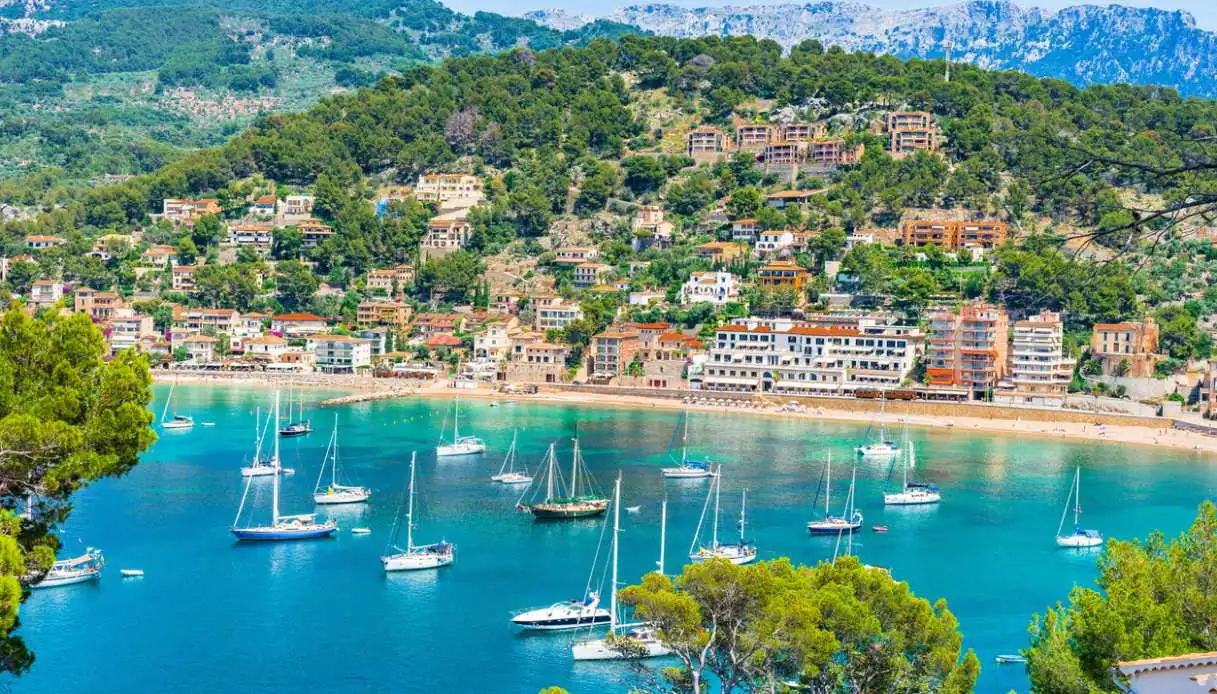
The Serra de Tramuntana, the great mountain range that runs through the northwest of Mallorca and is even a UNESCO World Heritage site, descends toward the Mediterranean, giving way to a wide and protected bay. A few kilometers further back, in the inner valley, lies Sóller, whose characteristic harbor for centuries has played a far more tangible role than that of a mere seaside resort.
Its location has a rare feature along the island’s northern stretch: the bay is one of the principal natural havens for fishermen and mariners in this part of Mallorca, set between rugged ridges and tranquil waters. Behind it, the Sóller Valley still preserves the orchards and olive groves tied to the local economic history.
The landscape tells a story of goods, departures, and returns. Between the 19th and early 20th centuries, oranges and lemons left the valley for other European markets, while many Sóller residents emigrated mainly to France. The contact with French and Belgian cities brought new ideas, tastes, and architectural models. The wealth accumulated through trade, industry, and textile activities returned to the valley as palaces, villas, and modernist façades.
What to see in Port de Sóller and surroundings
The beauty of this area lies precisely in the relationship between the small port and the valley. A visit limited to the beach would overlook a crucial part of its identity, because the true story of Port de Sóller is born from its bond with Sóller and with the mountains that crown it.
The bay and the promenade
The Port de Sóller bay has a broad, sheltered shape, protected by the Tramuntana peaks. Along the waterfront run terraces, restaurants, shops, and homes, while boats fill the most protected part of the water.
The main beaches are Es Través and Playa d’en Repic, both tucked into the curve of the bay. The second offers a particularly pleasant vantage for admiring the mountain profile behind the sea.
The Santa Catalina district and the Oratory
On the eastern side of the port lies Santa Catalina, the old fishermen’s quarter characterized by small houses and narrow streets climbing up the slope. Up above sits the old Oratory of Santa Catalina, a religious building dating back to the 13th century that today is tied to the maritime memory of the port.
The Sóller Tram
The most iconic mode of transport in the area is undoubtedly the Tram de Sóller, which along its route winds between citrus groves that illustrate the perfect link between landscape and the valley’s economic history.
The line was inaugurated on October 4, 1913, and links Sóller to the port across about 4.868 kilometers of track. The first trams were built by the Zaragoza company Carde & Escoriaza and some of the cars numbered from 1 to 3 still belong to the original 1913 stock. The trip lasts about 20 minutes and offers a scenic passage from the valley to the Mediterranean.
Sóller and Plaça Constitució
From the harbor it’s convenient to reach Sóller, the historic heart of the valley. The Plaça Constitució gathers some of the most representative buildings of the local prosperity. The church of Sant Bartomeu has medieval origins, but the façade that dominates the square today belongs mainly to the early 20th century.
The modernist façade, attributed to Joan Rubió i Bellver, creates a curious contrast with the surrounding historic fabric. Nearby is the Banco de Sóller, built in 1889 during a period of great economic growth for the valley. Its presence tells more than many words about the wealth achieved by Sóller traders through relations with France.
Can Prunera
To understand the history of Sóller’s Modernism, it’s worth visiting Can Prunera, on central Carrer de Sa Lluna. The house was built between 1904 and 1911 by Joan Magraner and Margalida Vicens, a couple who made their fortune in France trading fruit, vegetables, and liqueurs. In Sóller they were known by the nickname els Pruneres, tied to their involvement in the fruit trade.
The interiors form a small catalogue of Art Nouveau, with decorated encaustic tiles, sinuous lines, worked woods, and ornamental motifs. “The attribution of the building to Joan Rubió,” however, remains an unconfirmed hypothesis, an interesting detail for those who love architectural history.
The Tren de Sóller
Another experience tied to local history starts from Palma. The Tren de Sóller was officially inaugurated on April 16, 1912, after a project designed to connect the valley to the capital more quickly than the difficult mountain roads.
The route passes through tunnels, bridges, and the landscapes of the Tramuntana before arriving in Sóller. Today it still preserves carriages with a historic look and stands as one of Mallorca’s most unique rail experiences.
What to do in Port de Sóller
The ideal day blends sea, history, and mountains, without crowding the schedule. Port de Sóller shines when you take time to observe the landscape and follow the pace of the place.
- Swim in the bay: it offers a different perspective on the mountains, especially in the morning when the light is clearer.
- Sample Majorcan cuisine: it lets you bring to the table products tied to land and sea. Among the regional specialties, tumbet, croquetas, frito mallorquín, and sobrasada deserve attention.
- Reach Fornalutx: a small mountain village with honey-colored stone houses, green shutters, stairways, and narrow lanes that compose one of the most characterful rural landscapes of the Tramuntana.
- Proceed to Biniaraix: an even more compact hamlet, surrounded by the valley’s terraces. The village is also linked to an ancient network of stone paths and water-conduction systems.
- Head to Torre Picada: it offers a wilder perspective of the coast.
- Await the sunset over the port: one of the most beautiful experiences of the day. When the sun sinks toward the horizon, the mountains darken and the water reflects a golden light.
Where it is and how to get there
Port de Sóller lies in the northwest part of Mallorca, within the Serra de Tramuntana, about 4 kilometers from Sóller. Palma is roughly 30 kilometers away by road, while the island’s international airport sits near the capital. By car, from Palma you follow the Ma-11 toward Sóller. The route traverses the Tren de Sóller tunnel, the main modern link through the Serra de Tramuntana.
Once in the Sóller area, road signs direct toward the port. For a more scenic approach, the old climb through the Serra d’Alfàbia offers a much more dramatic and demanding itinerary. The center of Sóller also imposes restrictions for certain vehicles and has areas reserved for parking, so it’s wise to leave the car in authorized lots.
By train, you depart from Palma’s Plaça d’Espanya aboard the famed wooden historic train. The journey to Sóller takes about an hour. From the station you continue with the Tram de Sóller to the port, for another roughly 20 minutes. By bus, line 204 c directly connects Palma with Port de Sóller in about 45 minutes. Line 203 takes a more scenic route through Valldemossa and Deià, with a travel time of around 80 minutes.