
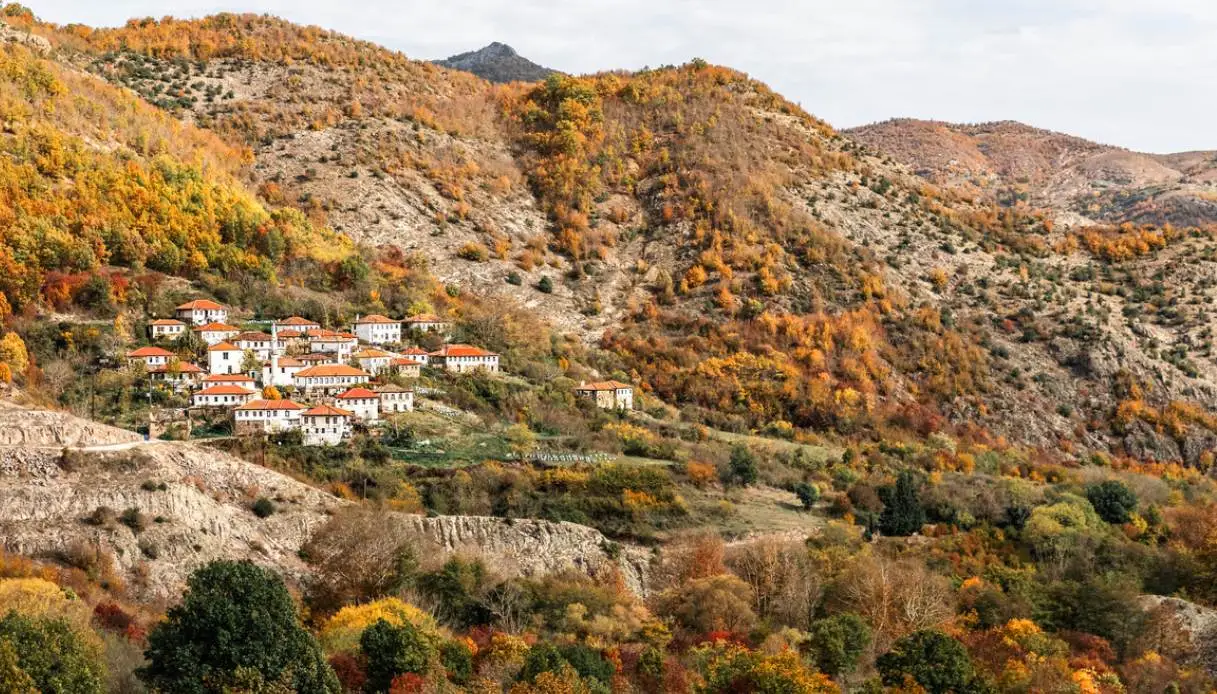
Among the mountains of Thrace, in Greece, a road climbs through forests, deep valleys, and small cultivated fields. Houses begin to appear, clustered on the slopes, while above the rooftops rise the minarets of mosques. These are the Pomacchi Villages, known in Greek as Pomakochoria, inhabited by a Muslim community with a Slavic linguistic tradition, whose history crosses centuries of Ottoman domination, political transformations, and intricate relations with neighboring countries.
The Pomacchi are Greek citizens, but their cultural identity encompasses diverse influences: beside Greek and Turkish, Pomak itself survives, a Slavic linguistic variety tied to the Rhodope dialects. The sense of belonging also varies from person to person, between those who claim their roots and those who identify more with a Turkish identity.
For decades these territories remained within a military surveillance zone, with strict restrictions on movement, only lifted in the mid-1990s. An isolation, both geographic and political, that inevitably left deep traces on daily life. Today, visiting these villages offers a glimpse of a different Greece, full of stone bridges, vividly colored traditional clothing, ancient houses, and recipes passed down through the years.
Sminthe, the village of the white mosque
We begin this particular journey in Sminthe (also called Sminthi), a small settlement that preserves the look of a mountain town, with houses arranged along streets that follow the terrain. What stands out here is certainly the white mosque, its pale color emerging among the rooftops and the mountain’s green tones.
Sminthe is also a good starting point to discover the surrounding landscape: in this region the Kosynthos River flows, directing its course toward Lake Vistonida, while ancient paths connect the small settlements. One of the historic routes leads toward Oraio and crosses the Stamatis stone bridge, a testament to the routes used by inhabitants before the construction of the modern road network.
<
Myki, the town of colorful traditional clothing
Then there is Myki, one of the region’s liveliest hubs that truly manages to astonish thanks to its residents: the traditional women’s garments, characterized by bright fabrics, decorative motifs, and colorful headdresses, are still part of the attire worn by some local women, especially during celebrations and festivities.
The hues of the scarves stand out against the façades of the houses, while the streets preserve a daily rhythm tied to the community’s customs. As one might guess, textile tradition remains a central element of the local heritage even today, even though new generations have adopted different lifestyles and habits.
Echinos, the ancient mosques and the memory of war
Undoubtedly no less fascinating is Echinos, and in fact it is one of the region’s largest Pomacchi settlements in the Xanthi area. Compared with the smaller centers, it features a more articulated urban fabric, a result of economic and housing transformations in recent decades. Among the main buildings stand the historic mosques, testimonies to the long-standing Muslim presence in this part of Thrace.
The town’s history also includes a World War II episode: in April 1941, the area was the theater of battles tied to Greece’s defense against the German invasion. For this reason, a monument recalling Christian and Muslim fallen soldiers stands along the streets.
Glafki, between silk scarves and Rhodope traditions
The road toward Glafki winds through a landscape becoming increasingly mountainous. The houses follow the terrain’s contours, while the view opens onto gorges and the forested slopes of the Rhodope Mountains. Here the cultural heritage is mainly tied to language, clothing, and community celebrations.
Particularly distinctive are the vibrant silk scarves, a component of the traditional women’s attire. On festive occasions, these fabrics take on an even more prominent presence.
Pachni, the village at 770 meters among gorges and mountains
Pachni captivates at first glance thanks to its striking position on the western Rhodope slopes, at around 770 meters above sea level. The mountains enclose the settlement and the streets climb the terrain’s varying elevations, weaving groups of houses with panoramic openings.
The village’s small cafés are traditional meeting places, while outside the settlement the landscape becomes more rugged. In the surroundings there are numerous natural cavities and rock formations worth exploring. One of these is Momtski Kamen, a name translated as the “Rock of the Girls.”
Medousa, the two-arch stone bridge over the Kompsatos River
If you’re seeking something absolutely characteristic, you must reach Medousa, which presents a landscape dominated by steep slopes, lush vegetation, and waterways that have left a deep imprint on the territory. Its most recognizable feature is an ancient two-arched stone bridge spanning the river.
Kotani, the tiny village with houses over 200 years old
Kotani, also written Kottani, is reachable from Medousa after about 7 kilometers of mountain road, with stretches requiring careful driving. The village has fewer than 30 homes and preserves traditional buildings dating, in some cases, to more than two centuries ago.
The houses typically rise over two floors, with stone walls, wooden frameworks, and tiled roofs. Yet here there is also a culinary specialty: in an old traditional residence, a tavern-museum has been created that brings together local cooking and everyday household items, where you can sample patatnik, a preparation based on grated potatoes, and parenik, made with corn flour.
Satres, between cultivated fields and the tobacco history
The village of Satres reveals another essential facet of Pomacchi culture: farming. The roads wind between cultivated plots and mountain slopes, within a region that for a long time relied primarily on agricultural products.
One of the historically most important crops is tobacco, particularly the Basma aromatic variety, which contributed to Xanthi region’s commercial prosperity.
Thermes, the hot springs and the mysterious relief of Mithras
Finally (but the Pomacchi Villages do not stop at those we have told you about) Thermes, called Ladzha in local tradition, is famed for its thermal springs, long used for balneotherapy practices.
The waters reach temperatures roughly between 40 and 53 °C and feed baths and spa facilities. Alongside the Ottoman-era thermal remains, the area guards an even older archaeological monument: near Kato Thermes, a large boulder bears a relief depicting Mithras, a deity of Iranian origin worshipped also in the Roman world.
