
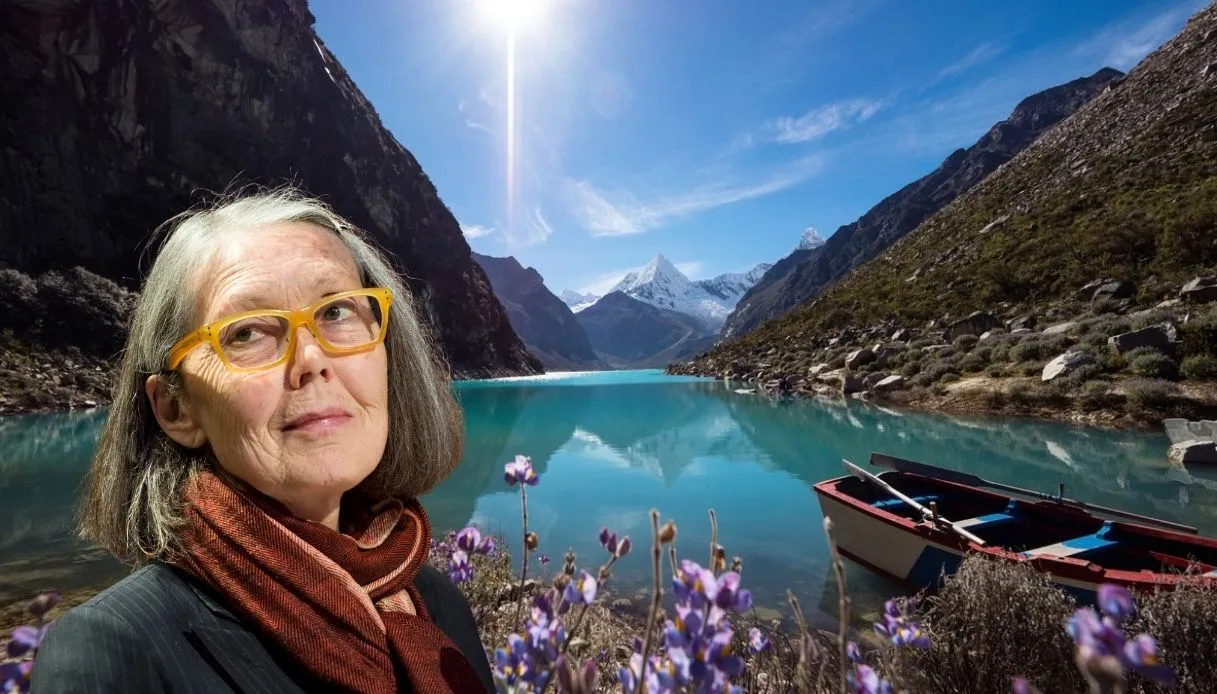
From the island of childhood to the streets of Buenos Aires, up to the volcanoes of the Peruvian Andes: the places of Autobiography of the Red tell of a journey through love, loneliness, and self-discovery. The verse novel is one of Anne Carson’s most captivating works, the Canadian author awarded the Nobel Prize in Literature in 2026.
In Autobiography of the Red, geography accompanies the emotional evolution of Gerione. From the island of his childhood to the streets of Buenos Aires, up to the mountains of Peru, each setting reflects a stage of his growth. The places thus become an integral part of a narrative suspended between reality, memory, and myth.
Canada and the Atlantic Island
The literary journey of Autobiography of the Red begins on an Atlantic island, in a North American setting often associated with Canada, the country of origin of Anne Carson. The author does not precisely identify the location, but describes a world made of familiar houses, schools, and everyday-life spaces.
From Gerione’s familial environment the story shifts to Hades, the hometown of Heracles, located on the other side of the island. It is a a place in Carson’s narrative geography, not a tourist destination identifiable with certainty. Gerione arrives there with the boy he loves and meets his grandmother, who keeps a photograph of a volcanic eruption that occurred in 1923. The landscape still bears the memory of the destruction caused by the volcano. This stop foreshadows one of the novel’s most important themes: the link between the earth’s fire and the protagonist’s emotions. It is also the place where the relationship with Heracles moves toward its painful end.
Buenos Aires
The Argentine capital is one of the most recognizable settings of the novel. Years after the separation from Heracles, Gerione arrives in Buenos Aires to attend a philosophy conference. The city, with its bustling streets, tango venues, and encounter spaces, represents a cosmopolitan interlude in his life. Here the protagonist, now twenty-two and passionate about photography, reunites with Heracles by chance, who travels with his new partner Ancash. Between conversations, walks, and resurfacing memories, Buenos Aires becomes the place where Gerione is forced to confront a love never forgotten. The urban landscape thus accompanies the transition from adolescence to a more complex self-awareness.
Lima and Peru
From Argentina the journey continues toward Peru, with a first stop in Lima. In the Peruvian capital, Gerione, Heracles, and Ancash reach the home of the latter’s mother. Along the seafront, urban spaces, and family conversations, the protagonist comes into contact with a culture different from the one known up to that moment. It is precisely in Lima that Ancash discovers Gerione’s hidden wings and tells him a legend tied to the Andes’ volcanoes: that of men who, after being cast into the fire, reemerge with red skin and wings.
Leaving Lima, the protagonists head toward Huaraz, a Peruvian town located in the Ancash region at the foot of the Cordillera Blanca. The landscape gradually changes: the streets of the capital give way to mountain routes, high altitudes, and panoramas dominated by the Andes. This part of the journey takes on the character of a geographical and inner exploration. Huaraz represents the gateway to a territory where local traditions, legends, and the imposing presence of nature take on a central role.
The final stop leads to Jucu, a locality in Carson’s narrative world situated north of Huaraz and marked by the presence of a volcano. Here the landscape becomes almost mythological: the fire that emerges from the earth’s depths echoes the red color of the protagonist and the emotions he has long tried to conceal. According to the legend recounted by Ancash, beings with wings and immortality would live in this territory, tied to the volcano. Gerione reaches the volcano by flight, recording its sounds, at a decisive moment in his personal journey. The flames and the mountains are no longer mere elements of the landscape, but become symbols of transformation. The journey ends with a powerful image, in which Gerione seems to finally recognize his own difference as part of his identity.