
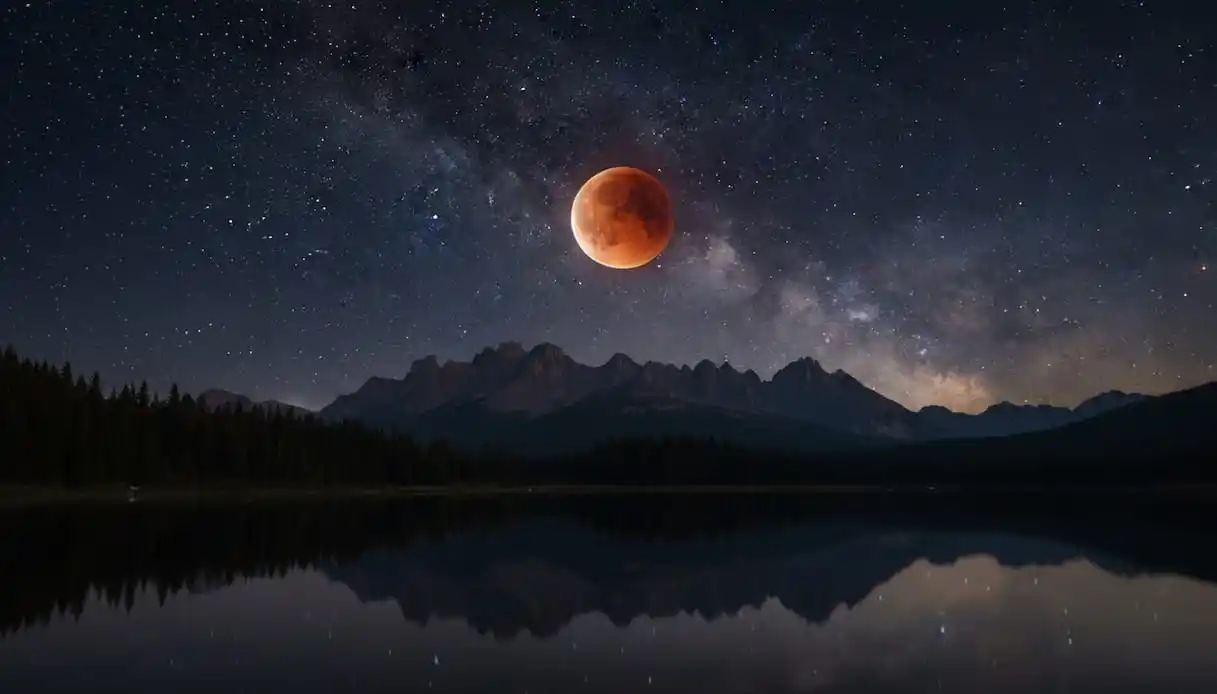
After the wishes voiced on the Night of Saint Lawrence and the following days spent chasing shooting stars, also punctuated by the year’s most anticipated astronomical event (the total solar eclipse of last August 12), the sky at the end of the month offers another appointment to mark in the calendar for those who love traveling in search of unusual panoramas. Friday, August 28, 2026 the full Moon, known as the Sturgeon Moon, will be the protagonist of a deep partial lunar eclipse: almost the entire disk will pass into Earth’s shadow, leaving visible only a thin illuminated edge.
From Italy the phenomenon will be observable in the early morning hours, albeit with a peculiarity: the Moon will already be very low on the western horizon. The most evocative moment will arrive just before dawn, when about 96.2% of the visible surface of the lunar disk will be immersed in Earth’s shadow. The spectacle, weather permitting, can be followed without astronomical instruments and will be streamed live online by the Virtual Telescope Project, directly from the Maremma in Tuscany.
What is the Sturgeon Moon
The Sturgeon Moon is the traditional name given to the August full Moon. The origin of the term is linked to the sturgeon, large fish once particularly abundant in the lakes and rivers of North America, especially in the Great Lakes region, precisely at this time of year.
The night between August 27 and 28 will coincide with the partial lunar eclipse, making the Sturgeon Moon more fascinating than usual. The phenomenon occurs when the Sun, Earth and Moon align and our planet lies between the Sun and the natural satellite. Earth thus projects its shadow onto the Moon’s surface, darkening it in part or, in the case of a total eclipse, completely.
That of August 28 will technically be a partial eclipse, not a true total eclipse: at the peak of the event about 96.2% of the lunar disk’s area will be inside the darkest shadow of the Earth. A thin illuminated rim will therefore remain. And it is precisely this detail that makes the event particularly interesting. The portion of the Moon immersed in the shadow could take on red, brown or coppery tones, while the un-eclipsed thin rim stays brighter.
The reddish color arises from the passage of sunlight through Earth’s atmosphere: the blue component is more widely scattered, while red and orange are refracted toward the Moon (it is the same optical principle that makes sunsets red and orange). The coincidence with the full Moon is particularly evocative also from a scheduling perspective: in Italy the full Moon will be reached at 06:18, while the eclipse’s maximum is expected at 06:12.
Where to see the lunar eclipse on August 28
To witness the spectacle in Italian skies you’ll need to rise early. In Italy the partial phase of the eclipse will begin at 04:33, while the maximum will arrive at 06:12. The penumbral phase will begin as early as 03:23, but in the early stages the change will be much harder to perceive with the naked eye.
The recommended observation window is therefore approximately between 04:30 and 05:45, when the shadow is already evident but the Moon is still high enough in the sky. At the moment of its maximum, instead, the satellite will be very close to the horizon: a completely unobstructed view toward the west-southwest will be required.
In Italy the best observing conditions will be especially in the western regions where an open horizon is possible. Sardinia will be among the most favored regions, but there are good chances also in Piedmont and Liguria. In Lombardy and central Italy the eclipse will still be visible, but the Moon will be lower in the sky.
In Milano, for example, at maximum the Moon will be just 4.7° above the horizon and will set around 06:46. In Turin it will be at 5.8°, in Genoa at 5.2° and in Cagliari at 6.7°. Unlike the last solar eclipse, however, this time the phenomenon can be observed with the naked eye and no special eyewear is required.