
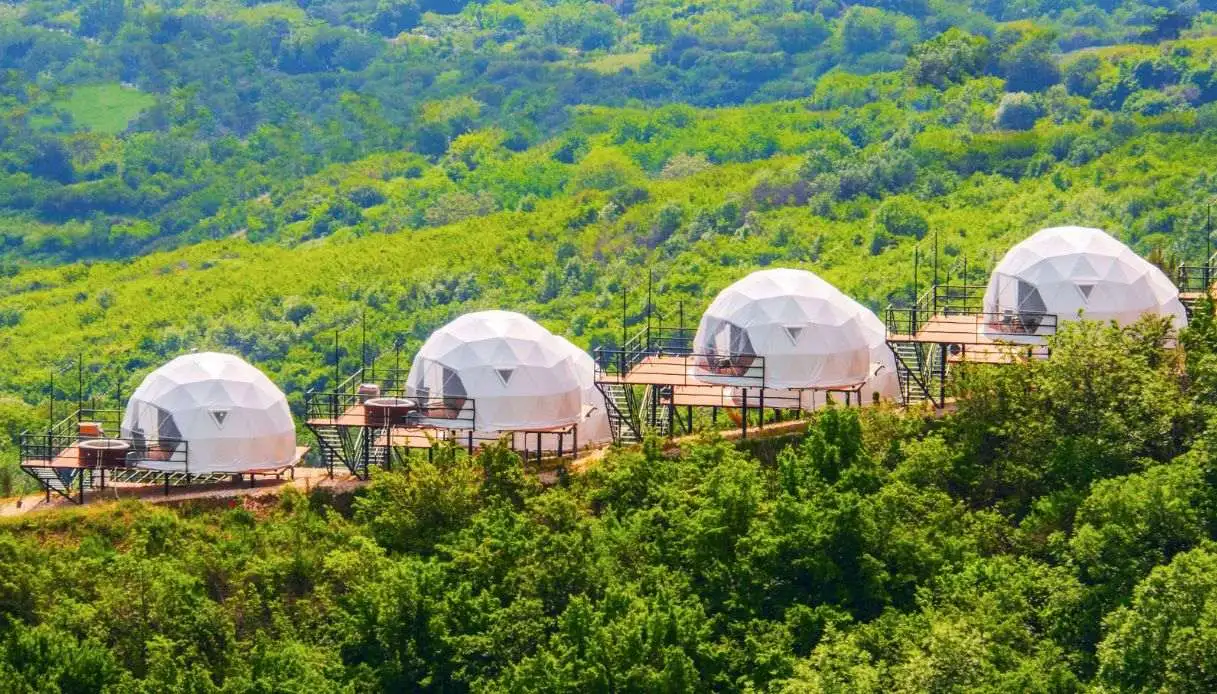
For millions of travelers, the perfect vacation is lived outdoors—whether sleeping in a tent, in a bungalow nestled among greenery, or within the comfortable confines of their own camper. It isn’t simply a matter of taste; the numbers affirm it as well. Open-air tourism, which encompasses campgrounds and holiday villages, remains one of the mainstays of European hospitality, growing faster than hotels and capable of extending the season far beyond summer.
To explain the evolution of this phenomenon is the General Assembly of EFCO&HPA, the federation that gathers open-air associations from 23 European countries. The meeting took place in Cavallino-Treporti, in the province of Venice, one of Italy’s camping capitals. On this occasion, Eurostat data on the sector’s performance and early projections for 2026 were presented.
The picture that emerged is of a Europe that is increasingly fond of holidays in close contact with nature, with Italy firmly among the protagonists.
The success of open-air tourism in Europe
According to Eurostat data, in 2025 EU open-air facilities logged 413 million overnight stays, representing 13.4% of all tourist overnight stays. It is a substantial market share that continues to grow: over the past decade, the sector has expanded by 28.5%, a pace that outstrips that of hotels.
The European rankings are led by France, which with 154 million overnight stays confirms itself as the undisputed camping destination. In second place is Italy, with 69.5 million stays. Following are Spain, with 49.8 million, Germany with 45 million, and the Netherlands with 26.8 million.
“Campgrounds and holiday villages offer high-quality holidays and support local economies,” said Arthur van Disseldorp, president of EFCO&HPA. According to the president, Italy well embodies the strength of the sector, and it is essential that European and national institutions create the conditions for businesses to continue investing and innovating.
Holidays in Italy Beyond Summer
Regarding Italy, the 2,600 facilities, collectively providing 1.3 million beds, forecast a 2% increase in arrivals compared with 2025. The real novelty, however, lies in the calendar: the open-air season no longer ends with summer and extends into October. The good weather also helped extend the season, boosting attendance across the country.
Veneto, which hosted the assembly, stands out as the clearest example of the sector’s economic weight. Here open-air tourism alone accounts for more than 27% of the region’s tourism turnover, and during the summer it recorded full occupancy. Its facilities account for more than one in four of the entire region’s overnight stays.
Behind the success of open air there is also a shift in how people travel. Lucas Pavanetto, vice president and tourism assessor of the Veneto Region, explained that the sector is well aligned with travelers’ new demands, who are increasingly seeking freedom, contact with nature, and sustainability.