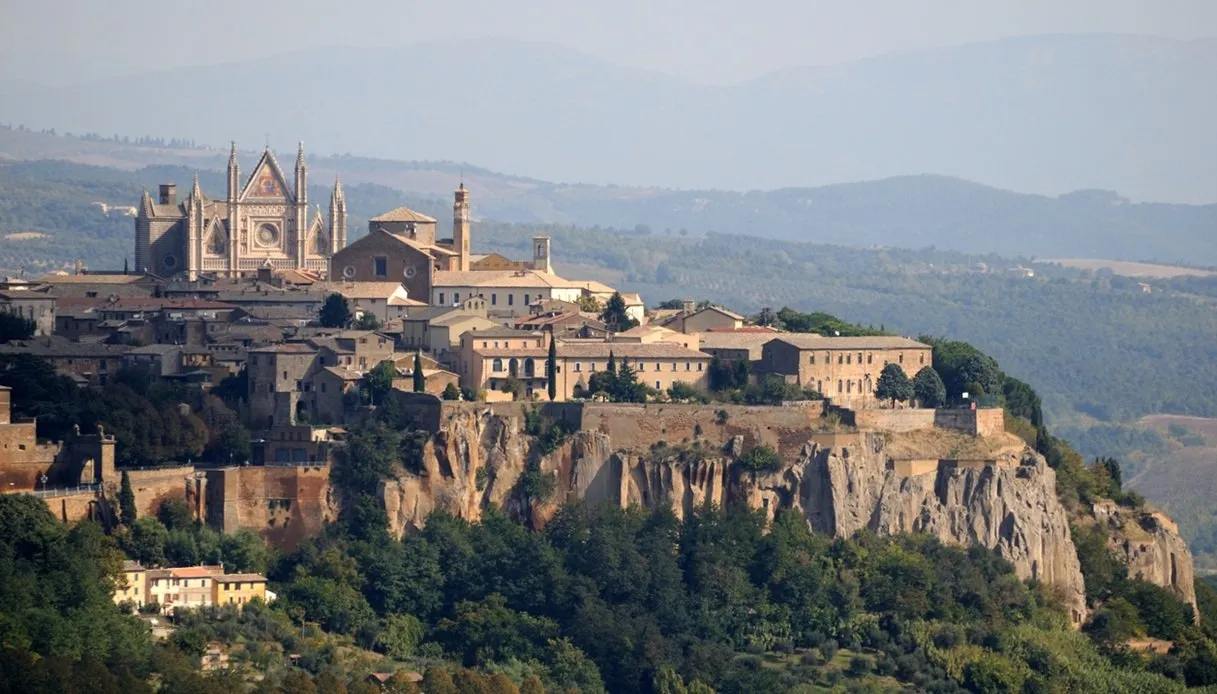
If Florence is the postcard that everyone knows, Orvieto is the surprise that reveals itself when you look a little deeper: perched on a dramatic tufa cliff and capable of hiding a completely different world beneath its streets, the Umbrian city has also captured the attention of The Independent, which placed it among the destinations to choose for venturing beyond the crowded hotspots.
The British daily indeed recommends it as an alternative to Florence, but not just any alternative: it is a city that, with a spectacular cathedral, Renaissance masterpieces and an incredible underground labyrinth, has a personality all its own. And it is precisely the journalist who visited it who reaches a meaningful conclusion: there is “too much flavor” here to be simply considered the alternative to some other, more famous city.
Orvieto, the astonishing city perched on the cliff
Arriving in Orvieto, the city appears almost suspended on a rock spur. Its profile is dominated by the Duomo, with a façade covered in gilded mosaics, sculptures, marble and a large rose window. The Independent notes its resemblance to Florence’s Cathedral, but specifies that it is not an imitation: the two cathedrals were developed and built in parallel, while Orvieto’s façade took more than two centuries to complete its spectacular front.
The surprise continues inside, in the Chapel of San Brizio, where Luca Signorelli created one of the most powerful painting cycles of the Renaissance. The route dedicated to the Stories of the Last Days was started by Beato Angelico in 1447 and completed by Signorelli between 1499 and 1504. The scenes of the Last Judgment, with souls dragged toward Hell, naked bodies and demonic figures, still strike today for their intensity. The British journalist describes it as something very close to “an animated Renaissance horror film” containing “one of the most visceral depictions of the apocalypse in Europe.”
Under the city lies a hidden world
Yet it is when you descend beneath the cliff that Orvieto reveals its most mysterious side: underground opens a labyrinth of over 1,200 among caves, wells and tunnels, dug into the volcanic rock over about 2,500 years. The oldest caverns date back to the Etruscans and, over the centuries, were also used to produce and store oil and wine, becoming part of the city’s daily life.
It is a kind of secret Orvieto, invisible to those strolling the streets of the historic center. Among the wonders to see is the Pozzo di San Patrizio, 54 meters deep and featuring two independent spiral staircases (for a total of 248 steps) designed to allow descending and ascending without crossing paths.
Then you return to the surface, among medieval alleys and views over Umbria, perhaps with a glass of Orvieto Classico, the white of the region traditionally produced with Grechetto and Procanico. It is the final piece of that tale of art, history and local products described by the Independent: not a mere alternative to the more famous Tuscan cities, but a special destination with a clearly recognizable character.