
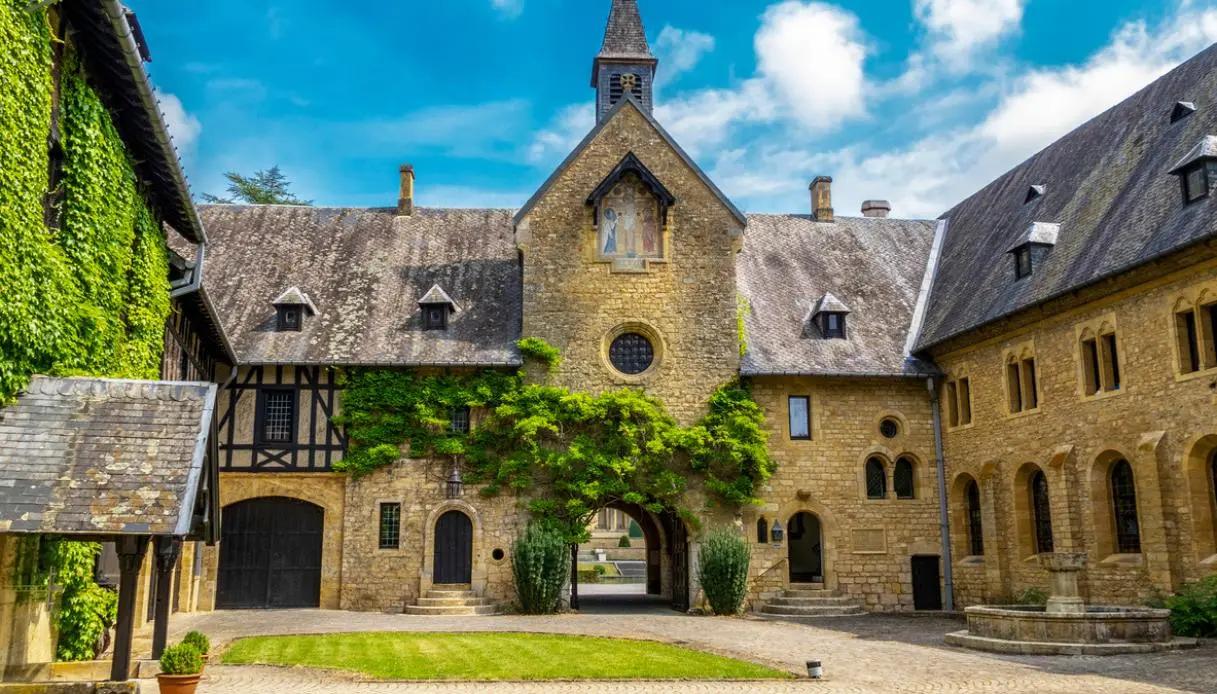
In a secluded valley of the Belgian Ardennes, greenery envelops the vestiges of an ancient abbey, while water still pours from the spring linked to its founding. A little further on, the monks’ labor continues to endure the passage of time, and it does so through a beer known worldwide. Orval brings together spirituality, architecture, memory, and gastronomy in a setting of great evocative charm.
The valley where it stands is called Val d’Or, “Valley of Gold” in French, and tradition holds that, over the centuries, the name was reversed to become Orval. The most recognizable symbol of the complex is a trout with a golden ring in its mouth, depicted on the abbey’s coat of arms and reproduced on the bottles of the famous beer.
The complex, among other things, sits in a region rich with woods, valleys, and small settlements. Its peculiarity, therefore, lies also in the coexistence of two realities: on one hand, the visitor route opens through the ruins and the museum spaces of the ancient abbey; on the other, the present-day monastery remains a Trappist Cistercian community, with a church, a guest center, and production activities tied to the locality’s tradition.
Brief History and Legends of the Orval Abbey
Orval’s history traces back to the 12th century. The foundation dates to 1132, near the spring linked to the legend of Matilda of Tuscany, the widowed duchess of Lower Lorraine. According to the tale passed down through the centuries, the noblewoman paused during a journey to drink from the water of a spring and dropped her gold wedding ring into the basin. After praying and pledging the founding of a monastery in that valley, she saw a trout appear with the ring in its mouth.
The vow was kept precisely with the birth of the monastic community. The spring, even today, continues to feed the complex and the brewery, making the legend a tangible presence in the abbey’s life. The first major trauma, however, arrived in 1252, when a fire destroyed the monastery.
Reconstruction restored life to the community, but wartime events continued to shape its destiny. In 1637, during the Thirty Years’ War, the abbey was sacked by French troops. Another dramatic episode dates to 1793: during the French Revolution, the monks offered hospitality to an Austrian army. Subsequently, the French revolutionaries set the complex on fire and forced the religious to abandon it.
The ruins and lands then passed into private hands. The rebirth began in 1926, when the owners donated the area to the Cistercians. Construction of a new monastery was thus launched, with a church consecrated in 1948. Regarding the brewing tradition, already present in the monastery’s past, it was revived in 1931 to help cover the costs of the works.
The project achieved great success thanks to a distinctive recipe based on a unique combination of hops and yeasts. It gave birth to one of the most famous Belgian Trappist beers, recognizable for its amber color, dry finish, and a bitter note with fruity undertones.
The Visit Through Ruins, Museums, and Medicinal Plant Gardens
The visiting route lets visitors learn the history of this jewel of Belgium through diverse settings, each with its own atmosphere. The ideal starting point is the complex of the medieval ruins, set amid the valley’s greenery. Remains of walls, arches, and structures belonging to the ancient monastery convey the grandeur of a religious site that endured fires, looting, and reconstructions. The vegetation, changing with the seasons, adds a nearly painterly dimension to the stones, while Matilda’s spring continues to flow near the site.
The admission ticket includes access to the ruins, the Monastic Museum, the Pharmaceutical Museum, Les Communs Abraham, and an audiovisual presentation dedicated to the monastery’s history and the life of the current community. The Monastic Museum occupies the neoclassical eighteenth-century cellars, designed by architect Laurent-Benoît Dewez.
These spaces were later used as a base for the construction of the present monastery. The collections tell Orval’s story through documents, photographs, illustrations, and models, alongside records of local ironworking, iron tools, kitchen utensils, and fireplace tiles from the area’s forge. A section devoted to sacred art presents older works and Art Deco pieces created around 1926.
Then there is the Pharmaceutical Museum, which leads into a reconstruction of an eighteenth-century monastic laboratory. Distillation stills, mortars, scales, vessels, and ceramic jars reveal the ancient preparation of remedies and medicines. The most pleasant moment comes in the herb garden, rich with scents and species used by traditional pharmacy.
Les Communs Abraham is the only building of the ancient abbey that has arrived to the present day in fully preserved condition. The name recalls Brother Abraham Gilson, an important figure in the monastery’s history, and houses an exhibition dedicated to beer production, a scale model of the complex, and an interactive path designed also for children.
The visit can continue in the abbey shop and in the tavern, open according to the site’s calendar. Here you can buy Orval beer, cheeses produced by the monks, books, religious items, and souvenirs. For enthusiasts, the brewery represents a particularly desired stop, but access is tied to the annual Open Door Day.
Where It Is Located and How to Get There
The Orval Abbey lies in the territory of Villers-devant-Orval, in Belgium’s Luxembourg province, in a southern part of Wallonia near the French border. Florenville serves as the nearby town to organize the visit and reach the complex.
By car from Brussels, the journey takes about 2 hours, depending on traffic and the route chosen. The option is particularly convenient for those who wish to also explore the Ardennes’ landscapes and the region’s small villages. Public transport requires more careful planning: the nearest railway station is Florenville, connected to Libramont by a few daily trains.
From the station, a bus reaches the abbey in about 15 minutes. Train services can be infrequent, so it is useful to check the schedules before departing and to plan the itinerary around connections.