
Sunday, August 23, 2026, some of Piedmont’s most beautiful castles reopen for a day. The Castelli Aperti event had already taken place on August 2 and is another opportunity to discover some of the patrons who have shaped Italy’s history.
Across all the provinces of Piedmont, there are countless manors, fortresses, and historic houses that overlook the valleys and are open to the public for visits. Even in summer, culture does not stop, and if you have the chance to be in the area, it is the most interesting Sunday excursion you could take.
Here are the castles that can be visited that day, listed by province.
Torino
In the province of Turin, the wonderful Castello di Agliè – Villa Il Meleto, Guido Gozzano’s House, opens. It is one of the most fascinating historic residences in Piedmont and a perfect destination for those seeking a cultural day trip outside the city (it’s about an hour’s drive from the Piedmont capital) with sumptuous interiors and a monumental park that looks like it stepped out of a period film (not by chance it has entered the Italian pop imagination as the set of the famous TV series Elisa di Rivombrosa). It can be visited from 9:00 to 12:30 and from 14:00 to 19:00. Admission: 8 euros.
The other castle in the Turin province is the Castello di Masino in Caravino. Set in a monumental park, the residence of a renowned Piedmontese family—the Counts Valperga di Masino—tells a thousand years of history through frescoed and furnished halls and a wonderful park. Today it is a property under the Fondo per l’Ambiente Italiano (FAI). It can be visited from 10:00 to 18:00. The ticket for the castle and park costs 15 euros (free for FAI members).
Asti
On the summits of the Asti hills there are many castles popping up here and there. Not all open for Sunday visits, but here are the ones that do: Torre del Conte Ballada di Saint Robert in Castagnole delle Lanze. The history of this place is special: in 1878, Count Paolo Ballada di Saint Robert moved to Castagnole where he bought the castle house and the adjacent hill, which he replanted with trees and flowers and had the tower built. It is open from 10:00 to 12:00 and from 15:00 to 17:00. Admission costs 3 euros, with a glass of wine 8 euros.
The area of the Castello di Castelnuovo Calcea is another visitable site. Of the medieval-origin castle today only the ramparts and the watchtower remain. Erected in 1154 by the will of the Marquises d’Incisa, it was destroyed by the Savoys in 1634, but rebuilt several times because it suffered numerous destructions during the wars that stained Monferrato in the following two centuries. The last major restoration took place in the 17th century, during which the towers, the donjon, and the damaged portion from a serious fire were repaired. The visit is free from 10:00 to 19:00 and admission is free as well.
The Castello di Costigliole d’Asti or Castello di Rorà recalls the castles of the Loire. While in the 16th century it became an important military fortress, what we see today is the result of renovations carried out in the 19th century. It remains partly privately owned and partly municipal. It opens from 10:30 to 12:30 and from 15:00 to 18:30. The ticket costs 5 euros.
In Asti, you can also climb the Torre medievale a San Giorgio Scarampi. In the Middle Ages, this village perched at 655 meters above sea level was an important military outpost. Access is free from 09:00 to 19:00.
Cuneo
The province of Cuneo boasts some of Italy’s most beautiful villages, some now famous worldwide. Among these is Barolo, and on Sunday you can visit the Castello Falletti di Barolo, home to the WIMU Wine Museum. Born for military use, it later became a residence, then was radically transformed to house a college, and finally a museum. Open from 10:30 to 19:00, admission is 9 euros.
Also open is the Castello Reale di Govone, from 10:00 to 12:30 and from 15:00 to 18:00. It is part of the circuit of the Piedmontese Savoy Residences, which UNESCO has included on the World Heritage List. Admission: 8 euros.
Famed as well is the Castello dei Principi d’Acaja in Fossano, which on this occasion offers tours at 11:00, 15:00, and 16:30. This historical fortress, built between 1324 and 1332 by Filippo I d’Acaja, was later transformed by the Savoys into a noble residence and today houses the civic library. Admission: 5 euros.
On Sundays, guided tours are organized every hour from 10:30 to 17:30 at the Castello di Roddi, an example of fortified architecture resulting from subsequent interventions. In the 16th century it belonged to Count Gaio Francesco della Mirandola, grandson of the great philosopher and humanist Pico. Inside are decorations dating to the 15th-16th centuries and kitchens from the 16th century. Admission: 6 euros.
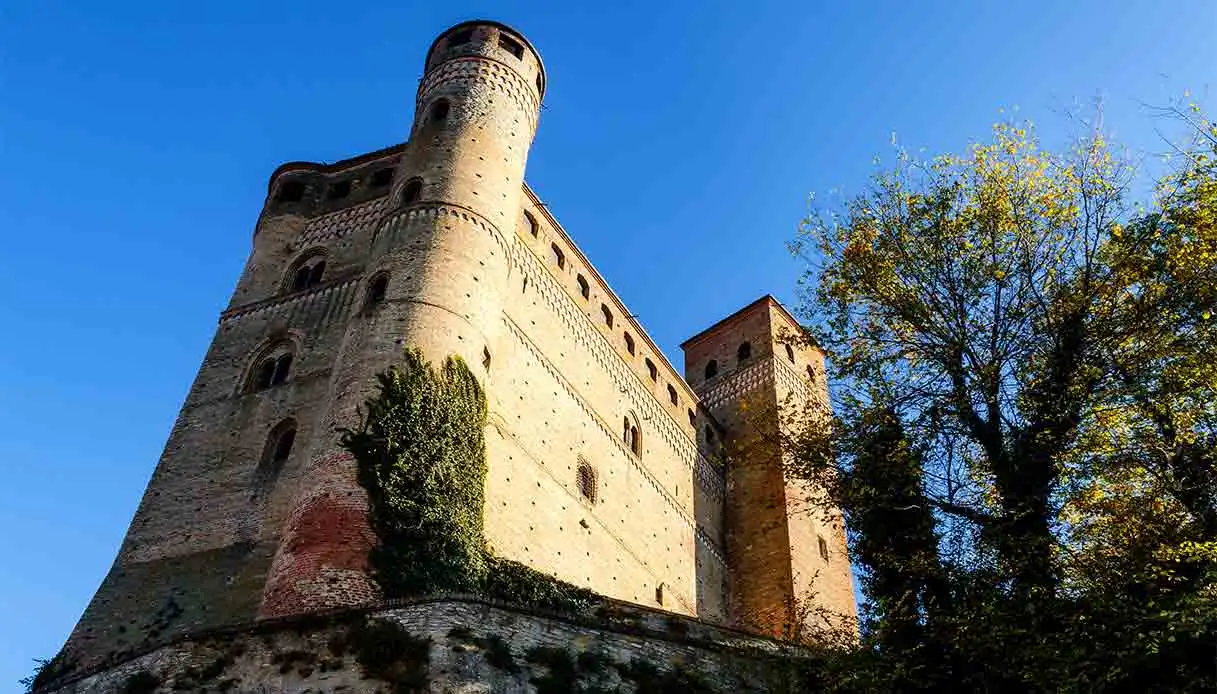
The Castello di Serralunga d’Alba is considered the symbol of this landscape and overlooks one of the most beautiful and intact villages of the Langhe, surrounded by the hills of renowned wines. It is one of the best-preserved examples of a 14th-century noble castle in Piedmont and represents a unique case in Italy for its architectural structure, akin to a French donjon. The castle is open for guided visits at 10:30; 11:15; 12:00; 12:45; 14:30; 15:15; 16:00; 16:45; 17:30. Admission: 6 euros.
Another property of the FAI is the Castello della Manta, a medieval fortress with austere charm, which in its Hall of the Baron houses a stunning example of late Gothic profane painting, inspired by chivalric romance themes. The castle is open with hours from 11:00 to 19:00. Full admission 11 euros, free for FAI members.
Many museums are also open for the Castelli Aperti day in Piedmont. In Alba you can visit the Diocesan Museum from 14:30 to 18:30, admission 5 euros. In Bra, the Civic Museum of Natural History Craveri and the Civic Museum of Palazzo Traversa, from 10:00 to 12:30 and from 14:30 to 17:30, with 5 euros for individual museums, 10 euros for all Bra’s civic museums. In Dronero the Luigi Mallé Civic Museum (15:00 – 19:00, admission 5 euros). In Magliano Alfieri the Museum of plaster ceilings and the Landscape Theatre, to which you can add the Castello degli Alfieri, open from 10:30 to 18:30. Full admission 5 euros for one museum, 7 euros for two museums. In Mombasiglio, the Museum of General Bonaparte at the Castle of Mombasiglio is worth a visit, especially with children, who will go wild at seeing thousands of soldiers and the scale model that recreates the Battle of Bricchetto on April 21, 1796, the event that opened Bonaparte’s path to history. Visiting hours are from 10:00 to 18:00, with admission of 8 euros.
A visit is absolutely worthwhile to its incredible history at the Palazzo Salmatoris in Cherasco. Built in the early 17th century, repeatedly embellished, enlarged, and reworked, here the peace of 1631 was signed, the Sindone was housed (taken from Turin in 1706), and here Napoleon Bonaparte imposed the armistice of 1796 on the Piedmontese; its rooms were repeatedly used as a residence by the Savoy court. Visits are open from 9:30 to 12:30 and from 14:30 to 18:30. Free admission.
In Saluzzo you can visit several places: the House of Silvio Pellico, with guided tours from 14:00 to 19:00, admission 3.5 euros; Casa Cavassa (10:00-13:00 and 14:00-19:00, admission 6 euros), the Civic Tower and the Olivero Art Gallery (10:00-13:00 and 14:00-19:00, ticket 3.5 euros), Villa Belvedere Radicati (10:00-13:00 and 14:00-19:00, 5 euros) and La Castiglia (10:00-13:00 and 14:00-19:00, admission 8 euros).
Diverse places are also visitable in Savigliano: the A. Olmo Civic Museum and the D. Calandra Gipsoteca (10:00-13:00 and 15:00-18:30, 5 euros); Palazzo Muratori Cravetta with guided tours and mandatory booking at 09:30 and 14:00; the Civic Tower at 10:30 and 15:00 (3 euros).
In Priero you can visit from 10:00 to 18:00 both the Medieval Tower and the village with guided tours, by reservation (4 euros), while in Corneliano d’Alba, only by reservation, you can visit the Tower.
Alessandria
The majority of Castelli Aperti on August 23 are in the province of Alessandria. Among them, the Castello dei Paleologi in Acqui Terme, which houses the Civic Archaeological Museum. Built in the 11th century, it was the residence of the bishops-counts of Acqui until the mid-13th century, then became a fortress of the town and the seat of the city’s Governors. It takes its name from the dynasty that held sway over Monferrato for centuries. It is open from 10:00 to 13:00 and from 15:00 to 19:00, with free tours. Admission costs 4 euros.
The Castello dei Torriani e dei Bandello, also called the Palazzo Pretorio, is what remains of the old castle of Castelnuovo Scrivia. Of the medieval complex, the high 39-meter crenellated tower and portions of the walls of the ancient fortification survive, on which, around the 14th century, the palace was built.
The Torre del Castello di Trisobbio can be visited from 17:30 to 19:00 with mandatory booking. Admission costs 2 euros. The 13th-century castle today houses a hotel and a restaurant.
Also in Acqui Terme is open Villa Ottolenghi Wedekind, a historic residence built in the first half of the 20th century on the hills by Count Arturo Ottolenghi and his wife Herta von Wedekind zu Horst, a painter and sculptor fully recognized among the avant-garde of the early 1900s. Today it hosts a relais, a restaurant, and is a venue for events and weddings. Guided tours are offered by reservation at 16:30 (time subject to confirmation). The entrance costs 15 euros.
In Alfiano Natta the Tenuta Castello di Razzano is open, hosting the Artevino Museum. The museum and aging cellars are open from 15:00 to 17:00 and admission costs 8 euros. If you wish, you can also stay there as it is a resort.
In the province of Alessandria you can also visit the villages of Ozzano Monferrato, a small jewel in the heart of Monferrato Casalese, with traces of ancient walls, a curtain tower, and Casa Bonaria, a very rare 15th-century house. It is visited with the aid of audio guides available via QR Code. And the village of Rosignano Monferrato where visits by donation are organized at 10:00, 11:30, 15:00, 16:30. Booking is recommended. Do not miss the underground infernot, UNESCO World Heritage.
Part of the Alessandria Castelli Aperti initiative are also the Gipsoteca Giulio Monteverde in Bistagno, open 10:00-13:00 and 14:00-18:00. Admission costs 5 euros; the Museo d’Arte Sacra di San Francesco Paola Benzo Dapino in Cassine, open 16:00-19:00, admission 4 euros; and the Elisabeth de Rothschild Foundation at Palazzo Lignana in Rivalta Bormida offering guided tours at 10 euros by reservation with hours 10:00-19:00.
Novara
There are lovely castles also in the province of Novara, though they are less known. You can indeed visit the Castello dal Pozzo in Oleggio Castello, which overlooks Lake Maggiore. Home to the Marchesi dal Pozzo d’Annone, it has a millennial history, begun in the year 900 when a Roman castrum was uncovered where the 5th Legion is said to have been stationed. The castrum was named Q.Legio, from which the name Oleggio seems to derive, renamed Oleggio Castello in 1186 in honor of the viscount building erected around the year 1000. A marvelous place with splendidly frescoed halls, truly unexpected. Visits are by reservation. The ticket costs 15 euros.
It isn’t exactly a castle, Casa Calderara in Vacciago di Ameno, a village overlooking the hills of Lake Orta. This is a Renaissance palace from the late 16th century that hosts the Antonio and Carmela Calderara Foundation, a contemporary art house-museum that preserves more than 300 works of painting and sculpture from the twentieth century. Visits are free from 10:00 to 12:00 and from 15:00 to 18:00. For guided tours, please contact the facility to arrange time and payment.
Also in the Novara province, the Castello di Vinzaglio opens – by reservation only – facing the Sesia River. Of the 13th-century fortress, only the remains of three towers and parts of the walls survive near the current Renaissance castle. In the 19th century the building became the property of the Sella family, who restored and altered it according to the standards and function of a country aristocratic residence.
Biella
Several places are also open in the Biella province. Starting with Palazzo Gromo Losa in Biella, where, from Saturday, August 22, the “Fatti ad Arte” event kicks off with Elham M. Aghili’s exhibition “Tutto rose e fiori” (All roses and flowers) (until October 18, 2026), from 10:00 to 19:00 (7 euros). And Palazzo La Marmora, a XVI-century historic palace that has belonged to the same family for centuries and today hosts events and weddings, which can be visited freely from 16:00 to 20:00. Admission 10 euros.
Among the must-see visits in the Biella province is the Ricetto di Candelo, a medieval architectural complex comprising about 200 buildings covering an area of about 13,000 square meters, crossed by streets. The first known reference to Candelo dates to the year 988. Access is free, but the Pro Loco also organizes guided tours. If you haven’t been, it is really worth it.
And finally, in Magnano the Enrico Collection at Villa Flecchia, a property of the FAI, is open to the public, offering guided tours from 14:30 to 18:30. It houses 60 paintings created between the 19th and 20th centuries, in refined dialogue with the landscape and the mountain scenery visible from the windows. Admission 8 euros, 4 euros for FAI members.