
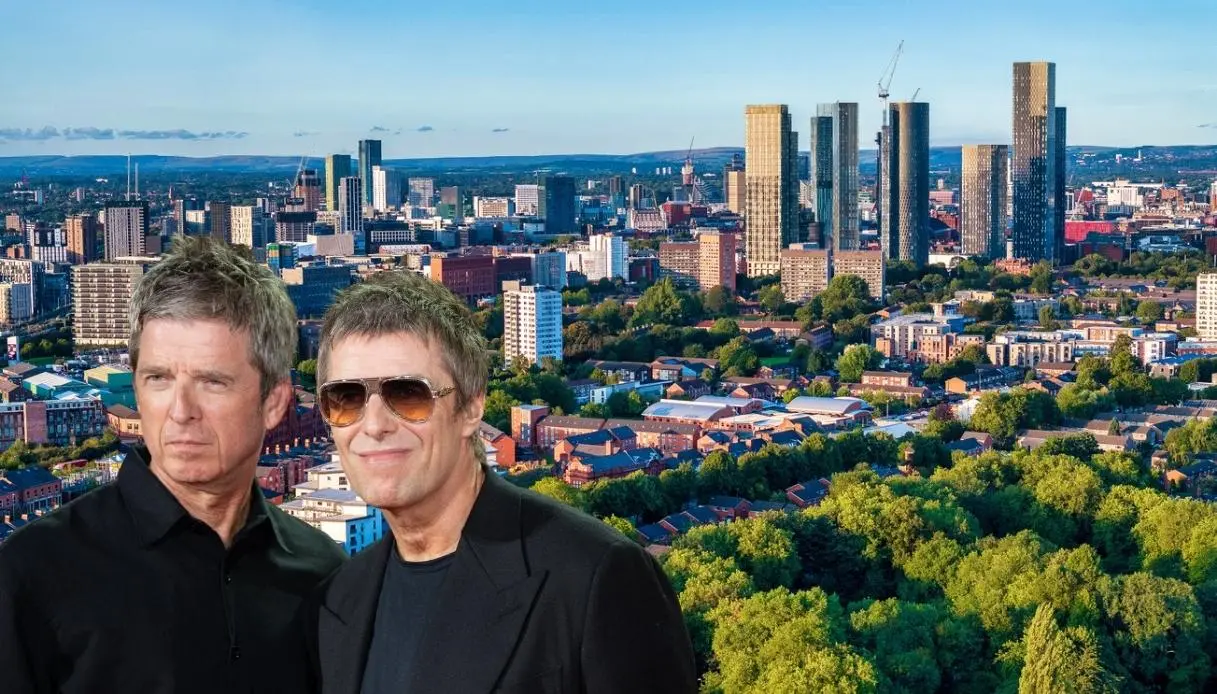
Following the reunion with the 2025 concert dates, the Gallagher brothers return to make the most famous Oasis songs echo for fans, with a handful of significant shows right in Italy: Rome, certainly, and maybe Milan. The most beloved British rock group of all time is ready to prompt crowds to sing along to their biggest anthems, and enthusiasts can only wait for ticket sales, revisiting their treasured venues, the concerts that defined them, and of course looping the most iconic tracks.
Here are all the Oasis’ places close to heart. To truly tell the Oasis story, it isn’t enough to line up records, gigs and memorable feuds. One must visit the places that built their imagination: streets of Manchester, record shops, intimate clubs and colossal stadiums. Places where Liam and Noel Gallagher were once two music-obsessed brothers and later the rock stars capable of turning Wonderwall, Don’t Look Back in Anger and Champagne Supernova into generational anthems.
Burnage: where it all began
Before the ocean of fans, there was Burnage, a neighborhood in the southern part of Manchester where Liam and Noel Gallagher spent a large portion of their childhood. Terraced houses, a frequently grey sky, and a humdrum suburban life: it’s hard to picture a scene more distant from the delirium that would soon surround the Oasis.
Yet, the band’s DNA is rooted here as well. The working-class pride, the unyielding Mancunian accent, and that “us against the world” attitude seem to spring straight from these streets. Before becoming Supersonic, the Gallaghers were simply two Burnage brothers with plenty to prove.
Sifters Records: the shop that became part of the songs
For an Oasis fan, Sifters isn’t a regular record store. It’s almost sacred ground. Noel used to visit it as a boy to buy albums and broaden his musical education, so much so that the shop would later enter directly into the band’s universe through Shakermaker. Even today it perfectly embodies the Manchester from which the Oasis were born: no rockstar posturing, just shelves full of vinyl, music waiting to be discovered, and the sense that the next album could change your life. Probably Noel, at sixteen, never imagined that one day someone would walk in because they had listened to one of his songs.
Wembley and Cardiff, the stadiums of the reunion
2025 marked the official reunion between the two brothers who kicked off the tour in Cardiff, Wales, where the Principality Stadium hosted around 74,000 fans… a record-breaking figure. The highly anticipated concert, sixteen years after the separation that began in Paris in 2009, traveled around the world. Wembley Stadium in London stood as one of the reunion’s triumphal events with the most dates. Three performances on July 3, two in August, and a grand finale with two encore performances in September.
The Boardwalk: Oasis’s first stage
Before Knebworth, before Maine Road, and before every concert opened with thousands of fans singing along, there was the Boardwalk. In the Little Peter Street club, the Oasis played one of their earliest gigs in August 1991. The venue no longer exists in its original form, but in the band’s emotional map it remains fundamental. It’s one of those places that makes clear how vertiginous the Oasis ascent was: from a room in Manchester’s indie scene to becoming, within a few years, one of the planet’s biggest bands. Far more than Definitely Maybe, destiny looked almost inevitable in hindsight.
Stratford Avenue: the cover of Definitely Maybe
Number 8 Stratford Avenue, in Didsbury, is instantly recognizable to anyone who has studied the Definitely Maybe cover at least a hundred times. It was the home of guitarist Paul “Bonehead” Arthurs and that living room became one of the most celebrated interiors in the history of British rock. Liam lounging on the floor, Noel with the guitar, photographs, objects, and cultural references scattered around the room: the image perfectly captured the Oasis of 1994. Ambitious, brash, and already convinced they were the best band in the world. In the same place, some images linked to Shakermaker were also shot. For a devoted fan, stepping from Stratford Avenue is almost like stepping inside an album.
Oldham Street and the Northern Quarter, Manchester’s music heart
The Northern Quarter is one of the districts that best captures the alternative Manchester loved by the band. The Oasis frequented venues and shops in the area, from the legendary Dry Bar to Piccadilly Records and Afflecks. It was a world filled with musicians, fanzines, records, clothes, casual encounters, and new bands. In other words, the perfect ground for turning a guitar into an escape. Walking today along Oldham Street with Live Forever in the headphones remains one of the best ways to understand the cultural ecosystem the Gallaghers emerged from.
Maine Road
In April 1996 the Oasis arrived at Maine Road, then the stadium of Manchester City. For Liam and Noel, devoted fans of the club, it wasn’t merely another big show: it was a statement of triumph. The band was riding the peak of (What’s the Story) Morning Glory?, and Manchester found itself facing five guys who had risen from its neighborhoods to dominate Britpop. Few images capture the Oasis ascent better: Liam in front of the crowd, Noel with the guitar, and an entire city ready to sing.
Knebworth: when they seemed invincible
If Maine Road marked a triumphant homecoming, Knebworth was the ultimate conquest of their realm. In August 1996 roughly 250,000 people attended the two shows, while millions across the world tried to grab a ticket. It’s arguably the moment when the phrase “the biggest band in the world” stopped sounding like a Gallagher provocation. In front of that sea of fans, songs like Wonderwall, Champagne Supernova and Don’t Look Back in Anger belonged to everyone. The Oasis had started on Manchester’s streets and had reached this point without losing their swagger, their guitars, and the absolute belief that they were meant for something colossal. Perhaps this is the thread that links all their favorite places: from Burnage to Knebworth the scale changes, but the attitude remains the same. As one fan might have shouted at the stage: mad fer it.
Heaton Park
In the emotional map of the Oasis there deserves a place as well Heaton Park, the vast green space in Manchester that in June 2009 hosted one of the more energetic shows of the band’s later era. In front of tens of thousands, the night was marked by technical glitches and interruptions that could have derailed everything. Yet, Liam, Noel, and the rest returned to the stage and carried on with the performance. And it’s hard to imagine anything more Oasis: chaos, tension, a massive crowd, and, in the end, songs big enough to hold it all together. Listening to Slide Away or Live Forever while picturing that sea of fans under the United Kingdom sky means stepping into a different chapter of their story, less innocent than Knebworth and closer to the brink that would come soon after. For this reason, Heaton Park remains a special place: it tells not only about success but also about the Gallagher brothers’ unpredictability.
