
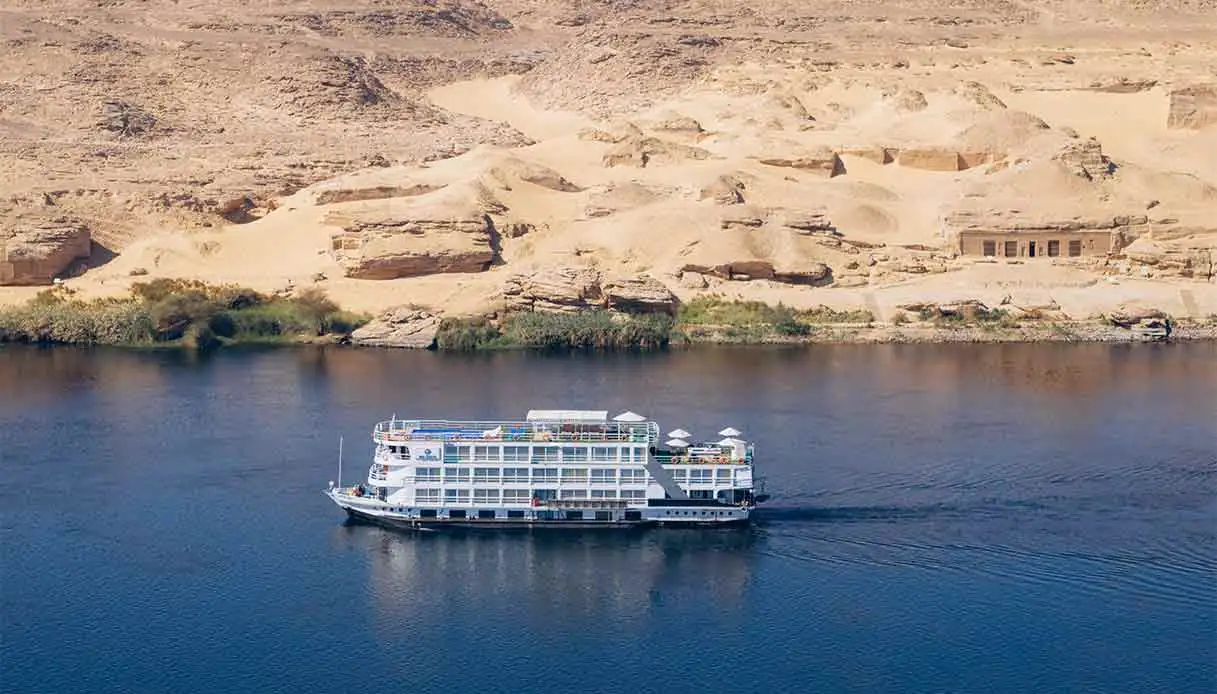
I’ve done countless trips, and they have all been wonderful. Each one gives something: a place, a landscape, an atmosphere, an experience, a new piece of knowledge. As Paulo Coelho says, “No two journeys are identical on the same path.” So it isn’t easy to rank the best trips. Yet there is one that, in my opinion, stands out with a capital “V” for Voyage, because it encapsulates every experience one can have, and that is the Nile cruise to discover the Classical Egypt.
Why Take a Nile Cruise
The Nile cruise, the longest river in the world (6,852 kilometers across eight African countries), is not the ordinary cruise that often touches places accessible by other means.
Many Places in One Journey
The Nile cruise is the only way – at least for now – to reach certain sites. They are mainly archaeological sites that rose along the watercourse while behind them there was only desert, because, as we know, without water there is no life. And this is why the ancient Egyptians founded their cities, such as Luxor, one of the essential stops on this journey, and places of worship, like the Karnak Temple, perhaps the largest and most majestic of the complexes of pharaonic Egypt, and the Temple of Edfu, two of the other unmissable stops during the cruise, all along the course of the Nile. Between one stop and the next, often there is nothing, there are endless landscapes, cultivated fields, small villages and roads that line the river are not always present: navigating is the only solution to move.
A Journey Rich in Experiences
Having explained the logistics, from a historical and cultural standpoint the Nile cruise is an incredibly rich journey. Each day is dense with experiences, information, and emotions. The guide, who accompanies the tour from start to finish, is, of course, essential for conveying historical knowledge (the dynasties of Ancient Egypt in relation to the Gregorian calendar, for example), genealogical trees of pharaohs and queens, explanations (the meaning of hieroglyphs, for instance), stories, anecdotes, and symbolisms. Because the information is abundant and complex, the advice is to ensure that the guide accompanying your trip speaks Italian, because even if we know languages well, speaking Italian truly makes a difference in grasping every nuance.
The Journey of a Lifetime
At the end of the trip we will know everything about the pharaohs, be able to recognize the symbols that represent them on temple or tomb walls (in the Valley of the Kings and the Valley of the Queens), know their history and the archaeologists who have dug in the desert and unearthed the treasures we can admire today, as well as the culture, religion, and traditions of Ancient Egypt, but also the geography of Egypt, in a way we never did as children despite spending hours and hours in our school books.
The Classic Stops of the Nile Cruise
Before anything else, it should be noted that Nile cruises come in different types, as the duration of the journey varies (from 5 to 15 days, the longest typically starting from Cairo) and the places visited differ. Additionally, the cruise is always paired with either the outbound or the return leg with a stop in Cairo, including the Giza Plateau to visit the Pyramids (Khufu, the largest and the only one you can enter; Khafre, the medium; Menkaure, the smallest. Moreover, the pyramids are not only three but nine because beside the main ones there are six queen pyramids), the Sphinx, and now also the newly opened Grand Egyptian Museum. During the day you also visit the “old” Egyptian Museum, which remains open even though the new one has been inaugurated, and some areas of the city, starting with the bazaar.
So one night or two, depending on arrival, are spent in the Capital, while to board the ship – unless you depart directly from Cairo, but only in some seasons due to the Nile level – you must fly to Luxor, about an hour by plane. Let’s say the classic Nile cruise includes a couple of nights in Cairo and four to five nights aboard the ship for a total of seven to eight days.
The Stops of the Classic Nile Cruise
The cruise ships head south, toward what was once Upper Egypt, and sail against the current (the Nile flows into the Mediterranean Sea). The classic stops are those between Luxor and Aswan and are thus:
- Luxor, on the east bank of the Nile, to visit the Karnak Temple, one of the most imposing and spectacular religious complexes of Ancient Egypt, which is connected via the Avenue of Sphinxes to the Temple of Luxor, both UNESCO World Heritage sites;
- Valley of the Kings and the Queens, to visit the tombs of the pharaohs and queens already located in the desert area and accessible by coach. The tombs are visited on a rotating basis, so returning multiple times doesn’t guarantee you’ll see the same ones. To visit Tutankhamun’s tomb, discovered almost intact by Howard Carter in 1922, you must buy a separate ticket. The same day you also visit the Temple of Hatshepsut, at Deir el-Bahari, the woman who ruled as pharaoh for nearly half a century, and the Colossi of Memnon;
- Esna Lock, Temple of Edfu (one of the best preserved) and Kom Ombo, right on the banks of the Nile;
- Aswan with a visit to the Aswan Dam, a piece of modern engineering dating from the 1970s to address the drought problem, and the Temple of Philae (reachable by boat).
The Excursion to Abu Simbel
Usually the journey continues with a visit to Abu Simbel, perched on Lake Nasser rather than the Nile and therefore reachable by a three-hour coach ride (sometimes an overnight stay is arranged so you embark again the next day). Occasionally the Abu Simbel excursion is not included in the package, but if you want to complete the journey it is absolutely essential to include because visiting the two temples, Ramses II’s and his preferred wife Queen Nefertari’s, is worth half the trip, not only for beauty, majesty, and state of preservation but also for the history behind them: in a multinational archaeological undertaking in the 1960s the site was dismantled piece by piece to avoid being submerged by the Aswan Dam, and rebuilt a little further upstream.
The Longer Cruises
There are also longer cruises from Cairo to Aswan (or vice versa) that traverse almost the entire Egypt along the Nile. They are less frequent because, besides lasting longer, they are also more expensive, but they allow you to see Middle Egypt as well, therefore less touristy but just as fascinating. It stops at Beni Suef – El Minya where you visit the Meidum Necropolis, the Tell el-Amarna sites and the Beni Hassan Necropolis with rock-cut tombs; then to Abydos to visit the Temple of Seti I; to Dendera where the Hathor Temple is, before arriving in Luxor.
The Downside of a Nile Cruise
This is one of the world’s most successful journeys: it appeals to virtually everyone. According to the latest tourism data, about 14 million visitors come to the Pyramids of Giza each year, and almost all of them continue or arrive (as noted, Cairo is an obligatory stop on the Nile itinerary) from the Nile route.
Since each ship can carry between 100 and 150 passengers, do a quick calculation of how many ships can navigate this river simultaneously during peak season, which, aside from two periods in the year (January and July–August), is basically always. This means that, when docking, even in large cities like Luxor or Aswan, there isn’t room for all of them and they have to line up alongside one another, forming a line of four to five ships, and the situation is chaotic on any of the ships.
In fact, if you dock first (though not guaranteed) and your ship is closest to the pier, it’s easier to embark and disembark, but it also means passengers on the other nearby ships must cross your decks to move to and from their ship. If you arrive last, you must cross the other ships to go up or down. If you’re stuck between two ships, the worst of all, because in addition to the above inconveniences you’ll also have to look out of and be looked at, since the cabin windows will be right across from each other. So the number one problem is the overcrowding of ships.
Overtourism Problem at Archaeological Sites
Then there is the second problem, namely the crowds at archaeological sites. The guide who led my group, Tony, told us that to visit the Philae Temple, located on an island reachable by small boats, during high season you stand in line outside for an hour, often with no time to enter because you must move on to the next site. Not to mention the Sphinx in the Giza Plateau: to reach it you must squeeze into a rather tight space and when groups arrive it’s almost impossible to even take a photograph. Entering the Khufu Pyramid or the tombs in the Valley of the Kings is also futile; and if you suffer even a little claustrophobia it is strongly discouraged (the pyramid tunnel is one-way and you cannot turn back if you change your mind…).
Tips for an Unforgettable Nile Cruise
So what is my very personal recipe to enjoy what is arguably the most beautiful journey one can take in life? There are two pieces of advice, which is also what I did: start in the low season to find fewer crowds and fully enjoy the sites of the Ancient Egypt and choose a small ship.
Travel in the Low Season
The low season comprises two periods: January (for any trip, generally the time when people travel the least is between Epiphany and roughly the end of the month—airlines and hotels often offer discounts because after Christmas not many can travel). In Egypt during this period it isn’t freezing cold nor unbearably hot, so dress in layers and pack from a down jacket to a t-shirt.
The other period is July–August, when it is truly hot (40–45°C at noon), but visits are organized smartly because they begin very early in the morning (around 6–7), return to the ship for lunch and rest during the hottest hours, and go out again in the late afternoon when the sun is lower, to give you an idea.
In fact, at sunset you can enjoy a wonderful spectacle of the sites, especially those on the banks of the Nile, which are illuminated in the evening, since the temples close between 8 and 10 PM. It is essential to always carry a water bottle to stay hydrated, a hat to protect from the sun, and sunscreen to avoid sunburn, and try, following the guide’s example, to always find shade. Traveling in the low season will help you avoid long lines to visit temples and to pass the Esna Lock (often you’re the only ones who need to pass, otherwise you end up lining up for hours) and you’ll avoid peering into other people’s cabin windows.
Another tip I want to share is, if you can afford it, to opt for a cruise aboard a small ship that can accommodate only a few guests. Today there are ships that feel more like yachts and that, on board, offer just a few cabins but spacious ones, to host around twenty passengers. Of course, this type of cruise is a bit more expensive (roughly double), but not prohibitive (around €3,500–€4,000 all-inclusive, including flights), and if you travel in the low season, it costs even less.
On the Savoy, for example, which hosts only 12 suites with wall-to-wall windows to enjoy the river scenery from the bed, only 24 passengers can travel (sometimes it’s chartered for a single group of friends), there’s a restaurant with an à la carte menu, two bars, one in the common lounge and another on the rooftop, where there’s also a fantastic infinity pool.
The advantages of taking part in a small-group cruise are numerous in terms of timing and organization, the quality of onboard services, and in the restaurants where you stop for lunch occasionally. If you also think about the bathroom break for twenty people or for 150 you’ll quickly see the wisdom of these recommendations.
Furthermore, with these more exclusive cruises you also visit less frequented sites and off the beaten tourist paths—such as the Medinet Habu complex, Ramses III’s grand funerary temple on the western bank of the Nile—and you can lunch in more distinctive but smaller restaurants, where there’s room only for small groups, such as the Nubian restaurant on the island of Begheh, opposite the Temple of Philae with a view of this emblematic site of Ancient Egypt.