
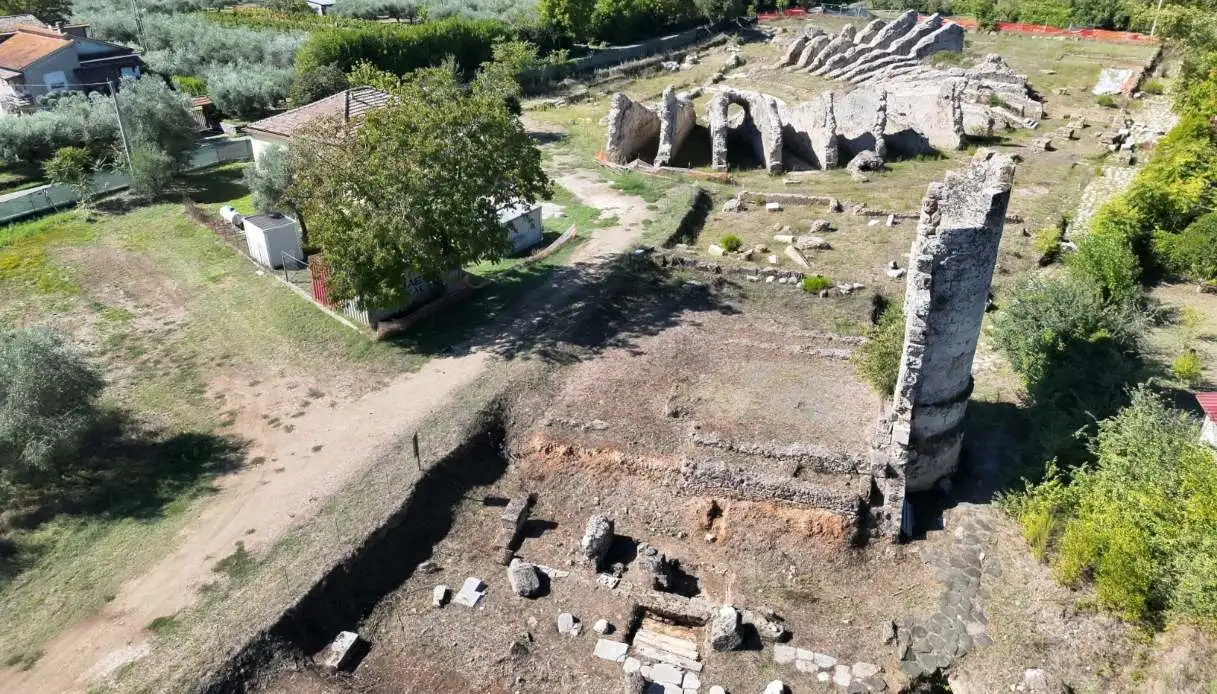
The ancient Roman town of Aquinum, in the territory of Castrocielo and Aquino, continues to reveal valuable testimonies from its past. The eighteenth Excavation Campaign of the University of Salento has unearthed two archaeological artifacts of particular interest, presented to the public for the first time during the Archaeology Weekend on October 3.
The new discoveries allow adding important pieces to the knowledge of the public, religious, and monumental life of the Roman colony. For eighteen years the excavations, directed by Giuseppe Ceraudo, professor of Ancient Topography at the University of Salento, have involved researchers and students in a project that combines research, training, protection, and enhancement of the heritage.
The Discovery
The first artifact is a richly decorated stele, repurposed in the pavement near one of the main intersections of the ancient city. On the monument appears the name of the dedicant, probably Caius Ammius Cammarus, although the full reading of the inscription still needs to be verified.
What makes the stele particularly interesting is the decorative program, consisting of garlands, festoons, and bucrania that frame three animals: an ox, a ram, and a pig. Their presence on the same monument could be linked to the sacrificial triad of the suovetaurilium, one of the most solemn rites of Roman religion, during which exactly a pig, a sheep, and a bull were sacrificed.
The second artifact is a marble votive altar, particularly significant because a newly recovered fragment has enabled the reconstruction of part of an inscription that was previously known only incompletely. It is now possible to identify the deities to whom it was dedicated: the Genius of Augustus, the Lares of Augustus, and the Genius of the Colony.
To commission the dedication was Manius Popidius Anteros, a wealthy freedman who held the office of seviro augustale. The altar thus provides a precious testimony to the religious and civic dimension of the colony, showing the bond between the community, the imperial cult, and public life.
The Importance of the Discovery
The two artifacts contribute to telling Aquinum, where religion, politics, and civic life were tightly interwoven. The stele opens new questions about ritual practices and the public spaces of the colony, while the altar allows deeper exploration of the relationship between the cult of the imperial house and the community’s identity.
The 2026 campaign also brought to light other significant testimonies. In the Roman theatre, investigations continued, yielding a marble slab with the formula FVL(GVR) C[ONDITVM], connected to the ritual by which Romans bury and consecrate a place struck by lightning. It is a rare testimony that could indicate an ancient atmospheric event interpreted as a manifestation of divine will.
During the Weekend of Archaeology five restored marble heads were also presented, including the so-called Caesar of Aquinum and a portrait attributed to Drusus Major.
The campaign marks, finally, an important novelty for the project: for the first time archaeological investigations have extended to the municipal territory of Aquino. The collaboration between Castrocielo and Aquino thus allows the historical unity of the ancient Roman colony to be restored, surpassing current administrative borders and broadening the prospects of the research.