
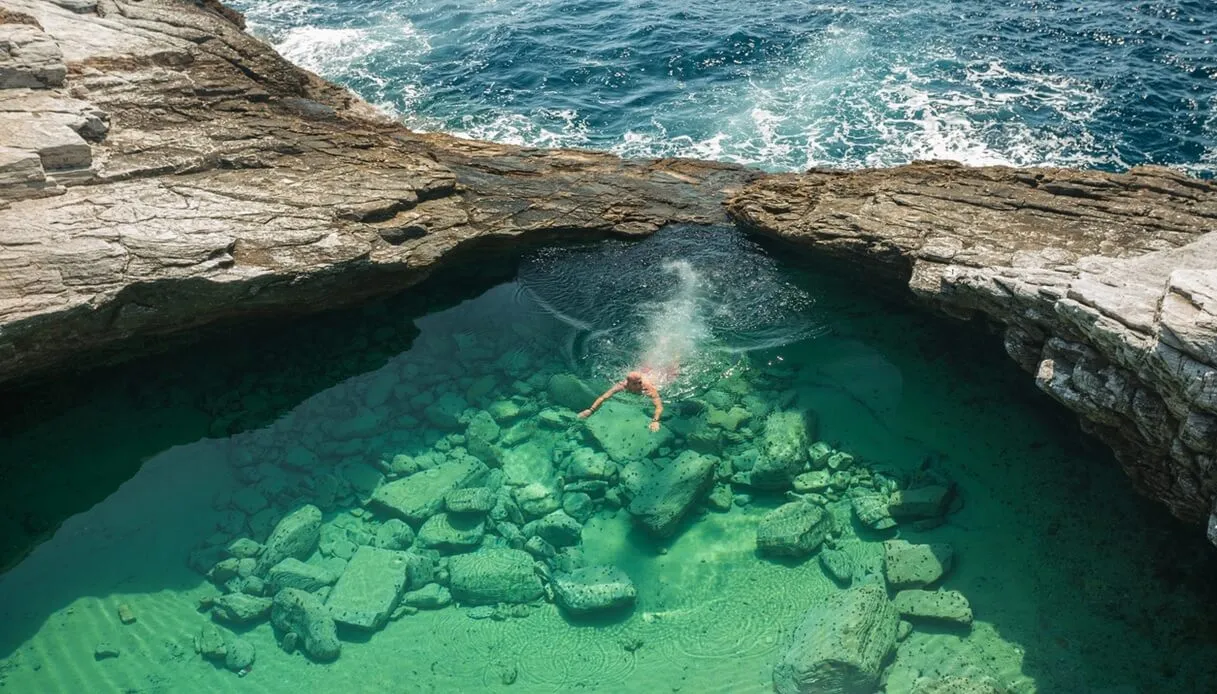
When people talk about natural pools, they refer to pools of fresh or salt water that characterize a particular corner of the landscape: here the current is mild, the water pristine, and the surrounding scenery provides a striking view. They are ideal places for summer, where one can enjoy moments of endless relaxation between one dive and another, when seeking relief from the heat in the transparent basins.
The Italian coastline bathed by the and the Ligurian Sea hides a heritage of these small basins, where seawater remains trapped among the rocks. They are the product of millennia of wave-polishing work. They are places rarely found by chance: almost always you must earn them with a path, descending a staircase carved into the rock or perhaps facing a descent not always easy, but which more than compensates the effort with the beauty of their cool, crystal-clear waters and with wonderful panoramas.
Iscolelli Natural Pools
In the Cilento National Park, along the famous Infreschi Path that winds from Marina di Camerota, one encounters the Iscolelli natural pools. They are basins carved into a dark, rugged cliff, washing the shore of a small white-pebble beach, protected and connected to the open sea only through a narrow passage that keeps boats at a distance.
To reach them, it is convenient to drive to the Oasi degli Infreschi, an accommodation facility from which a short trail starts, fording the low and fragrant Mediterranean scrub, that leads to the pools, not far from the remains of the ancient watchtower. The path is not precisely signposted, and precisely for this reason the Iscolelli pools are frequented by few, but the approach route is one of the great beauties of the place.
In the small pools the water is shallow, but cool and crystal-clear, a true midsummer dream.
Punta Rossa Batteries
Punta Rossa, a maritime headland under the Monte Circeo, in the heart of the Park of the same name, is an especially scenic spot on the Tyrrhenian coast, in its Lazio stretch.
Here, indeed, the cliff opens into two emerald-green natural coves, perfect for snorkeling among crevices inhabited by fish and mollusks: they are the so-called Punta Rossa Batteries, a jagged stretch of coastline that owes its name to the remains of a Napoleonic-era fort still visible at the summit of the promontory.
To reach them you park on Via del Faro, then proceed on foot past an always-open gate that leads to a private road: from here begins a paved descent, followed by a short path through the Mediterranean scrub that finally leads to the sea. The overall trek takes about ten minutes of walking, not strenuous but to be tackled with proper footwear.
The Batteries are a historic destination for locals from Lazio, who love leaping into the sea from the higher rocks in the area, but they also offer space for those seeking a quiet bath away from the beach clubs along the coast.
Queen Giovanna’s Baths
It is said that Queen Giovanna II, Angevin queen of Naples in the first half of the 15th century, liked to retreat secretly to a particular stretch of the Sorrento coast to bathe with her young lovers. Today those places are known as Queen Giovanna’s Baths, a small natural lagoon, connected to the open sea through a dramatic arch of rock carved by erosion, giving rise to one of the most beautiful and scenic natural pools in Campania.
To reach Queen Giovanna’s Baths you start from Capo di Sorrento, a hamlet reachable by bus or car from Sorrento, and you walk along a path a little over half a kilometer, immersed in the Mediterranean vegetation, closed by a rather steep staircase that finally descends to the small bay.
Beyond the myth of the queen, what remains visible on the cliff are the vestiges of Villa Pollio Felice, a Roman seaside residence dating back to the 1st century BC, mentioned by ancient authors such as Statius and Pliny the Younger.
Sant’Andrea Natural Pools
On the western side of the Isle of Elba, the largest in the Tuscan Archipelago, lies the municipality of Marciana. Here, the Sant’Andrea beach serves as the starting point to reach some of the most beautiful natural pools in the Tyrrhenian Sea. Going beyond the so-called Cote Piane, huge granite slabs smoothed by the sea, and crossing a crack in the rock, one comes to the Sant’Andrea natural pools, ideal for those who love diving and exploring the seabed with a mask and fins.
The coastal path that links the main beach to these basins circles Capo Sant’Andrea, offering views of beautiful rock formations eroded by sea and wind. It runs partly on wooden walkways, partly on sections carved into the rock.
Nearby, to the east, is also the Cotoncello beach, where the combination of smooth rocks and small coves with shallow water creates a natural-pool setting.
Punta Pineda Bozi
The basins, or bozi, as the Spezzino dialect says, of Punta Pineda are large troughs carved into the sandstone, protected by a barrier of rocks that shields them from the open sea and creates an authentic pool-like effect, all in a completely natural state.
Punta Pineda lies in the Cinque Terre, near Riomaggiore. Campi is the nearest settlement to the cape, a historic rural village clinging to the coast high above the sea. From there one must tackle a steep, exposed staircase that descends toward the sea. It is a challenging descent, about 30 minutes of walking, but it allows access to a wild and nearly untouched stretch of coastline.
The basins, once used by local farmers as small artisanal salt pans to extract salt from seawater evaporated in the sun, today welcome those seeking an unusual bath, away from the summer crowds that fill the park’s most famous beaches.