
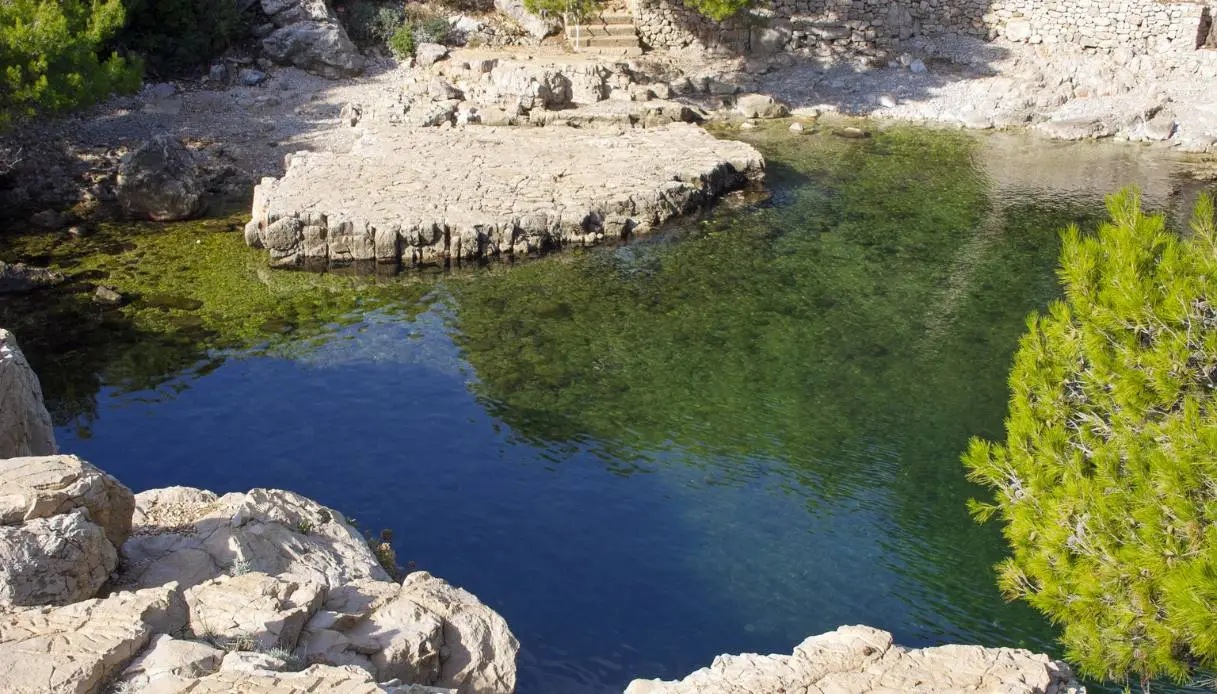
Did you know Europe has its own Dead Sea? It sounds odd to believe, and yet it’s true, and, among other things, it is located quite close to our country: it’s in Croatia, a short distance from Dubrovnik, one of the Adriatic’s most famous towns. Specifically, it comes to life on the Lokrum Island, right opposite the Pearl of the Dalmatian Coast.
Its name is Mrtvo More (literally Dead Sea) and it is one of the most peculiar natural wonders of the area, housing crystal-clear seawater sheltered from the waves and surrounded by lush nature. What appears to be just a pond, in fact, belongs to the Adriatic marine system, with which it communicates through an underground connection.
Origin, Formation, and Legends of Mrtvo More
Certainly the Mrtvo More did not form overnight, and indeed, to understand its origins one must travel far back in time, when geological processes began shaping the rocks of the present Lokrum Island. Its territory is mainly composed of limestone and dolomitic formations dating back about 85 million years, affected over the ages by tectonic movements and erosive phenomena.
It is precisely the combined action of seawater and karst processes that gave rise to this singular environment. In the beginning, instead of a basin there was a cave, developed along a natural fracture in the rock. Erosion and dissolving of the limestone gradually widened the cavity, until the collapse of the upper vault.
From the ceiling’s disappearance arose a depression opening toward the sky, later occupied by seawater. Even today a underground channel about 15 meters long connects the Mrtvo More to the Adriatic, allowing water exchange with the open sea. Speleological investigations have documented the system’s complexity, identifying a cavity partially flooded, 22 meters long and 15 meters deep.
The rocky formation protects it from the sea’s motion and helps create favorable conditions for swimming. Also, its name deserves a clarification: while the expression Dead Sea undoubtedly evokes the famous saline basin located between Jordan, Israel, and the West Bank, the Croatian one contains water originating from the Adriatic. The nickname thus stems from the salinity of the lagoon and its apparent immobility, rather than from the exceptional saline concentrations of its Mid-Eastern counterpart.
To the geological events, a darker story is added, belonging to Lokrum’s legendary heritage. According to an old tale, in 1798 the Benedictine monks, forced to leave the island after centuries of stay, organized a night procession. Cloaked in their mantles, they walked the paths with candles lit downward, uttering a curse against future owners.
The misfortunes that subsequently struck some people connected to Lokrum fed the legend. Among them is Massimiliano d’Asburgo, who became Emperor of Mexico and was shot in 1867. The curse concerns the entire island and belongs to popular tradition, but it adds a certain charm to a territory already rich in historical features.
Visiting Mrtvo More: What to Do and See
To reach the Mrtvo More you must cross one of the most evocative natural settings of this Croatian islet. From the small harbor of Portoč, the paths lead toward the southern part of the terrain, among Aleppo pines, holm oaks and Mediterranean shrubs. The route generally takes 10-15 minutes and alternates shaded stretches with sections on limestone ground.
With almost no warning (in a sense, if you don’t seek it out deliberately it’s even hard to imagine), the vegetation reveals a water pool. Mrtvo More, in fact, is enclosed in a natural basin, with rocky walls that seem to guard it away from the rest of the landscape. And with careful observation you can notice that in the shallower areas you can distinguish the bottom where small schools of fish swim.
During the morning, part of the basin remains in the shade of the rocks and trees. When the sun reaches the surface directly, the reflections become more intense and the stones take on almost silver tones.
Swimming represents the main experience here, also because the salty water is generally calmer than that of bays exposed to the open sea. Access is through rocky surfaces, but you must do it with care and wear shoes suitable for the rocks. Deck chairs and umbrellas make way for the rocks, used by visitors to lay a towel and rest.
A particularly curious encounter concerns the peacocks that roam freely on the island, now one of its symbols. They were introduced in the 19th century (probably during the stay of Archduke Massimiliano d’Asburgo) and today can be observed in the gardens, along the trails and near the areas frequented by visitors. But be careful, feeding them is strictly forbidden.
The visit to Mrtvo More can then continue toward the ancient Benedictine monastery of Santa Maria, of which remains evidence of the Romanesque-Gothic basilica from the 12th-13th centuries. The Gothic-Renaissance cloister is especially interesting, with arches surrounding a green central space. A short distance away also unfolds the botanical garden that gathers Mediterranean and exotic species.
Where It Is and How to Get There
Mrtvo More lies in the southern part of Lokrum Island, about 600 meters from Dubrovnik’s coast, in southern Croatia. The island belongs to a special protected forest vegetation reserve since 1948 and is included in the European Natura 2000 network. To reach it, boats depart from Dubrovnik’s Old Port, inside the historic center. The crossing generally lasts 10-15 minutes and ends in Portoč Bay, the starting point for the walking paths that cross the island.
Connections follow a seasonal schedule, with more frequent departures during the tourist months. Before departure it is advisable to check the updated timetables on the reserve’s official site, especially to know the last ride back to Dubrovnik. During the winter closure period, tourist access is suspended.
To devote the right amount of time to Mrtvo More and Lokrum’s other attractions, it is advisable to plan at least half a day: the early morning hours generally allow a calmer atmosphere, while the afternoon light enhances the water’s nuances.
